Audio
Listen to the article
- France averaged roughly 15,000 hectares burned a year between 2006 and 2025; a six-day blaze west of Bordeaux had scorched nearly three times that by July 28th, while fires near Madrid forced more than 300,000 people to be evacuated.
- The EU saw over 1m hectares burn last year and could break that record, as Europe warms faster than any other continent and fire-friendly weather grows more frequent and extreme.
- Smoke, not flames, causes most wildfire deaths — projected to rise from 240,000 a year in the 2010s to 1.4m a year by 2100 — so suppression alone will not meet the new possible.
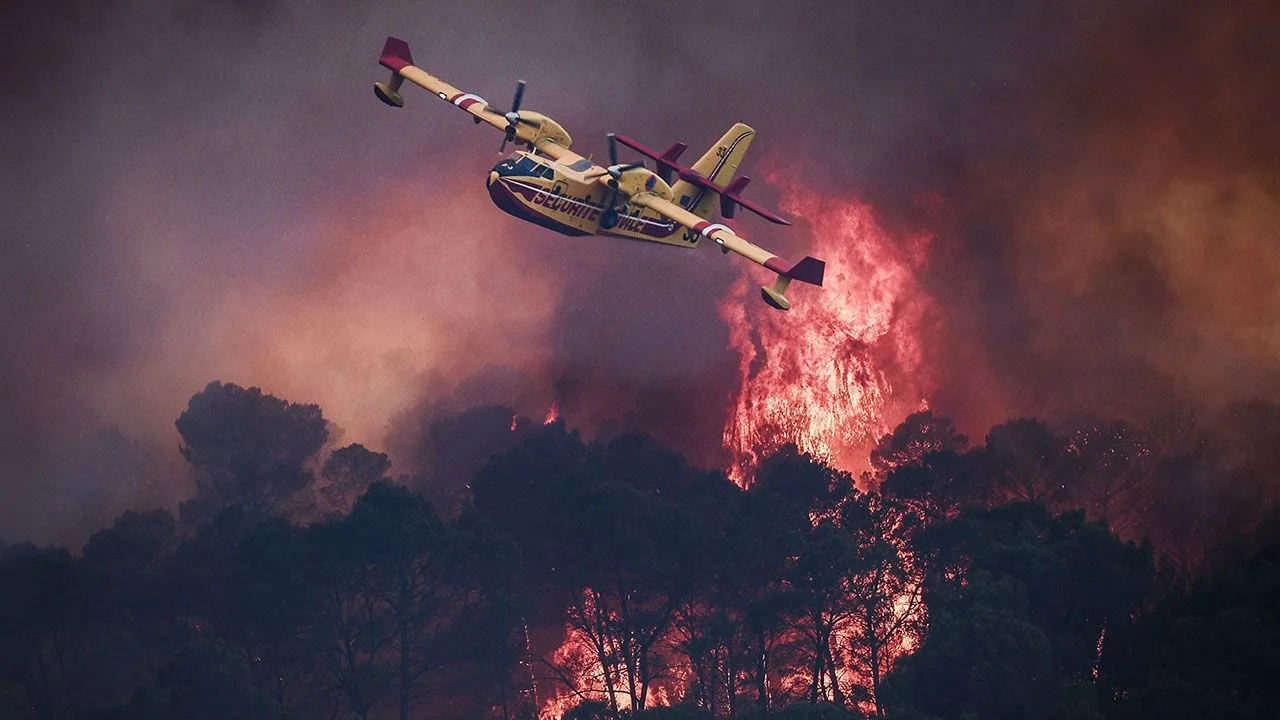
Europe’s wildfires are not a new normal — but they are firmly within the limits of the new possible. Between 2006 and 2025, wildfires in France consumed an average of roughly 15,000 hectares each year — an area slightly smaller than Washington, DC. By July 28th, the blaze west of Bordeaux, ignited just six days earlier, had already scorched nearly three times that.
About 500km to the south, fierce flames crept perilously close to Madrid. More than 300,000 people have been evacuated. These conflagrations may prove to be the worst Europe witnesses this summer. But do not count on it. A succession of heatwaves has left vast areas desiccated and ready to burn — and more hot weather looms. Last year, the European Union saw over 1m hectares go up in flames; this year could shatter that record.
France average burned per year, 2006–2025
EU burned last year; record at risk this year
Of planet’s fire-prone area faces rising risk
They are not a new normal — but worse remains possible
Nor is this a single summer’s aberration. The continent is warming faster than any other. With decades of escalating hazards ahead, it must prepare now.
The rest of the world trails not far behind. Wildfires are not purely a product of climate, but climate plays a decisive role. The frequency and extremity of fire-friendly weather have been climbing for 40 years; conditions that were highly improbable before climate change are becoming increasingly routine. Measured against a definition of extreme fires that combines size and intensity, the past decade has been especially severe.
Fire-risk projections cited here compare a world roughly 0.5°C warmer than the average of the early decades of this century — about 1.5°C above the 19th-century baseline — and the additional risk from 1.5°C to 2°C. “Fire-prone area” excludes desert and ice sheet.
In a world roughly 0.5°C (0.9°F) warmer than the average of the early decades of this century (and thus about 1.5°C above the 19th-century baseline), fire risks are projected to rise across 88% of the planet’s fire-prone area — virtually everywhere that is not desert or ice sheet. The jump from 1.5°C to 2°C amplifies the danger even further.
Expect more heroism, more politicians receiving grim briefings from soot-covered firefighters, more disrupted lives, more destruction and destitution. It will also magnify the less visible but more insidious toll on the lungs of people who never come within a thousand kilometres of the flames.
The smoke kills more than the flames
Most wildfire-related deaths stem from smoke inhalation. The wind-borne particles that choked cities across Canada and the United States in mid-July will have shortened hundreds or thousands of lives. Smoke from Indonesian fires is estimated to have killed 100,000 people in 2015. Something similar is all too likely there this year.
Demand for biofuels in a world of pricey oil fuels the destructive slash-and-burn agriculture at the heart of the problem, and a strengthening El Niño will promote fire weather across the region in the coming months, as it did in 2015.
projected deaths a year from wildfire smoke by the end of the century, up from an estimated 240,000 a year in the 2010s, on a fairly moderate emissions scenario and accounting for an ageing global population. A recent study suggested up to 30,000 excess deaths a year from wildfire smoke in America by 2050 — overshadowing all other direct climate impacts.
Particles travel far beyond the fire front. Even cities a thousand kilometres away can see measurable, lasting health effects from prolonged exposure.

Firefighting must expand — but prevention matters more
Firefighting is, to some extent, like waging war; if the enemy attacks more often and with greater ferocity, you need greater force on your side. So places that have not previously felt threatened need to up their game. They may also wish to deploy new technologies. Satellites can spot fires almost as soon as they start — intelligence that could sometimes prove crucial, provided systems are capable of acting on it. Drones will doubtless have a role. Allies can help, too. Europe has pooled firefighting resources now being deployed in Spain and France; Mexico is helping Canada.
Being better at fighting fires, though, is not enough. The greatest benefits will come from being better at preventing them and living with their effects. The dictates of danger and urgency tend to mean fire-suppression eats into budgets for managing landscapes, teaching the public about when to filter the air or how to protect a house, and so on. No such projects are ever needed in the same way as a planeload of cold water on a fire-front. But they are vital nonetheless.
The fires in France and Spain are not, as some say, the new normal. Fire is capricious. It does not repeat itself from one year to the next. But this year’s fires are firmly within the limits of the new possible — and the extremities of that new possible have yet to be mapped.
Sources
France fire area 2006–2025 and Bordeaux/Madrid evacuations; EU annual burned area; continent warming rate; 40-year trend in fire weather and decade of extreme fires; global fire-risk projections for 88% of fire-prone area; smoke mortality estimates for Canada/US, Indonesia 2015, and projections to 2100 and 2050 as described in article.
Image: Getty Images via French Civil Security, Cotignac, France, July 23rd 2026.
KEEP THE CONVERSATION GOING
A good story is worth sharing.
Send this story to someone who values the bigger picture.
See more from GlobeBriefly on Google
Choose us as a preferred source in your Google preferences.