Audio
Listen to the article
- America’s 2009 UAE deal was a \”gold standard\” — no enrichment or reprocessing and the Additional Protocol. The July 22nd Saudi deal would not require either.
- Leaks point to a two-year joint study on Saudi enrichment needs, with a possible US-built facility or a ten-year pause, without joining the Additional Protocol.
- The precedent risks hardening Iran’s stance, unsettling Israel, the UAE and Turkey, and weakening the NPT far beyond the Middle East.
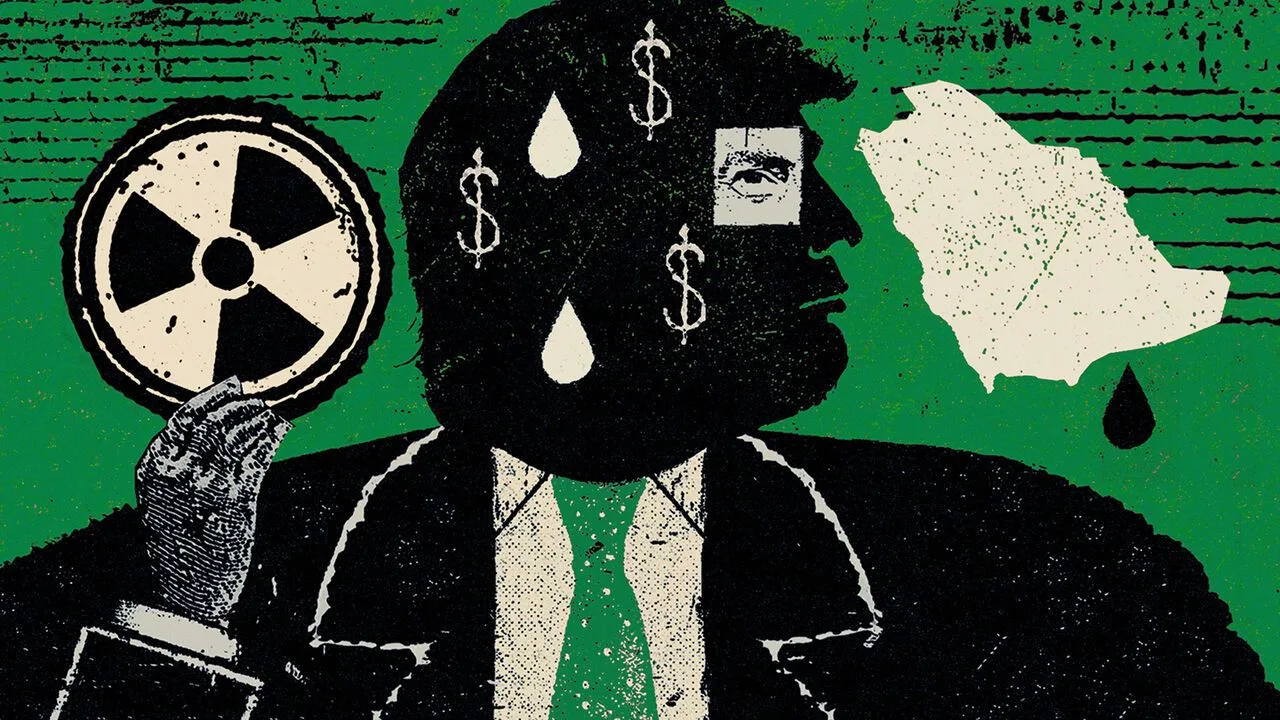
President Donald Trump’s Saudi nuclear co-operation deal, announced on July 22nd, would break America’s own non-proliferation precedent. By not requiring Saudi Arabia to forgo uranium enrichment, it risks undermining the nuclear Non-Proliferation Treaty with consequences far beyond the Middle East.
Editor’s note (July 24th): Mr Trump said on Truth Social that the nuclear deal with Saudi Arabia was “totally subject” to the kingdom’s recognition of the state of Israel; and that there would “be no enrichment”, though what he meant by that was unclear.
The gold standard America set with the UAE
When America signed a nuclear co-operation deal with the United Arab Emirates in 2009, it insisted on strict conditions. The Emiratis had to forgo domestic uranium enrichment and reprocessing and sign up to the Additional Protocol, a follow-on to the nuclear Non-Proliferation Treaty (NPT) that provides for tough inspections.
The UAE agreed. It now has four reactors supplying 25% of its electricity. American officials called it a “gold standard” agreement.
Additional Protocol — an expanded inspections arrangement under the NPT that gives the International Atomic Energy Agency broader access to verify a state’s nuclear programme.
What Trump’s Saudi deal would allow
The deal with Saudi Arabia that President Donald Trump announced on July 22nd would not even qualify as bronze. The text has yet to be published, but if leaks are accurate, it will firm up America’s twitchy relations with the kingdom and be lucrative for American companies. But it risks undermining the NPT.
The agreement, which Congress must review, will not require Saudi Arabia to swear off enrichment. Instead, the countries will together conduct a two-year study on whether the kingdom needs such a capability. If yes, America could build an enrichment facility on Saudi soil; otherwise, the kingdom would agree not to pursue one for ten years.
The Trump administration promises that any Saudi nuclear programme would be subject to rigorous inspections. But the kingdom would not have to join the Additional Protocol. Congress could block the deal but would need a two-thirds majority to overcome a presidential veto.
Why Riyadh wants nuclear power
Saudi Arabia has reasons to pursue a civil nuclear programme. Sweltering summers strain its grid; it burns crude oil to meet soaring demand, a dirty and wasteful way to produce electricity. Nuclear power would free up more oil for export.
Why Washington wants the deal now
The benefits to America are narrower. A nuclear deal was originally meant to help persuade Saudi Arabia to establish ties with Israel. That looked imminent before the war in Gaza began in 2023. No longer.
Announcing it now looks like an attempt to elbow out China and Russia, which saw a chance to get closer to Saudi Arabia. It may be a sop to a country furious at Mr Trump’s bungling of his war with Iran. It is typical Trump: a flawed deal as compensation for an incompetent war.
The proliferation risks in the Middle East
What are the risks? Saudi Arabia has been a stable monarchy for a century and an American ally for almost as long. But governments can change, and the kingdom has a history of extremism; no one knows for sure who would control a Saudi nuclear programme in the future. Muhammad bin Salman, the crown prince, has said that Saudi Arabia would build its own nuke if Iran developed one. Recent events will hardly have made him less wary of his belligerent neighbours.
All this complicates matters in the region. Iran’s position in any nuclear talks with America may harden: why agree to relinquish its uranium-enrichment programme, as Mr Trump insists, if the Saudis are getting their own? The UAE may not be happy, either, seeing its Saudi rival win a more permissive deal than it achieved. Israel, the region’s only nuclear power, will be nervous. Turkey may ask if it should race for a nuke.
The wider risk to the NPT
That points to a larger problem. The NPT had been a rare success. Since it was signed in 1968 only four new countries have acquired and kept nuclear weapons. The taboo on proliferation has long been a point of bipartisan agreement in America. Mr Trump may see this sort of proliferation as harmless, since it involves an ally. But this is how the NPT starts to crumble: with American allies pursuing latent nuclear capabilities.
Officials in South Korea, for example, are quietly discussing if getting a bomb would better deter their nuclear-armed neighbour to the north, especially if America’s nuclear umbrella becomes unreliable. Similarly, Japan’s defence minister recently urged a debate on his country’s nuclear-weapons policy.
A shoddy deal Congress should improve
Perhaps the Saudi enrichment facility will never be built. When you cannot solve a problem, commission a study: it is a time-honoured way to avoid hard decisions. The two-year timeline means the choice may fall to America’s next president, who will surely be less erratic and less financially beholden to the kingdom than Mr Trump.
Still, the deal is shoddy — far better to insist the Saudis accept the same terms as the Emiratis did. Congress should press Mr Trump to do better.
KEEP THE CONVERSATION GOING
A good story is worth sharing.
Send this story to someone who values the bigger picture.
See more from GlobeBriefly on Google
Choose us as a preferred source in your Google preferences.