Audio
Listen to the article
North-East Asia
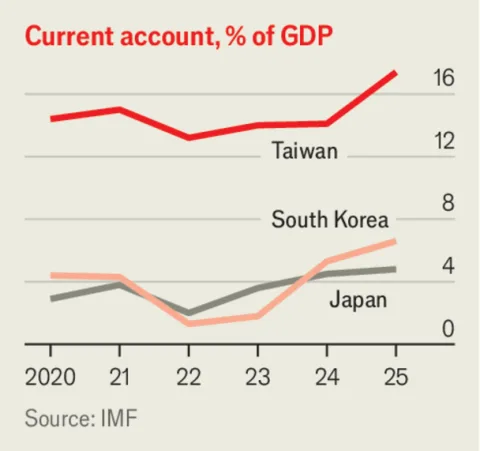
America’s artificial-intelligence boom has put the rich economies of north-east Asia into overdrive — and exposed a deeper China shock. Taiwan’s output is growing at a blistering 14% annual pace on soaring sales of chips and servers for data centres, South Korea’s memory-chip makers have seen operating profits rise by over 500% in the past year, and even sluggish Japan is benefiting. In 2025 all three enjoyed record exports and current-account surpluses.
- Taiwan, South Korea and Japan posted record exports and current-account surpluses in 2025 on an AI-led chip boom — Taiwan growing at 14% and Korean memory-chip profits up over 500%.
- Outside high-tech chips, the region is deindustrialising as China now competes across the whole supply chain, flipping Taiwan’s goods surplus with the mainland into deficit and pushing Japan’s bilateral deficit to a record.
- With export-basket concentration 73% above the rich-world average, reform of labour markets, pensions, credit allocation and regional trade is presented as the alternative to doubling down on subsidies.
Record exports hide a hollowing industrial base
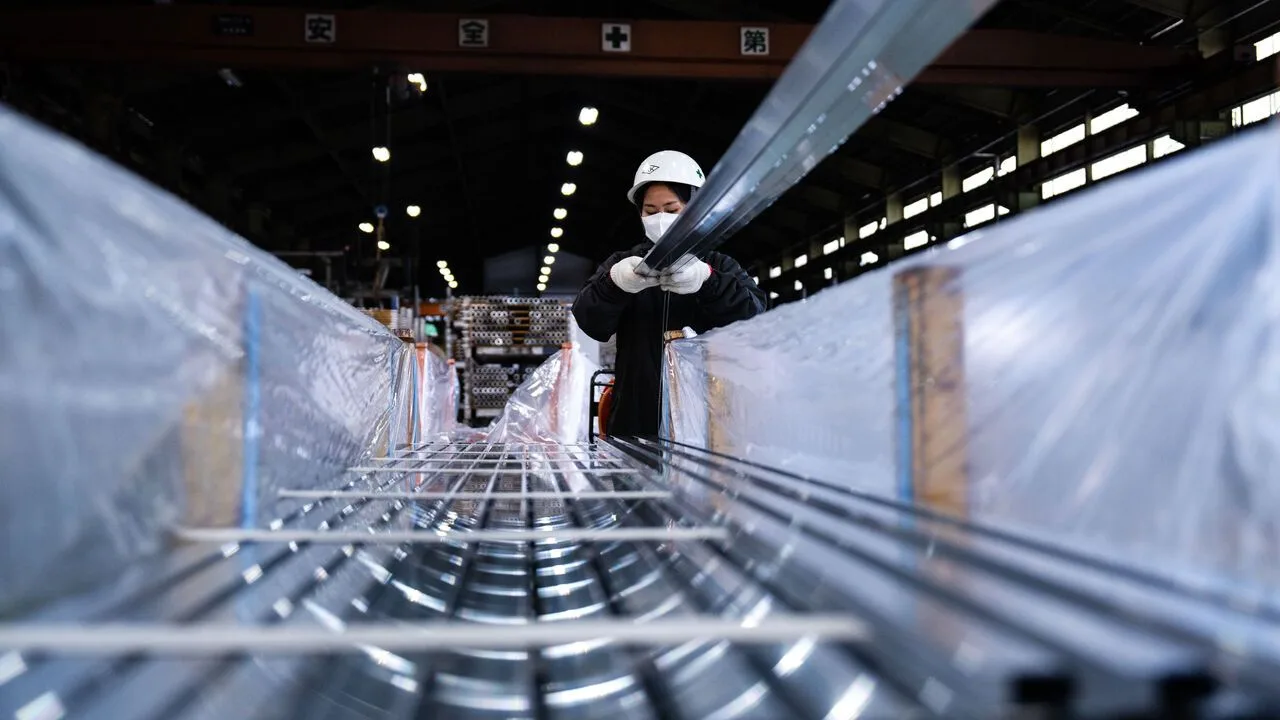
The export bonanza obscures what is happening in the rest of the economy. As outside its highest-tech sectors, rich north-east Asia is deindustrialising. Strong competition from China, paired with increasing specialisation in chips, has disrupted an economic model based on a wider range of manufacturing exports — the model that helped make the region prosperous in the 1980s and 1990s.
Even as it booms, north-east Asia increasingly needs reform if it is to sustain growth beyond the chip cycle.
China now competes across the whole supply chain
In the past few years China’s relations with its rich neighbours have been transformed. Once it imported high-value parts from north-east Asia and focused on low-value final assembly. Now it competes across the whole supply chain.
Taiwan’s long-running surplus in goods with the mainland flipped into deficit this year, as South Korea’s did years ago — though in the past few months Korean chip exports have returned it to surplus again. In Japan the bilateral deficit with China has plumbed new depths, setting a record earlier this year.
Industries from carmaking to chemicals are under intense pressure. As in the West, the perception that domestic manufacturers are competing with goods produced by subsidised Chinese firms is feeding protectionist sentiment.
Chip concentration brings volatility and exposure
The specialisation in chips is an understandable development that reflects these economies’ maturity. Yet this particular focus also creates fragility. The tech-hardware cycle is notoriously volatile and its vicissitudes increasingly affect the region’s economies. The tech supply chain also relies deeply on America and China for both critical inputs and end-user demand.
On an index of export-basket concentration, north-east Asia is 73% higher than the rich-world average, and concentration has risen since 2019. This leaves the region dangerously exposed to protectionism by either superpower.
There is nothing wrong with specialisation, as David Ricardo would attest. However, East Asia’s rich economies would be better off if they paired their chip-export juggernauts with dynamic domestic economies. The trouble is that domestic demand is too low — a legacy, in part, of outdated economic structures that hold down consumption in order to promote exports above all else.
Why domestic demand stays weak
Two-tier labour markets guarantee employment for insiders, often working for big exporters, while inflicting wage penalties and precarity on everyone else. Freeing up labour markets would improve the matching of workers and firms, lifting real wages.
Pension systems favour staff at exporters but are stingy for others, leaving the region with some of the rich world’s highest rates of relative poverty among the elderly. Higher minimum incomes would boost aggregate spending.
Taiwan has engineered a weak currency, and South Korea and Japan use the state to allocate credit. Less financial engineering would let resources flow to the firms that will use them best.
What deep reform would mean
North-east Asia must allow failing manufacturers to die a natural death. Support should be stopped for mighty firms such as TSMC and Samsung Electronics, which do not require lavish subsidies to compete.
And although East Asian countries can hardly avoid relying on markets in America and China — the world’s two biggest economies — they can cut other barriers to trade. Some of these barriers are local. Grievances from colonial times mean that South Korea and Japan still do not have a bilateral free-trade agreement. South Korea should join the Japan-led CPTPP, a top-notch trading pact.
The risk of doubling down on industrial policy
The danger is that, spooked by the China shock, the region’s governments will instead double down on aggressive industrial policy. South Korea has promised $530bn in chipmaking subsidies and Takaichi Sanae, Japan’s prime minister, is overseeing state-led investment into 61 “strategic” goods.
Using the power of the government to promote exports succeeded for these economies when they were poor and trying to catch up with the West. It is not an approach that works in places that are already rich. Doubling down on exports will leave north-east Asia poorer and more exposed. Instead, the region’s best economic bet is to become more dynamic at home and more diversified abroad.
KEEP THE CONVERSATION GOING
A good story is worth sharing.
Send this story to someone who values the bigger picture.
See more from GlobeBriefly on Google
Choose us as a preferred source in your Google preferences.