Audio
Listen to the article
- The EU ran a current-account surplus of 1.9% of GDP in 2025 — Germany’s was more than double that — even as leaders blame global imbalances and China.
- Manufacturing’s share of value added is one percentage point lower than in 2018, but only about a third of Germany’s lost market share abroad is explained by Chinese exports, per the Kiel Institute.
- Closing competitiveness gaps means lower energy costs, more flexible labour markets, integrated capital and services markets and leaner regulation — not blanket tariffs on China.
Europe’s industrial decline is being blamed on an imbalanced world economy and on China. Yet the EU, like China, is a surplus economy — and its factories are losing ground mainly for home-grown reasons.
European leaders are pointing to global imbalances to explain the continent’s troubles. Emmanuel Macron is using France’s presidency of the g7 group of rich countries to sound the alarm. Friedrich Merz, Germany’s chancellor, grumbles about competing with those who invoice in undervalued currencies. “Some countries produce too much and do not consume enough, and vice versa,” says Ursula von der Leyen, president of the European Commission.
Why Europe blames an imbalanced world — and means China
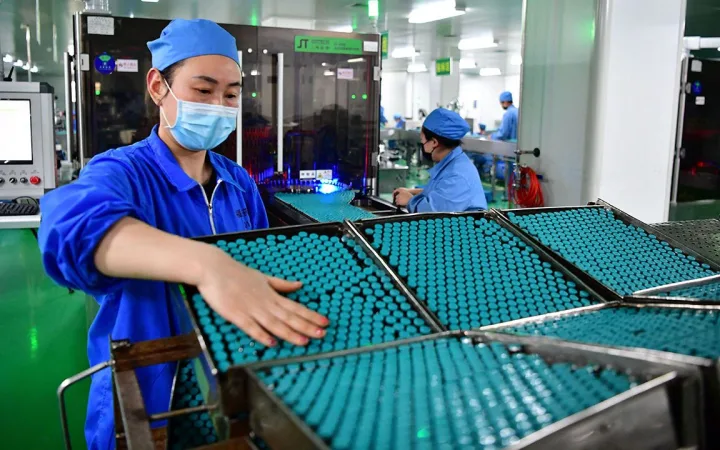
What these leaders really mean is they have a beef with China, whose formidable manufacturers are outcompeting European producers in many markets. Partly as a result, Europe is gently deindustrialising: the share of value added in manufacturing is one percentage point lower than it was in 2018. Because the lost jobs are concentrated in industries that draw special political attention, most notably carmaking, fear of the “second China shock” has become politically explosive. In blaming China, Europe’s leaders risk losing sight of their own failings.
The surplus economy Europe forgets it is
The Europeans are right that the world economy is imbalanced and that China is partly to blame. China runs a large current-account surplus of almost 4% of its vast GDP, although some analysts think it is even higher. Its economy has unusually low consumption, often blamed on the lack of a social safety-net for households. Its exporters, though in brutal competition with each other, do indeed benefit from subsidies and a cheap currency. At a global level, America provides much of the corresponding deficit that soaks up China’s surplus, mostly as a result of its huge government borrowing.
EU current-account surplus, 2025
China current-account surplus
Germany surplus: more than double EU level
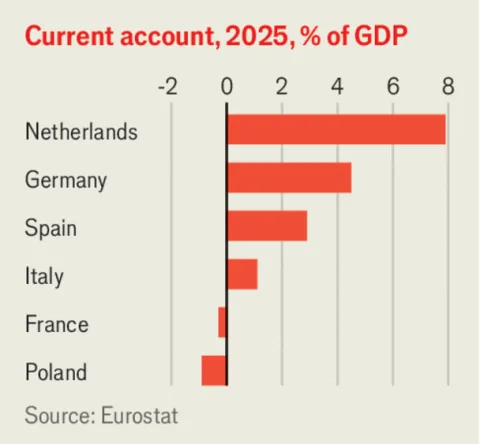
You might think from Europe’s complaining that it, too, is on the deficit side of the ledger, with imports swamping exports. In fact in 2025 the EU ran a current-account surplus of 1.9% of GDP. In Germany, which has the biggest deindustrialisation headache, the figure is more than double that.
Why rebalancing would not save Europe’s factories
Correcting “imbalances” would not mean fewer imports in Europe. It might mean the opposite: raising consumption and investment in a way that strengthens the euro and harms exports. Europe’s producers might not even benefit if America and China brought their current accounts towards balance, supposing that were to happen. Companies would suffer less competition from China but more from America. What they gained in one trading relationship, they would lose in another.
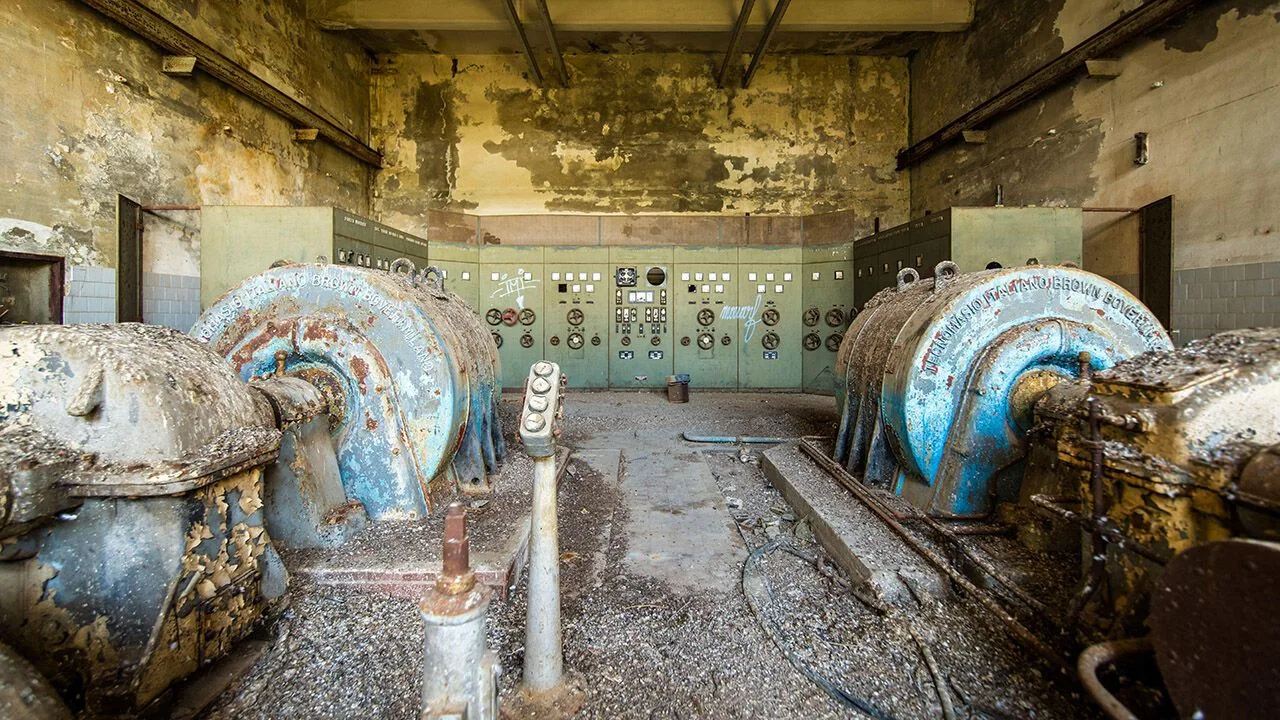
The current account reflects the balance between saving and investment. A surplus means a country saves more than it invests; it can co-exist with industrial malaise and does not itself measure manufacturing strength.
Europe’s error stems from a mercantilist mistake: believing a current-account surplus and manufacturing strength to be the same thing. In fact, the current account reflects the balance between saving and investment, and a surplus can co-exist with industrial malaise. Within the EU there is no correlation between the current account and manufacturing’s share of output — not counting Denmark and Ireland, whose statistics are skewed by pharma and, in Ireland’s case, tax.
What really explains the lost market share
The continent’s leaders should instead consider what problem they are trying to solve. Europe may have a bilateral trade deficit with China. But in Germany’s case, only about a third of its loss in market share in other global markets can be explained by Chinese exports, according to the Kiel Institute, a think-tank. The rest reflects a broader loss of competitiveness.
The home-grown fix Europe is avoiding
Fixing that would mean bringing down energy costs, making labour markets more flexible, integrating markets for capital and services and culling unwise regulations. Some progress is being made at a European level, but national governments are more interested in protectionism, such as the blanket EU tariffs against China floated by advisers to the French government earlier this year. Talk of “global imbalances” helps that agenda, while doing little to raise the remote prospect of either America or China changing tack.
Protectionism does not remove the need for reform. Diversifying away from the cheapest supplier raises costs and harms growth, making domestic competitiveness even more urgent.
Rebalancing is desirable — but not a cure
Make no mistake: it would be a good thing if America were to borrow less and Chinese consumers were to spend more. There is some evidence that imbalances tend to increase the risk of a financial crisis — and they certainly breed protectionism. Market competition must be seen by voters and consumers to be fair, and it is wise to avoid giving China choke points in critical supply chains or total dominance of carmaking.
Yet Europe must recognise that erecting trade barriers with China only increases the need for reforms, because diversifying away from the cheapest supplier raises costs and harms growth. An economy of China’s size and stage of development will always have significant manufacturing exports. If Europeans want their industries to thrive, they should focus not on shutting out competitors but on fixing their own house.
Sources
Current-account figures: EU 1.9% of GDP in 2025, Germany more than double; China almost 4% (some analysts higher). Manufacturing value-added share one percentage point lower than in 2018. Germany market-share analysis: Kiel Institute. Leaders cited: Emmanuel Macron, Friedrich Merz, Ursula von der Leyen.
KEEP THE CONVERSATION GOING
A good story is worth sharing.
Send this story to someone who values the bigger picture.
See more from GlobeBriefly on Google
Choose us as a preferred source in your Google preferences.