Audio
Listen to the article
- Robert Harris returns to ancient Rome after his Cicero trilogy with Agrippa, a novel told by Marcus Vipsanius Agrippa, lifelong friend and general to Octavian, the future Augustus.
- The book is timely on centralised power, loyalty and patronage, but its blunt soldier-narrator limits the wit and wordplay of the earlier Roman novels.
- The final third lifts as Augustus takes power, yet the choice of narrator keeps it from becoming the full philosophical meditation on friendship and power Harris intended.
Robert Harris’s Agrippa marks the novelist’s return to ancient Rome after more than a decade — a timely, loyalty-obsessed portrait of power centred on Marcus Vipsanius Agrippa, the low-born general and lifelong friend of Octavian, that is more accessible than Edward Gibbon but blunter than his acclaimed Cicero trilogy.
Agrippa. By Robert Harris. Doubleday; 384 pages; $32. Hutchinson Heinemann; £22

Why Harris keeps returning to Rome
How often, runs a popular meme, do men think about the Roman Empire? For Robert Harris, the answer would seem to be every few years.
His first foray into the Roman period, Pompeii (2003), came about because he wanted to write a dystopian novel about America. After stumbling upon a newspaper article about excavations at Pompeii, he decided that the Roman period offered a better way to satirise the complacency of a decadent superpower.
He later wrote a bestselling trilogy based on the life of Cicero, the last of which was published in 2015, charting the erosion of democratic norms in the dying days of the Roman Republic.
Harris’s historical thrillers often consider past eras that mirror present-day concerns. Act of Oblivion (2022), about the national self-harm of the English civil war, has strong Brexit overtones; An Officer and a Spy (2013), about the Dreyfus affair, has parallels with internet-era surveillance, paranoia and whistleblowing.
His thrillers set in the present day have led to popular screen adaptations, notably The Ghost Writer (2010) and Conclave (2024).
What Agrippa is about: friendship, loyalty and centralised power
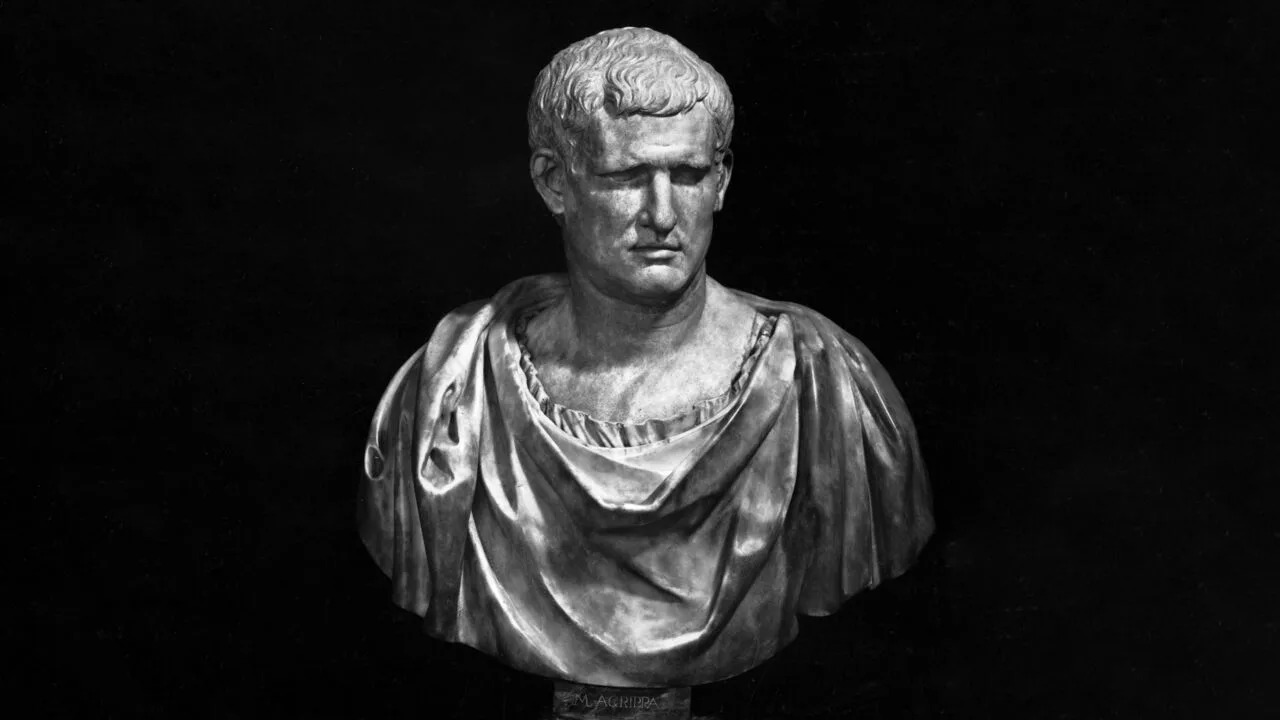
After more than a decade, Harris has returned to ancient Rome in a new novel written from the perspective of Marcus Vipsanius Agrippa, the lifelong friend and general of Octavian (the future emperor, Augustus).
The low-born Agrippa and aristocratic Octavian were boyhood friends and, as in many of Harris’s novels, the narrator’s outsider perspective helps the reader navigate what may be an unfamiliar historical milieu.
It is a time of chaos, with the Roman world riven by internal conflict. Power and loyalty matter above all, and people will do anything to remain in the supreme leader’s good graces, even if that means abandoning their principles or trampling long-standing rules. Political appointments depend on family connections and marital ties. To impose peace and order, the emperor claims he must centralise power.
The modern parallels hardly need to be pointed out, which may explain the current resurgence of interest in Roman history. But few people want to wade through all six volumes of Edward Gibbon. Hence the vogue for repackaging Roman history for mainstream consumption — from the spectacle of Gladiator 2 to the rebranding of Marcus Aurelius’s Meditations as a self-help book.
Agrippa is the latest example. As wars and intrigues rage, readers follow the ebb and flow of Agrippa’s friendship and unspoken rivalry with Octavian. Initially he rarely questions whether staying close to power and helping his friend pick off his enemies are the right things to do. Yet eventually he wonders whether his loyalty to Octavian has cost him his honour.
A soldier’s memoir, not a senator’s oration
For much of the book Harris seems hamstrung by his choice to frame the story as an end-of-life memoir written by Agrippa, depicted as a no-nonsense soldier who disdains politics and is happiest on a battlefield.
In an afterword, Harris says the inspiration for his characterisation was the matter-of-fact inscription on Agrippa’s most prominent surviving legacy, the Pantheon in Rome, which essentially says “Agrippa made this”. Not a man for literary flourishes, in short.
As a result Agrippa lacks the wit and wordplay of Harris’s Cicero novels. But it gets going in its final third, as Octavian becomes Emperor Augustus.
By this time Agrippa has gained some political savvy, but is also inescapably bound to Augustus by the ruthless acts they have committed to maintain his grip on power. Agrippa starts to consider how the world might look if he had made different choices — a question heightened by a clever plot twist.
Verdict: enjoyable primer, muted meditation
Ultimately Harris’s choice of narrator means this swords-and-sandals tale does not quite result in the philosophical meditation on friendship, loyalty and power that he aimed for.
But the author’s many fans will welcome this return to the Harris Ciceronic Universe. And for everyone else, Harris’s novels provide an enjoyable primer on the grandeur that was Rome.
For more on the latest books, films, TV shows, albums and controversies, sign up to Plot Twist, our weekly subscriber-only newsletter.
KEEP THE CONVERSATION GOING
A good story is worth sharing.
Send this story to someone who values the bigger picture.
See more from GlobeBriefly on Google
Choose us as a preferred source in your Google preferences.