Audio
Listen to the article
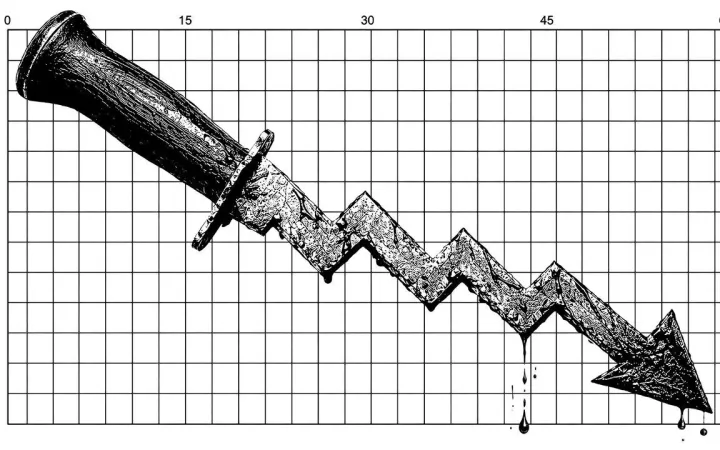
- More than 70% of Britons think knife assaults are rising. Hospital admissions for assault by sharp object are down by a third in England since 2019 and homicides fell to a 50-year low last year.
- The retreat is uneven: London, Birmingham and Manchester have cut knife violence fastest, while many shire counties show smaller falls or rises.
- The geographic shift tracks a changing drugs trade — from city-to-county rail couriers to local hubs and “internal lines” — leaving policy chasing an older model.
Norwich · London
On January 28th 2022, Joe Dix, aged 18, was discovered collapsed on a roadway. Members of a competing narcotics crew had stabbed him seven times, one attacker brandishing a 24-inch (61cm) sword. Dix succumbed around an hour afterwards. “His insides were coming out,” his partner would later tell the court.

Where would you guess that killing took place? London, infamous for blade attacks, feels like the natural answer. Birmingham, Manchester and Liverpool, all with their own legacies of gang conflict, suggest themselves too. Yet Dix was killed in Norwich, a compact and picturesque city lately named by the Sunday Times as the best place to live in Britain.
Homicides last year
Hospital admissions for assault by sharp object in England since 2019
Share of knife-linked homicides and attempted murders in Birmingham, London and Manchester, year to March 2018 vs year ending March 2026
Why most Britons think knife crime is rising
Over 70% of Britons think knife assaults are climbing nationally. They are not. Admissions to hospital for “assault by sharp object”, among the most dependable measures of violent crime, are down by a third in England since 2019. Last year homicides dropped to a 50-year low.
Gloomy feeds on social media help account for that mismatch, alongside jumps in shoplifting and phone snatching. A less recognised factor is that violent crime is changing location. Metropolitan hubs long linked with violence have secured impressive reductions across the last ten years. In the shires, rates have eased far more gradually. In some they have climbed.
Cities are cutting violence fastest
Take Birmingham, London and Manchester. In the year to March 2018, when Britain’s knife-crime epidemic began, those three cities made up 47% of the nation’s knife-linked homicides and attempted murders. For the year ending March 2026 that share had fallen to 36%. Homicides in each city are down by more than 30% from peak.
Improvement has been considerably weaker in Suffolk (down by 18%), Hampshire (14%), Nottinghamshire (13%) and Cambridgeshire (up 23%).
The pressure is sticking — and rising in parts of the shires
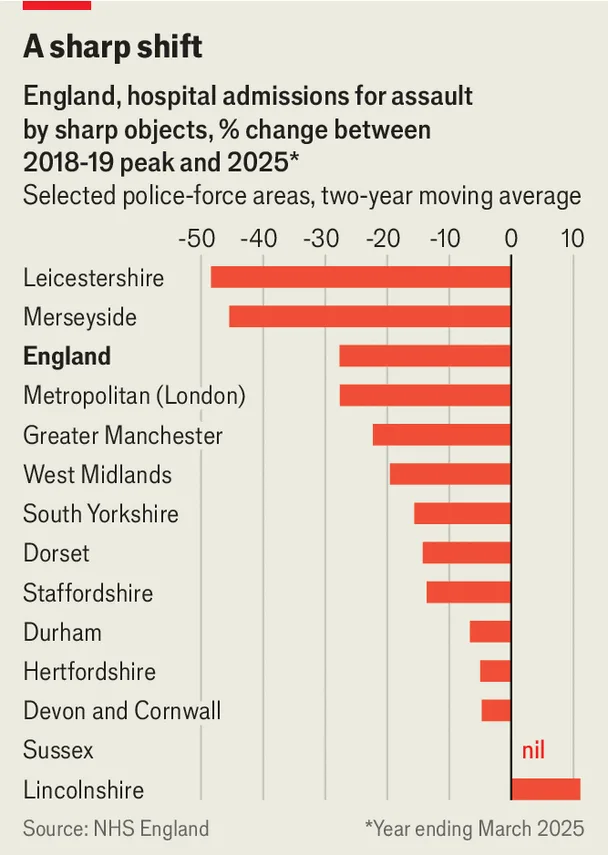
Admissions for “assault by sharp object” display a comparable geographic split. For most police forces figures run only to the year ending March 2025. On a two-year rolling average, London’s figure is down by 28% versus the peak years of 2018 and 2019. Far smaller declines occurred in Staffordshire (down by 14%), Durham (7%), Devon and Cornwall (5%) and Hertfordshire (5%). Sussex recorded no fall whatsoever (see chart).
Admissions are accelerating most quickly, though starting from a modest level, in Cambridgeshire and Bedfordshire — manicured, suburban areas which last year saw rises of 60% and 50%, respectively. Middlesbrough, an impoverished town without a sustained record of acute street violence, now logs more sharp-object admissions than during Britain’s peak years. After the killings of two police officers and seven other people, plus escalating public disorder, it is now the focus of an organised-crime investigation.
Even inside London, police-recorded violence is rising quickest in such comparatively prosperous outer boroughs as Hillingdon (up by 9% last year) and Kingston upon Thames (up by 13%). In sum the surge of the 2010s is holding on most stubbornly beyond the inner cities normally tied to violent crime.
County lines: how the drugs trade redraws the violence map
That pattern largely reflects a transformed architecture in Britain’s drugs trade. Violent crime in Britain tracks drug trafficking closely. That holds in the counties just as in cities. A study published in 2021 examining six years of air-ambulance dispatches in Kent, for instance, found that cases of “penetrating trauma” tended to cluster beside drug-trafficking routes.
Those “county lines” appeared in the late 2010s when the arrival of the dark web (deployed more for wholesale drug purchases than retail), combined with reductions in officer numbers, fostered a multiplication of drug crews in urban centres. Rivalry among them principally fuelled Britain’s knife-crime surge in the late 2010s.
It also carried extra violence into the counties, as crews sought quieter markets outside the cities. They developed an operation that exploited vulnerable children as couriers — carrying consignments from city outfits to countryside users. Blades offer a means to defend yourself, and your stock, against competitors who might seize it.
Fortunately most districts log less violence than during that initial expansionary wave. Yet countryside violence is proving persistent because such districts still offer drug-dealing groups their most lucrative avenue for expansion. In 2020 a Home Office review concluded that flattening city drug consumption was pushing crews toward fresh markets around towns and universities. Yearly threat assessments put the count of county lines known to the authorities at 720 in 2017, against more than 6,500 today. Sellers have widened their catalogues as well. Whereas the first county-lines outfits focused chiefly on crack and heroin, they now move cannabis, powdered cocaine, ketamine and prescription drugs too.
From rail couriers to local hubs
Heightened rivalry in country districts has produced a business built on customer service. More than anything that demands rapid drop-offs. Across many British towns narcotics can now arrive within an hour — think Amazon Prime for amphetamines. That promise is hard for a London-based operation to honour for buyers in Margate. Distribution networks have had to evolve. “The classic county-lines model of sending your boys down on the train has gone,” explains Simon Harding, a criminologist. “It’s much easier to set up a local hub and deal from there.”
Consequently drug crews are progressively home-grown in country districts, operating out of neighbourhood addresses and enlisting neighbourhood youngsters. The tally of “internal lines” (running inside rather than between counties) known to police tripled between 2022 and 2025. The proportion of lines starting in “task-force areas” (spanning the conventional hotspots) dropped from 70% to 50%.
Policy is still targeting the old rail model
Ministers look ill-prepared for that transition. The Knife Crime Action Plan, published at the start of April, contains much sensible material. Yet it employs a dated conception of the county-lines system — vowing to equip the British Transport Police to break up rail routes shifting drugs from cities to towns, and to raise money for County Lines Taskforces. That aims at a commercial pattern already mutating.
Blades out of date
Where so much bloodshed is committed by at-risk teenagers enlisted by exploitative organised criminals, avoidance is as much a public-health challenge as a law-enforcement one. In the established centres of knife violence, familiarity with crews has generated some grasp of offending methods, from alert relatives to savvy youth workers. Country districts miss that sort of familiarity.
Many still regard knife crime as a metropolitan, even a racial, issue answerable through harsher policing. “That is a very difficult mindset to get out of,” admits Niven Rennie, a former police officer who served as director of the Scottish Violence Reduction Unit. “But once you understand it, you don’t go back.”
For more expert analysis of the biggest stories in Britain, sign up to Blighty, our weekly subscriber-only newsletter.
This article appeared in the Britain section of the print edition under the headline “On the edge”

From the September 5th 2026 edition
Discover stories from this section and more in the list of contents
Islamism is a threat to Britain. Islam is not
The government is struggling to deal with the problem

Blighty newsletter: The tale of a king, a president and a tapestry
Sophie Pedder, our Paris bureau chief, joins Emmanuel Macron and King Charles III for their viewing of the Bayeux tapestry

Warming seas are enticing octopus to British waters
But some fish are being pushed away

Why the world’s best female footballer joined a tiny London team

Can Andy Burnham extend his winning streak in London?

The British government turns to influencers to get its message out
KEEP THE CONVERSATION GOING
A good story is worth sharing.
Send this story to someone who values the bigger picture.
See more from GlobeBriefly on Google
Choose us as a preferred source in your Google preferences.