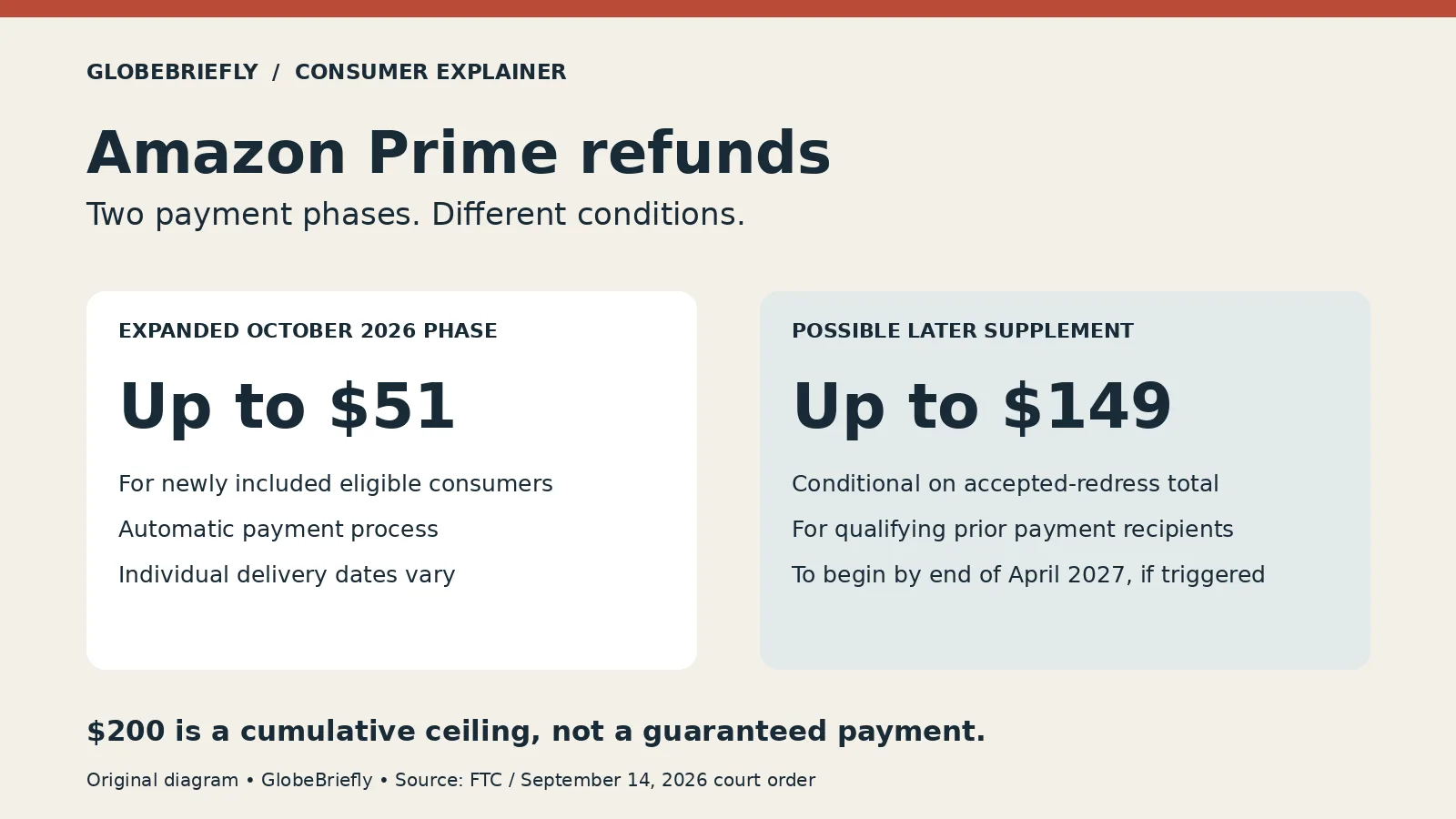
October 1 is the scheduled start of an expanded phase of automatic Amazon Prime settlement refunds. For newly included consumers who meet the program’s requirements, payments in this phase remain capped at $51. The widely cited $200 figure is a cumulative ceiling that includes a possible later supplement.
How the two payment phases differ
The September 14 court order retains the $51 cap for the current escalation phase. It separately provides for pro-rata payments of up to $149 to qualifying consumers who previously accepted a settlement payment, conditional on total accepted redress remaining below $1 billion. That later distribution would begin by the end of April 2027. Neither the maximum supplement nor a $200 total is guaranteed. Read the court order, pages 6–8.
The expanded cohort includes otherwise eligible consumers who used between 11 and 20 Prime benefits during a 12-month period and were not previously issued a payment. October 1 is the date specified for beginning this phase, rather than a promised arrival date for individual recipients. The FTC’s announcement explains the expanded cohort.
Who the program covers
The FTC’s revised guidance lists three eligibility conditions: US Prime membership; enrollment through one of the challenged sign-up flows, or a qualifying unsuccessful online cancellation attempt, between June 23, 2019, and June 23, 2025; and use of no more than 20 Prime benefits in any 12-month period following enrollment. Amazon administers the program. A search result, an unsolicited message or Prime membership alone does not establish an individual’s eligibility.
The revised program does not require a new claim form. Qualifying payments are sent by mailed check, PayPal or Venmo. Consumers should follow the instructions accompanying a genuine payment and check its expiry date. The FTC warns that nobody from Amazon will ask for money to obtain a refund, and the agency is not contacting consumers about these payments. Consult the FTC’s current eligibility and payment guidance.
For background on the subscription practices behind the dispute, see GlobeBriefly’s explanation of predatory design and Big Tech safety tests.
Illustration: original GlobeBriefly procedural diagram, created with code rather than a generative image model. Sources checked October 1, 2026. This article explains the published program and does not determine individual eligibility.
KEEP THE CONVERSATION GOING
A good story is worth sharing.
Send this story to someone who values the bigger picture.
See more from GlobeBriefly on Google
Choose us as a preferred source in your Google preferences.