Audio
Listen to the article
- At its semiquincentennial on July 4th, America remains the founders’ anxious experiment — buffeted throughout its history yet never tipped into tyranny.
- At home the separation of powers is strained and the American dream of immigration is curdling; abroad Washington is dismantling the post-1945 order it built.
- Talk of decline misreads immense dynamism — from AI to a proven capacity for reinvention — that still points toward renewal.
Two and a half centuries ago the architects of the American republic believed their creation would stand as a beacon to humankind. Yet they also understood it was an experiment, one that could easily fracture into chaos or despotism. That tension has defined America’s entire arc: slavery and nativism, graft and monopolists, civil conflict and global wars have all buffeted the nation even as it ascended to become the champion of the free world.
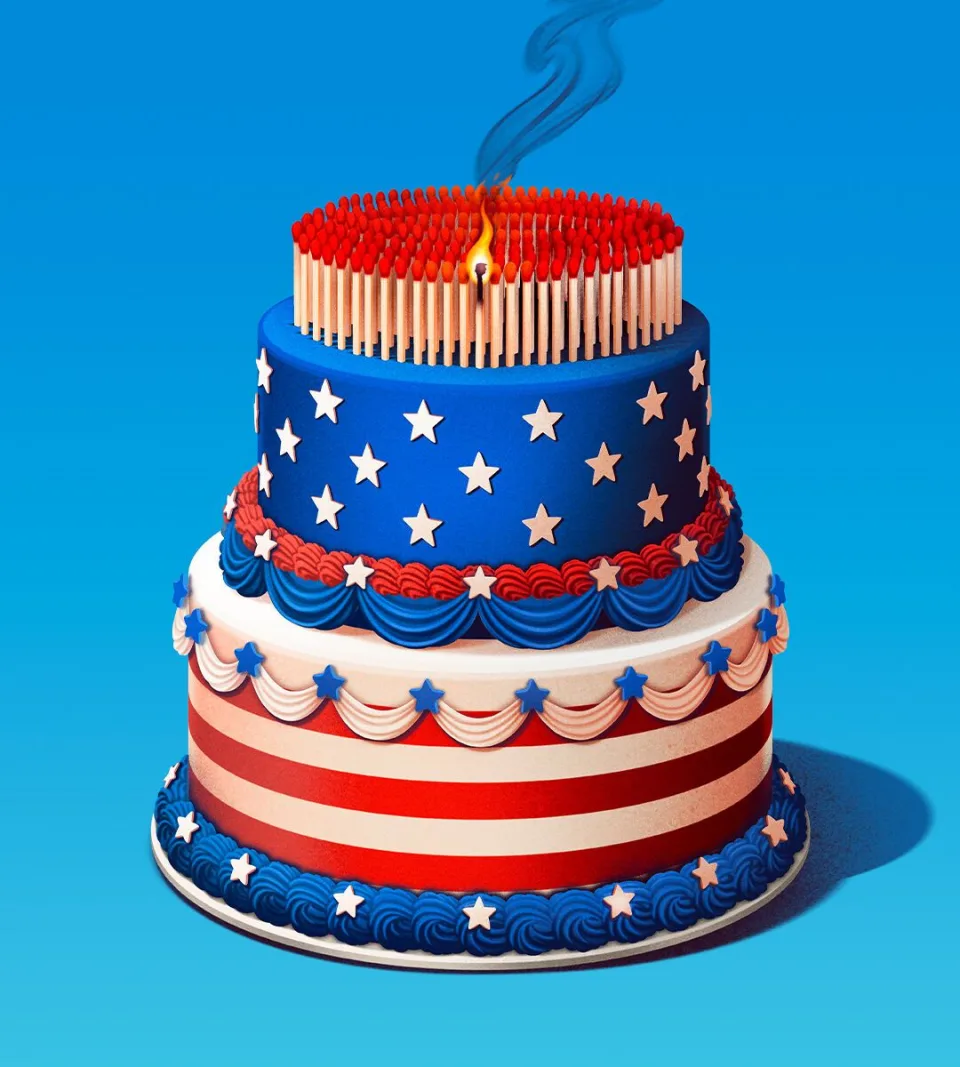
On July 4th, Americans celebrate their semiquincentennial — a word whose very heft refutes the founders’ pessimism. Far from yielding to tyranny, America thrice rescued the world from it. Its glorious disorder bred a dynamism that has long sustained America as a superpower. Dominance carries its own temptations, yet the United States has largely held up republican virtues as the salvation of people everywhere.
This birthday, however, arrives at yet another fretful juncture. Virtue seems imperilled, and talk of decline fills the air. Even as citizens gather in celebration, public life is riven by division. America is dismantling the global order it built after fascism’s defeat in 1945. The restless republic is turning a new page — but does that signal retreat, as some fear, or the harbinger of renewal?
A 250th anniversary seen through Tocqueville’s eyes
To grasp this moment, and to honour the 250th anniversary, The Economist followed the trail of Alexis de Tocqueville, the French aristocrat whose early-1830s tour produced “Democracy in America”, a lasting wellspring of insight into the republic. Listen to our podcast and you will hear many Americans echoing the founders’ anxieties.
At home: Congress, the courts and the American dream
They fear the separation of powers is devolving into a White House-takes-all system. Congress, designed to be the first branch, is paralysed by a vicious partisanship where “we” are righteous and “they” are malign. Lawmaking demands compromise, yet parties punish deal-making and gerrymandering rewards extremism.
The Supreme Court is amplifying executive might. This week, while striking down one presidential scheme on birthright citizenship, it also broadened his authority by allowing him to fire federal agency officials.
A nation of immigrants, America has at its finest moments treated newcomers as a source of vitality and a vindication of the American dream. China has a dream too, but outsiders are barred by the immutable fact of birth. In contrast, anyone of any race or creed can become American. Their welcome is the promise that what they and their children achieve is bounded only by imagination and hard work.
Yet the American dream has curdled. Elements of the MAGA movement want to halt legal immigration, not just the undocumented kind. Net migration this year could be zero. As the share of Americans identifying as “white” approaches 50%, some on the right propose special status for “heritage Americans” — those whose ancestors arrived generations ago. This is an ugly reversion to the racism Americans rejected as part of the moral and material progress that best defines the republic’s success.
Abroad: a wrecking-ball retreat from 1945
Abroad, America is also retreating from its values. As our essay this week describes, Donald Trump is leading a Wrecking-ball revolution to demolish the institutions and alliances the postwar generation erected to shield the world from despotism. He and many Americans on both right and left disdain a global system they blame — wrongly, in The Economist’s view — for abetting China, punishing American workers, and sending young soldiers to die in distant lands.
Consequently, America is throwing its weight around like any other power chasing wealth and influence. Freedom and democracy for foreigners are off the table. Trade, once a system of mutual gain, has become a lever for extracting concessions. Shared values that once united America and its allies are now seen as dependencies to be exploited.
Why decline is the wrong diagnosis
Many conclude America is in decline. This newspaper regards that as a grave misreading. America’s power is immense — and could soon grow beyond recognition. For evidence of its unabated dynamism, look beyond its dysfunctional politics.
America’s artificial-intelligence companies have rapidly marshalled hundreds of billions of dollars to pursue technological supremacy. If, as they predict, AI transforms everything, then America and its AI stack could become utterly dominant — for a time, at least. Some of that will inevitably spill over into its businesses and formidable armed forces. Its allies, however alienated by Mr Trump, would face a stark choice: submit to America or side with authoritarian China.
As America amasses awesome power, the great experiment could go disastrously wrong. Mr Trump has poisoned public life with a cynical worldview that sees the worst in everyone. Boosted by AI-enhanced agencies, executive power could become overwhelming. The concentration of wealth and political power could breed a predatory elite. Partisanship, fanned by social media, gerrymandering, and zealot-dominated primaries, could become further entrenched. Politicians might prove unable to manage the economic and social upheaval ahead.
Present at the destruction — or at a reinvention?
As domestic politics grows dirtier and nastier, America could also become more predatory abroad. Imagine its abandonment of the project to promote liberty is permanent. Other countries will follow suit. Violent, ambitious leaders will feel emboldened to conquer or coerce their neighbours. The world will descend into chaos.
Yet, as the founders would attest, that dark future is not certain — or even likely. The corollary of America’s dynamism is its capacity for reinvention. Setbacks like Pearl Harbour, Sputnik, and Watergate spurred it to recover and surge ahead. Roused, Americans set about ensuring that next time they would do better and be better.
One way or another, change is coming to America, because too much today is unsustainable. The social contract, financed by borrowing, is fiscally unsustainable. Mr Trump’s generation is biologically unsustainable: his successor will belong to a new, younger cohort. The hope must be that voters will decide the two parties’ sterile mutual contempt has become politically unsustainable, too.
Restlessness is precisely what prevents the republic from sinking into stagnation. All those arguments and fights are a precondition for the creative destruction that precedes renewal.
GlobeBriefly · Leaders
As celebratory fireworks light up cities and towns across America, remember that restlessness is precisely what prevents the republic from sinking into stagnation. All those arguments and fights are a precondition for the creative destruction that precedes the nation’s renewal.
Naturally, the founders would be worried today, just as they were 250 years ago. Yet their revolutionary insight was to build their great experiment on the wisdom of the people. Time and again, that faith has been richly rewarded. ■
Production note: Edited for clarity and structure from source material, including The Economist’s Tocqueville trail reporting. No new facts added.
KEEP THE CONVERSATION GOING
A good story is worth sharing.
Send this story to someone who values the bigger picture.
See more from GlobeBriefly on Google
Choose us as a preferred source in your Google preferences.