Audio
Listen to the article
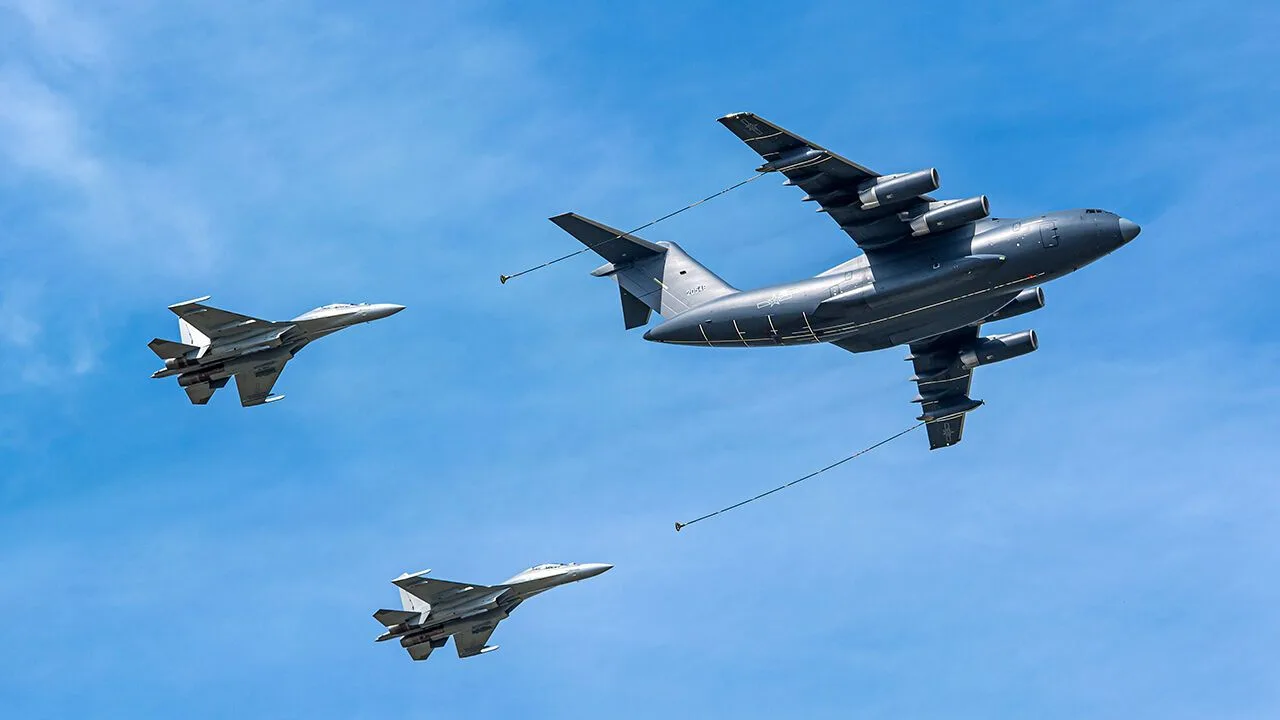
Six Chinese fighter jets flew over Egypt in the last week of August, and the manoeuvres on display were both aerial and diplomatic. The J-16s — among the longest-range and most heavily armed aircraft in China’s air force — have been doing joint exercises with Egypt for the first time.
What made the drills stand out was the opposition. Chinese aircraft staged mock combat with French-made Rafale fighters, which are used by Egypt but also by India, whose border dispute with China flared into deadly clashes in 2020. That is noteworthy given Egypt’s close defence ties to America and new doubts about America’s reliability in the region.
- Six Chinese J-16s flew over Egypt for a first round of joint drills with Cairo’s air force, including mock combat with Egypt’s Rafales.
- The fortnight-long exercises end in early September, just as Xi Jinping arrives in Egypt for his first visit in a decade.
- The trip let China test long-range power projection — 6,000km and about nine hours from home — and gather data on a Western fighter.
Chinese fighter jets over Egypt
Flown from China to Egypt
Flight time for the J-16s
Why China sent its J-16s to Egypt
The fortnight-long “Eagles of Civilisation” exercises are expected to end in early September, just as Xi Jinping, China’s leader, arrives in Egypt for his first visit in a decade.
The drills and the visit were probably planned well before America’s war with Iran started in February. The aerial drills were happening for the second year running. And the official purpose of Mr Xi’s visit is to mark the 70th anniversary of diplomatic ties between China and Egypt. Nonetheless, they send a clear signal about Chinese ambitions in the region.
China is demonstrating its potential as an alternative supplier as well as its growing capacity to project air power far from home. And it is doing so just as America’s dominant military role in the Middle East is undermined by its failure to defeat Iran, the depletion of its weapons stockpiles and the damage done to its bases, which it has been unable to protect adequately.
China has neither the capability nor, it seems, the desire to supplant America in the Middle East. But it is getting steadily better at carrying out limited operations to help partners and protect its interests in a region that is vital for China’s trade and energy supplies. At the same time, it is gaining experience and data that could help its pilots in future combat against Rafales and other Western equivalents.
A marketing exercise as much as a military one
Such drills are partly marketing exercises. In 2024 Egypt was reported to have placed its first order for Chinese fighter jets, an undisclosed number of single-engine J-10s. China denied that. But it sent J-10s to the first round of joint air drills with Egypt in 2025 in an apparent bid to clinch a sale. Egypt may have been considering them as replacements for its ageing American F-16s, which it started buying in 1980. Now China appears to be touting the heavier, twin-engined J-16 as a way to help Egypt carry out longer-range operations over the Red Sea, the Horn of Africa and elsewhere.
Egypt is not the only target of Chinese military diplomacy in the region. China has used arms sales and joint exercises to improve defence ties with other countries too, including Saudi Arabia and the United Arab Emirates (UAE), even though both have close military links to America. China and the UAE were due to start their latest round of joint air drills in north-western China in late August. These have happened yearly since 2023. Neither side has said which aircraft will take part, but in the past they have involved the UAE’s French-made Mirage fighters, which Taiwan also uses.
Six thousand kilometres and a stopover in Karachi
The exercises also give China a chance to test its ability to quickly project air power far from its own borders. The J-16s took about nine hours to fly the 6,000km from China to Egypt. They were refuelled by a Chinese YY-20 air tanker that flew with them.
The Chinese fighters and other aircraft also stopped over in the Pakistani city of Karachi. Pakistan is one of China’s closest military partners, so the layover highlights its potential as a staging point for Chinese operations farther afield.
The Rafale mock combat that grabbed attention in China
But it was the mock combat with Egypt’s Rafales that grabbed most attention back in China. Its state television broadcast footage from the cockpit of one of the J-16s showing a Rafale manoeuvring nearby. It said the drills included one-on-one and two-on-two combat.
Dissimilar air combat training — drills in which pilots fly against a different type of aircraft rather than their own. According to the article, such training offers more valuable experience than exercises with the same kind of fighter, and also lets each side gather data on the other’s aircraft.
Such “dissimilar air combat training” offers pilots more valuable experience than drills with the same kind of fighters. They also let each side gather data on the other’s aircraft.
India will be especially concerned. During its conflict with Pakistan in 2025, at least one Indian Rafale appears to have been shot down by Pakistan’s Chinese-made fighters. (Indian officials, while acknowledging that they lost some fighters, deny that a Rafale was among them.)
How long it will be before China can engage in real combat so far from its borders is unclear. But as a future capability, it has clearly locked on to that target.
KEEP THE CONVERSATION GOING
A good story is worth sharing.
Send this story to someone who values the bigger picture.
See more from GlobeBriefly on Google
Choose us as a preferred source in your Google preferences.