Audio
Listen to the article
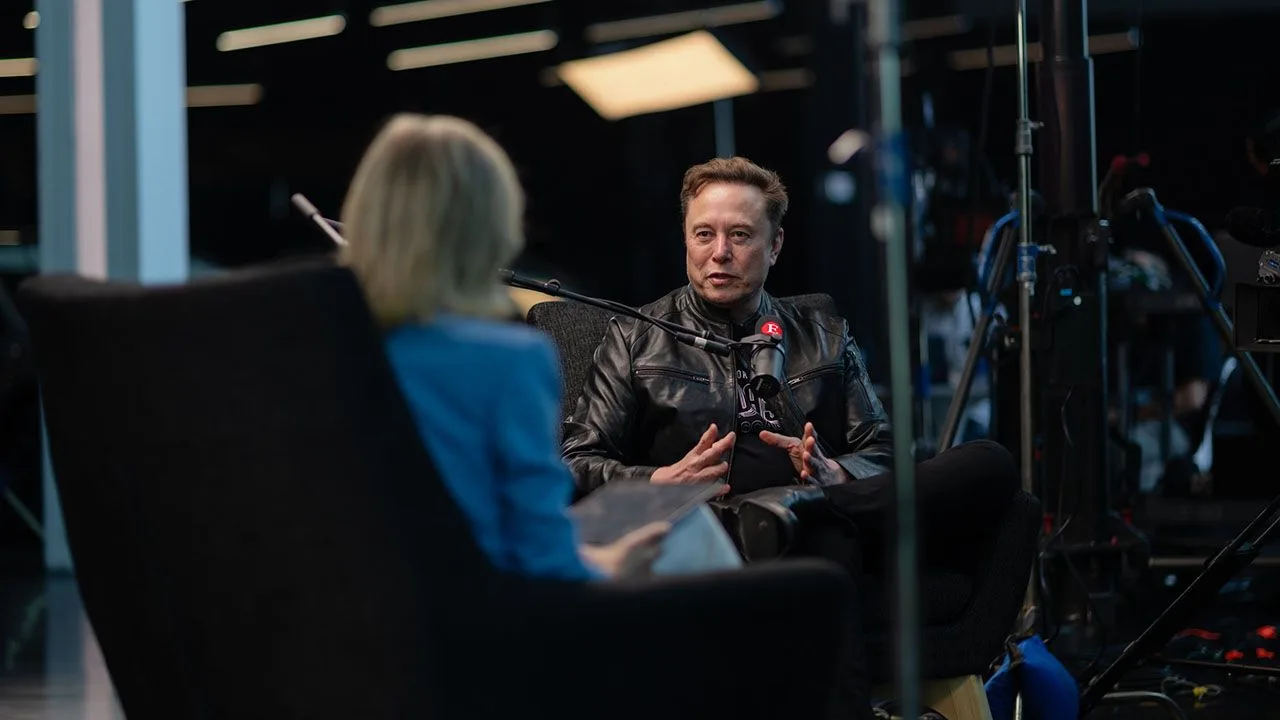
Our interview with Elon Musk sparked a lively letters inbox at The Economist. Here is a selection of our readers’ correspondence, edited for brevity, on AI, abundance, predictions and human purpose.
- Readers divide over a rigorous, candid Elon Musk interview, from praise for a free press to claims of double standards.
- Several letters challenge forecasts on self-driving, Mars, robots and ten-year abundance, and question consistency on Britain and crime.
- Others debate AI craftsmanship, work becoming optional, truth-seeking values, and what sustains purpose in abundant leisure.
Praise for a candid Elon Musk interview
I want to thank The Economist for its intelligent, rigorous, candid interview with Elon Musk.
I am not sure anyone could listen to it without a visceral emotional response. You do not need to be a sci-fi buff to feel the weight of Mr Musk’s doom-laden fable, starring robot protagonists, an absent moral compass and a finale where many countries descend imminently into an abyss of otherness-inspired hatred and civil chaos. Truly jarring and disturbing. It was also fascinating to watch Mr Musk squirm in response to certain questions. He is clearly not always right.
I am an American-British citizen living in Texas, feeling the heat of the next election cycle and seeing first-hand the dangerous times in which we live. Support of a free press has never been more critical.
CAREY JAYNE BRETT
Austin, Texas
Questioning fairness, forecasts and consistency
There was a clear double-standard in your line of questioning. You challenged Mr Musk’s comments on London by claiming he could not accurately judge the situation in the city because he does not live there. Yet mainstream foreign media routinely adopt strong judgments about the United States and Donald Trump without ever visiting the US or gaining a proper first-hand experience of the country.
This approach closely mirrors the framing often seen in German public broadcasting. In those outlets, one-sided narratives are frequently pushed while alternative perspectives are dismissed with broad labels, rather than offering objective and balanced reporting.
Demanding first-hand local experience as a prerequisite for commenting on London, while completely ignoring that exact same lack of experience when people critique America from afar, is contradictory.
Stefan Schulze
Wolfsburg, Germany
It may be premature to take Mr Musk’s forecasts seriously. Consider his record on full self-driving cars, for which there is a devoted Wikipedia page. In 2013 he said 90% of the miles in a Tesla car would be self-driven by 2016. In 2015 he predicted that Tesla would have complete autonomous driving by 2018. In 2016 the date slipped to 2019. Since 2020, it has been “next year” every year. The latest prediction is December 2026, a decade later than he first expected.
Mr Musk is a formidable innovator. But on self-driving cars, as well as Mars, data centres in space, robots, and AI, we should treat his prophecies with caution.
PATRICK GRADY
Brussels
AI robots versus human craft and logic
Regarding the sophistication of AI robots, although AI can conjure fanciful designs for a Michelangelo-inspired fresco for my living room ceiling, does Mr Musk really envision AI robots that could render that actual fresco? There is a whole world of craftsmanship from non-digital art to fine-furniture-making to culinary composition that I struggle to see AI robots competing with humans within my lifetime, let alone in the next ten years.
Moreover, I can’t say that The Economist is loathed by as much of society as Mr Musk claims, but I’ve been a subscriber for 25 years and I really enjoy your publication. It brings me daily enjoyment. Let’s hope that your journalism is safe from being taken over by AI as well.
SCOTT BRANDES
Chapel Hill, North Carolina
Two years ago, in response to Mr Musk’s comments about riots in Britain, you said he is “a man who must be clever but constantly finds new ways to make you wonder” (“The riots and the response”, August 10th). I thought your interview was a perfect illustration of that.
In ten years we will have so much abundance that money will be obsolete, and yet in 20 years there will be civil war in Britain? The lack of air conditioners in Europe is an indication of a failing society, and heat-related deaths should excuse American gun-death numbers? Crime is explained by repeat offenders in America, but any crime by a Muslim in Britain is indicative of a huge social issue? I really wondered if he had any ability to see the silliness of his arguments.
JEM ESKENAZI
London
I don’t know about Mr Musk’s analogy of Cassandra. That mythological prophet at least tried to keep the wooden horse out of Troy. Instead, Mr Musk encourages us to invite a gaudy, but grossly inefficient simulacrum of intelligence (AI) into our civilisation, knowing full well that it could be full of the agents of our enslavement and destruction.
DELBERT GREEAR
Helen, Georgia
Are English cities lawless?
You disagreed with Mr Musk’s contention that English cities are lawless.
Interviews with kids in Greater Manchester on “Troubled Town”, a BBC Radio 4 documentary, found daily violence and anti-social behaviour, with youth centres, bowling alleys, local football and rugby clubs, all places where kids used to get together, closed down. The children in the report are out on the streets, climbing roofs, smashing shop windows, breaking taxi mirrors “for fun”, yelling abuse at and fighting other groups, frightening everyone, saying they loathe their town, and are bored out of their minds. “Why should we care about our town, the town doesn’t care about us”, was their message.
Youth-centre leaders extolled the kids’ intrinsic good nature and argued for more clubs where they could, for example, learn to box, which stops their violent behaviour.
You challenged Mr Musk to take a tour of England. But have you actually reported on these furious young people? The Economist seems to be almost as uninformed as Mr Musk about street violence in England.
XANDRA BINGLEY
London
Abundance, work and human purpose
Mr Musk’s prediction that AI could soon outstrip human intelligence, making money obsolete and work optional is understandably unsettling for a lot of people, but I find it genuinely exciting. As he explained, work may become something we choose to do simply because we enjoy it, in the same way people currently grow their own vegetables instead of buying them at the supermarket, or do volunteer work when they retire. The doing becomes the reason, not just a step on the way to something else.
However we get there, whether it’s a universal basic income or something else, the door opens for all of us to spend less time on the proverbial treadmill and more time on what actually makes us human: ie, connection, craft, curiosity, contribution, play. Activities like farming, music, sport, learning, teaching and caring for one another could become things we simply want to do, not jobs we need.
The challenge will no longer be survival; it’ll be helping people find purpose when a job no longer defines it. To me, that’s a problem worth getting excited about.
Sandy Loyall
Bangalow, Australia
Your questioning of the infrastructure required to support Mr Musk’s claims (work becomes obsolete and goods effectively free) was the right pressure to apply. The world economy and way of life may as well be turned upside down due to AI, but it is preposterous to think that this will occur within ten years. Mr Musk’s own analogy undercuts him. Computers took over financial computation, but jobs within finance are abundant. What does he say about sport, doctors, tourism and experiences? There will always be room for humans to contribute and in turn the need for compensation to do so.
When speaking about AI, space exploration and the future of mankind, Mr Musk was measured, intelligent, and calm even in the face of challenge. As soon as public policy, the Department of Government Efficiency (DOGE) and politics arose, it was a case of Jekyll and Hyde. There was a sense of passion mixed with disdain that was alarming from a man that has so much sway and power to shape the future of humanity.
RYAN DAU
Minnesota
The meaning-shaped holes that our potential future AI overlords could leave in our hearts when they grant us “unbounded leisure” must be filled with ethical activities that are intrinsically meaningful, that is, those that do no harm and are ends in themselves. Some of us may find ethical meaning in playing sports, creating art, or seeking spiritual enlightenment. Others may well pursue gardening. In an AI utopia, the question of what truly gets us out of bed, aside from a hot cup of joe, will take on more urgency and seriousness than ever before.
ADVAIT CHANDRAMOULI
Singapore
Truth-seeking, values and fiction
One alarming statement that stood out in the interview was that Mr Musk’s “biological neural net” told him about AI safety, specifically, that “the most important thing for AI safety is to be maximally truth-seeking and curious.” The words “truth-seeking” appear in SpaceX’s prospectus, to describe Grok, and verbatim in Donald Trump’s executive order from July 2025, on “Preventing Woke AI in the Federal Government”.
Truth is a value. That Mr Musk holds it as a sort of uber-value, transcending all others, and that his view has permeated policy in a powerful country, does not make it so. In an open society, we are each free to identify, develop and balance our own values. Truth should always be one of them, but even it must be balanced with others. Truths that are held to be self-evident by some may not be so obvious to an advanced AI. As Geoffrey Hinton, a computer scientist, understands, fostering humanity, engendering the abundance Mr Musk predicts, will take more than truth-seeking.
CHAT ORTVED
Vancouver, British Columbia
You dismiss Mr Musk’s suggestion that chess and gardening might sustain the human spirit in an age of AI, noting that a “feeling of being superfluous can lead to misery and moral decay” (“Should you be afraid of Elon Musk?”, July 25th). Permit a dispatch from a profession that has been economically superfluous for more than a century. Since the phonograph, every note an orchestra plays has existed in a superior recording at negligible cost. By the logic of usefulness, live orchestras should have disbanded around 1910. Instead the halls keep filling, and, more telling, people keep joining amateur choirs.
And more people play chess today than before the machines became unbeatable in the game. Being surpassed emptied the game of careerism, not of meaning. Your example of superfluous men in Russian novels decayed not because they lacked a function, but because they had nothing they loved enough to practise.
How to finance the transition, tame the upheaval and restrain AI-powered authoritarians are questions squarely in your department, and you are right to press them. But on the question of what humans will do when nothing needs doing, the research is further along than you fear. It is being conducted, weekly, in choirs, chess clubs and allotments.
DAVID WOODARD
Conductor
Tampere, Finland
Please could you, or Mr Musk, explain what “an age of amazing abundance” means in real, practical terms. Do you, or he, envisage endless fields of wheat and rice and fruit laden orchards, or simply freely available techno bits and pieces directing our every move?
A Musk-style utopian future is even less alluring than Aldous Huxley’s “Island” or William Morris’s “News from Nowhere”.
SHEILA COUTTS
Denmead, Hampshire
Mr Musk’s forecasts may or may not prove correct, but I note that he cited Iain Banks’s culture series of novels as giving a glimpse into what things might be like. Mr Musk also mentioned the importance of AI models having “values” (though he didn’t say what those values would be).
Ian McEwan’s novel, “Machines Like Me”, about a humanoid robot called Adam, explores the tensions in values between humans and machines. The theme of this novel is also evident in your article about China wanting to end AI romances (“No more bots”, July 18th) as Adam (robot), Charlie (human) and Miranda (also human) form a love triangle.
NAOMI STANFORD
London
KEEP THE CONVERSATION GOING
A good story is worth sharing.
Send this story to someone who values the bigger picture.
See more from GlobeBriefly on Google
Choose us as a preferred source in your Google preferences.