
Ten business trends for 2025 point to lower inflation, higher IT spending and a continued green push, with detailed forecasts for 15 industries from automotive and energy to retail and travel.
- Lower inflation encourages rate cuts and consumer spending, while IT spending rises to $3.6trn as firms invest in artificial intelligence.
- Renewable electricity surges but fossil fuels still supply over four-fifths of energy needs; electric-vehicle sales rise by a quarter.
- World GDP grows by just 2.5% amid geopolitical tensions, while international tourism arrivals reach 1.6bn.
Forecasts are for 2025 unless otherwise indicated. World totals based on 60 countries accounting for over 95% of world GDP.
Ten business trends for 2025
- 1Lower inflation encourages central banks, including America’s Federal Reserve, to cut interest rates further—and prompts consumers to go shopping.
- 2IT spending rises to $3.6trn as companies tap into artificial intelligence. About 30% of large American firms invest $10m or more in AI, up from 16% in 2024.
- 3Adding to worries about humans passing their prime, about 12% of them are aged over 65. Yet only 10% of global GDP goes on health care.
- 4Governments push wide-ranging green schemes. Renewable electricity surges but fossil fuels still supply over four-fifths of energy needs.
- 5Electric vehicles are a bright spot for carmakers, with sales rising by a quarter. But range anxiety deters many buyers and pushes others towards plugless models.
- 6Airlines pledge carbon-emissions cuts, while buying new planes. As international arrivals ascend to 1.6bn, tourism generates 5-8% of all greenhouse gases.
- 7Housing markets cause policymakers and regulators jitters, even as $2.1trn of property loans mature. House prices are generally high, though China’s dip.
- 8Green policies drive global metals prices 7.5% higher, with demand growing for everything from car batteries to cables—and thus from copper to steel.
- 9Environmental goals stimulate infrastructure spending around the world. Gross fixed investment climbs to almost $28trn, a quarter of global GDP.
- 10Shippers must also navigate green trends: 40% of their emissions are brought under the EU’s emissions-trading system. Geopolitics, too, rocks boats.
Business environment: 2.5% growth amid tensions
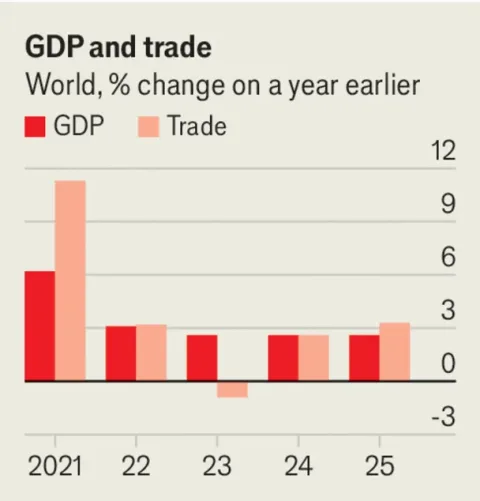
Even if 2025 brings no new major conflicts, geopolitical tensions will weigh on the global economy. World GDP will grow by just 2.5%.
European economies will strengthen but emerging markets will be flat due to trade barriers, climate change and technological hurdles. Inflation and interest rates will fall, but high public debt and defence budgets will crimp governments’ ability to spend.
Automotive: sales grow as electrics surge
After nearly stalling in 2024, global new-car sales will grow by 2% in 2025. Sales of new trucks will be speedier, rising by 4% thanks to expanding infrastructure in emerging markets.
Electric vehicles (EVs) will be the car market’s sole spark, surging by almost a quarter, though demand will stay below recent highs. Range anxiety and high prices will push buyers towards plugless models instead.
Efforts to cut vehicle emissions, though fitful, will be a focus. Norway aims to make all new cars emission-free by 2025, the first country to do so, though vans will miss the target. Australia, an emissions laggard, will finally introduce fuel-efficiency standards.
But the EU has delayed implementing its Euro 7 standards until 2028. Even so, cars running on petrol and diesel will hit roadblocks. More cities will impose zero-emission zones, with Stockholm the first to ban fossil-fuel guzzlers from its centre.
China will beat its goals for electrics, generating half the world’s sales. Its EV-makers will gain ground: BYD, the world’s biggest, aims to sell 1m vehicles outside China, helped by new plants in Brazil and Hungary. Vietnam’s VinFast will target India and Indonesia.
Western firms will hit back. Volkswagen and Tesla will be developing cheaper plug-ins, as Toyota launches a self-driving EV for China. But higher tariff barriers for China’s EVs will complicate green-car plans, as will tighter local-content requirements. As supply chains splinter, carmakers will look to new chip and battery plants to support EV production.
Defence: demand rises, spending is uneven
Wars in Ukraine, Lebanon and Gaza will stoke demand for weapons, but defence spending will be unevenly spread. America, the biggest spender, will raise its military budget by 4%, to $884bn, but China, the second-biggest, will increase its spending faster.
NATO will debate a national defence-spending target of 2.5% of GDP, although one in three members have missed the current goal of 2%. The alliance will draft a broad strategy to counter Russia and will hand Ukraine $43bn to fight on. But Germany plans to halve its outlay to Ukraine, to save money.
Worried that America’s commitment to NATO will fray, the EU will launch rapid-deployment forces and expand production of shells. Meanwhile much of Russia’s Soviet-era kit will be useless by mid-2025.
America will support Israel, despite some misgivings at home. China’s navy will keep skirmishing in Asian waters, bolstered by new diesel-electric submarines. The Philippines will lift defence spending in response; Australia will boost troop numbers by offering foreign residents citizenship for enlisting. Japan will deploy new drones, and America its hypersonic missile, designed to fly at 3,800mph (6,115kph).
Global tensions may soar but America’s air force will ground 250 old planes in 2025, leaving it with fewer than 5,000 aircraft, a recent low. New models will help, like the F-35 stealth jet—if its bugs can be fixed.
Energy: record use as green energy flourishes
Energy consumption will rise by 2% to a record 14.5trn tonnes of oil equivalent in 2025. Fossil fuels will provide over 80% of that, increasing carbon emissions by 1.7 times from 1990 levels.
Coal use will dwindle in Europe and North America, but India and Russia will stick with the black stuff. China’s coal consumption will near its peak.
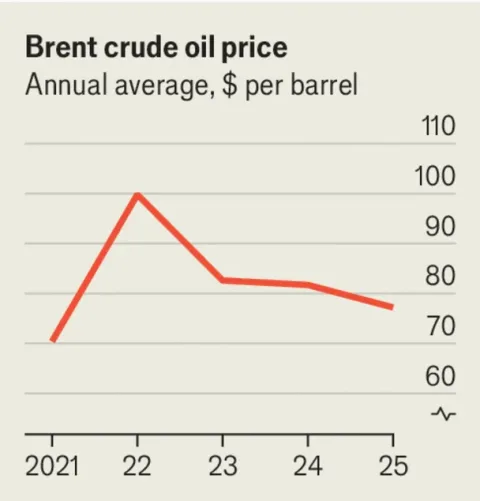
More oil will be burned, too. OPEC+ will continue cutting oil output to keep Brent prices around $77 a barrel in 2025, though non-OPEC output (mainly from the Americas) will surge. The EU will keep switching away from Russian oil, as the Czech Republic connects to supplies imported by pipeline from Italy.
The Baltic countries will disconnect from Russia’s power grid, but Russian gas will continue to flow to Europe, mostly via Bulgaria.
Green energy will flourish. Renewables (including hydro) will make up 14% of global supply. Wind and solar will deliver a sixth of all electricity. Gujarat will get a massive solar farm that will supply 4% of India’s power. Zambia will build dozens of solar mini-grids to serve outlying villages. Texas will gain its first grid-connected geothermal plant.
China, India, South Korea and Turkey will switch on (carbon-free) nuclear reactors, taking the global total to 447.
China will smash a country-wide target to make more than 200,000 tonnes of green hydrogen. In fact Inner Mongolia and Gansu, in the north and north-west, plan to produce multiples of that on their own. The catch? New pipelines will be needed to ship the fuel to China’s populous east.
Financial services: regulation, insurance and digital money
Banks will lobby regulators in 2025 as the Basel 3 “end-game” rules, drawn up after the financial crisis of 2007-09, kick in. American banks, wary of falling interest rates, will resist pressure to boost capital buffers. Backsliding could prompt protests from their EU rivals, but Asia’s banks, buoyed by faster growth, will be more sanguine.
Regulators will worry about loans to commercial property, given the shift to hybrid working, as global bank loans rise by 7% to $112trn.
Climate change will undermine insurers’ calculations. Yet Swiss Re, a big insurer, predicts the industry will grow rapidly, with life-insurance premiums reaching $3.1trn and non-life premiums $4.8trn. Environmental-disclosure rules will tighten in many countries; EU companies will issue their first sustainability reports. But an American backlash against “sustainable” investing will spread.
Cash is no longer king: the world will have 2bn credit cards but only 3m cash machines in 2025. The lines between banks and fintechs will blur further: the Philippines will permit new digital banks; Spain’s BBVA will launch one in Germany. Brazil will push forward with its central-bank digital currency, Drex. The EU will decide whether to move ahead with a digital euro. The US dollar, however, will remain dominant, defying China’s efforts to expand foreign use of the yuan.
Despite Brexit, LCH, a London clearing house, still processes around 95% of euro-denominated interest-rate swaps, and most denominated in dollars. The EU wanted investors to switch to rivals like Germany’s Eurex by 2025. Hard luck (for now).
Food and farming: cheaper commodities, shifting rules
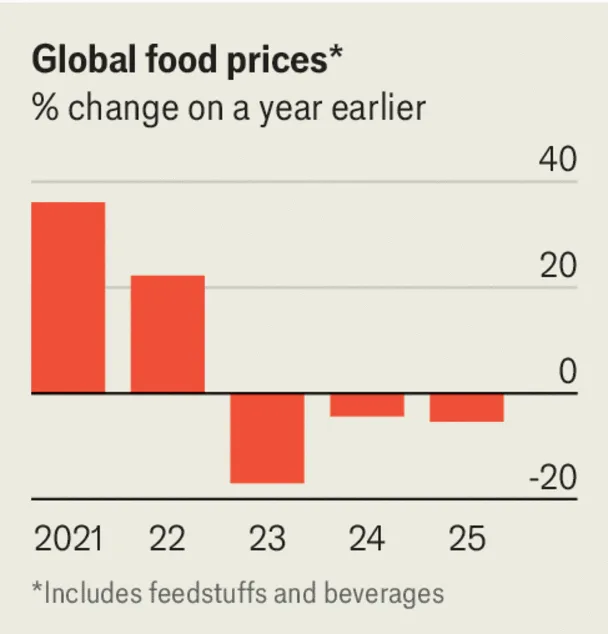
Most food commodities will get cheaper in 2025 as supplies swell. EIU’s index of food, feedstuff and beverages will dip to 25% below the peak of 2022. Beverages and sugar will lead the decline, with oilseed and grain prices holding firmer.
As El Niño blows over, La Niña will damage harvests in the Americas and help them in Asia. Wheat production will rebound despite the travails of Ukraine, a main producer. India will ease restrictions on rice exports as global prices slide. Even cocoa prices, which have soared during the last two years, will drop by a quarter, to chocolate-lovers’ delight.
Palm-oil producers and coffee markets will have an extra year to prepare for the EU’s delayed deforestation rules, just as American drinks-makers postpone targets for plastics use. But new EU rules will promote food composting and plastics recycling. China will clamp down on food additives, Japan on food packaging. Britain will extend its sustainable-farming incentives. But funding for a global biodiversity plan will not measure up.
Sin taxes on tobacco, alcohol, fat and sugar will spread. Germany may even impose one on meat.
Consumers will spend $11.5trn on food globally, nearly 6% more than in 2024. They will eat more fish and meat, despite rising sales of vegan food. But even as food sales accelerate, food companies’ profits will fall from recent highs. Unilever will cut 7,500 jobs and Danone will refocus its strategy on nutrition products.
Health care: ageing strains systems and spending
Health-care systems will ache in 2025 as populations age and staff struggle. Nearly 12% of the world’s population will be aged 65 or over. Yet only 10% of global GDP will be spent on health, down from 11% during the covid-19 pandemic. Worldwide spending will reach $11trn, nearly half of it in America.
Compulsory spending will outpace voluntary as countries expand public-health insurance. The United Arab Emirates will oblige expats to get insured; China will work to improve its public hospitals and clinics. Even so, a goal set by the World Health Organisation (WHO) to extend universal health care to 1bn more people globally will be missed. Nigeria’s plans for a universal system will falter; India’s government will miss its spending targets. America will debate the cost of Obamacare subsidies as their expiry looms again.
The WHO will embark on its 14th four-year plan, focusing on climate change. As deaths from extreme weather rise, governments will develop warning systems; carmakers in America will add heat alerts to cars. Alarm over infectious diseases will push governments to sign a delayed pandemic treaty. The number of obesity drugs will balloon as China and India produce cheaper versions. Novo Nordisk will try to turn its fat-busters into heart treatments. With further, expensive therapies emerging, overall drugs sales will bulge to $1.7trn.
Vaccines will advance in 2025. Bavarian Nordic will make 10m mpox jabs. Scientists will test an avian-flu shot and an all-in-one jab for coronaviruses. Deliveries of mRNA vaccines for cancer may even begin.
Infrastructure: green policies drive construction
Green policies will prompt a frenzy of construction in 2025. Gross fixed investment, a proxy for infrastructure spending, will rise by 6% to $28trn (about 25% of world GDP). Nearly a fifth will be in America, where Biden-era subsidies will spur spending but undershoot infrastructure needs. Europe and China will invest heavily in green infrastructure and digital networks.
Money will come from governments, pension funds and sovereign-wealth funds, as well as private companies. Much will flow into renewable energy. This in turn will support digitalisation, though the rise of data centres will strain power grids. 5G telecoms networks will also expand—gradually. Japan’s World Expo will conjure a digital future and Saudi Arabia will invest in its futuristic city, Neom.
Transport infrastructure will lag, despite a shift to greener travel. Europe will see a renaissance in its railways, gaining a night train from Brussels to Venice and new departures from Amsterdam. Eastern Europe, over-reliant on planes, will get a direct Budapest-Belgrade rail link. India will build roads, adding close to 13,000km in the year to March 2026. China will expand ports in Africa and open one in Peru, shoring up trade routes—and its military might.
Wars and online sabotage will threaten infrastructure plans in 2025. The fallout from the Gaza-Israel war will imperil power plants and the Suez canal. The UN will push forward with a treaty on cyber-crime as risks multiply. Hundreds of millions of cyber-assaults on critical infrastructure will occur in 2025.
Information technology: AI drives $3.6trn spending
The craze for artificial intelligence will help total IT spending grow faster, rising 8% to $3.6trn in 2025, though not quite as fast as during the pandemic-fuelled bonanza in 2021, when it surged by 14%. Data centres will see investment and revenue grow as more companies try to harness ChatGPT and other large-language models.
In America around 30% of businesses will invest $10m or more in AI, up from 16% in 2024, says EY, an accountancy firm. Apple will bring its generative-AI tools, Apple Intelligence, to more iPhone users.
Some of the investment craze may be plain crazy. Gartner, a consultancy, predicts 30% of generative-AI projects will not pass the “proof of concept” stage amid daunting costs and uncertain benefits. Even schemes that make it further will not always justify the hype. Regulators, meanwhile, are circling. In 2025 parts of the EU’s AI Act will take effect. The African Union will try to forge a common AI strategy.
In hardware, chipmaking rivalries will heat up, with Nvidia, the king of AI silicon, trying to fend off competitors such as Arm and Google. Governments will vie to attract chipmaking to their shores, to protect supply chains. Taiwan’s TSMC hopes to open its first, long-delayed plant in America. America’s Micron will manufacture its first India-made chips.
2025 will be the UN’s International Year of Quantum Science and Technology, marking a century since the field’s birth. Quantum computers could perform operations millions of times faster than today’s machines. But the path to wide adoption will be a slow one.
Media and entertainment: slower ads, streaming shifts
No Olympics. Fewer massive sporting events. And no American election. 2025 holds less excitement for advertisers than did 2024. Growth in global ad spending will slow in 2025 to about 4%, according to Dentsu, an advertising giant. Sales of digital ads—more than 60% of the total—will rise at their slowest pace since 2020.
Advertisers will turn to other digital tools. AI will be in vogue for making ads and targeting punters, though media giants’ battles with AI firms over copyright and other matters will drag on. Social media, crucial for advertisers, will attract regulators’ scrutiny. American lawmakers will continue to tussle with China’s TikTok. Malaysia will make big technology platforms apply for licences, roiling free-speech advocates.
Cable TV will be in its death throes. In 2025 72% of all American households will have either cut the cord or never had one. Its demise has been hastened by the launch of ad-supported tiers on streaming platforms such as Amazon Prime and Hulu. The death knell will sound with the loss of live sport on cable platforms. From 2025 Amazon will hold the rights to National Basketball Association games for 11 years. World Wrestling Entertainment’s weekly shows will go to Netflix.
Streamers are also hurting the box office. Even in 2025 cinema revenues will not recover to pre-pandemic levels: PwC, a consultancy, forecasts they will reach $41bn. Helping cinemas’ cause will be “Avatar 3” and the eighth film in the “Mission Impossible” series, both of which were delayed by Hollywood strikes.
Disney has struggled in India. But if regulators comply, its dreams will come true in 2025 when its Indian arm merges with the streaming business of Reliance Industries, a local behemoth. The new firm will have 750m Indian viewers.
Metals and mining: base metals climb 7.5%
Green policies and rising construction will drive metal prices higher in 2025, even as other industrial commodities decline. EIU’s base-metals index will climb by 7.5%, clearing its peak in 2022. Demand for electric cables and batteries will power copper prices. Infrastructure investment will firm up prices for steel, iron ore and aluminium, and galvanise zinc. Tin will shine thanks to electronics consumption. Gold, a safe haven in uncertain times, will glisten, and diamonds regain their sparkle.
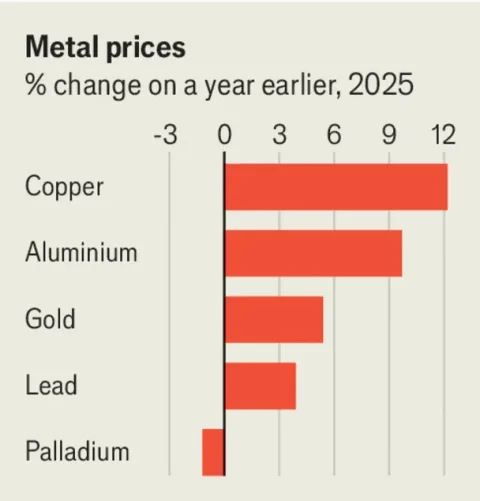
Dimmer fortunes await other metals. Nickel, cobalt and lithium will rise slowly as EV sales falter and carmakers toy with new types of battery. Lead prices will struggle upwards, while platinum and palladium dip.
Mining companies will hold investment steady. Anglo-American will keep capital spending at $5.7bn; Vale will stay at $6.5bn. Governments from Latin America to Africa will court investors eagerly. Ecuador will offer mining permits and Chile lithium contracts. China’s grip on rare-earth minerals will prompt a search for alternatives—including under the sea.
Exploring the Arctic will take on new meaning in 2025 as Norway auctions parts of its northern seabeds for mining. Investors are seeking copper, nickel and manganese. Norway says the seabed can be mined sustainably. Protestors will object noisily.
Property: cheaper loans but high prices
Falling interest rates will bolster property markets in 2025, although city centres will remain quieter than before the pandemic. Office leasing will pick up as more employers insist on seeing staff a few days a week. Shops in prime locations will be resilient. But warehouse leasing will flatten out as the online-retail surge subsides. Tourist cities will be buoyant but hotel-building will be slow, except in the Gulf and India.
Mortgages will get cheaper but shortages will keep house prices and rents unaffordable for many. Governments will encourage more building, especially in Europe. Britain’s will recolour parts of the green belt to help provide 1.5m more homes. Dutch construction will recover, while even Spain’s crumbling housing market is due a change of fortunes. With more housing, the average number of people per household will dip to 2.4 in Europe and 3.3 worldwide.
European bank regulators will keep an eye on the housing market for signs of popping bubbles. In China house prices will fall by 4% despite government efforts to stabilise the troubled sector. Office values will drop in America, while bad loans rise. Globally $2.1trn of real-estate loans will mature, three-quarters of them in America. Energy-saving targets will also bite. In the EU, many older buildings will need to be retrofitted—or become stranded assets.
Retail: volumes grow as costs and rules bite
Global retail-sales volumes will expand by more than 2% in 2025 from the year before, the fastest since 2021, helped by slowing inflation in the rich world. This is despite the economic obstacles hampering both bricks-and-mortar and online retailers. Elevated interest rates and credit-card debts will deter discretionary spending, shrinking many store networks: Family Dollar, an American discount-shopping chain, will shut more than 300 outlets.
Pity also purveyors of furniture and other household goods in rich countries, where would-be buyers of houses (and their contents) will be put off by high prices. Other barriers will be regulatory. American lawmakers will protect domestic businesses by cracking down on Shein and Temu, China’s low-cost online sellers. Another Chinese firm, TikTok, plans to expand its Shop feature in Europe, even as its future in America is under threat. Online shopping in North America (as in Asia) claims about 18% of all sales, higher than the global average.
The greening of commerce will add red tape. French lawmakers will seek to ban advertising of fast fashion to curb carbon emissions (producing textiles used by EU citizens generated 270kg of CO2 equivalent per person in 2020). To boost re-use and recycling, the EU will make businesses separate used clothing and footwear from other rubbish. Greenness (and cheapness) will spur more young shoppers to buy second-hand clothes: ThredUp, a resale platform, says hand-me-downs will account for 10% of the fashion market by 2025.
Shipping and logistics: rerouting and green charges
Tensions in the Middle East will disrupt maritime traffic through the Suez Canal, the shortest link between Asia and Europe, into 2025. Shipping companies will keep rerouting vessels around the Cape of Good Hope, lengthening journeys—and depriving Egypt of hundreds of millions of dollars of revenue. More delays and losses for shippers globally could come from strikes by disgruntled port workers.
Regulatory whirlpools also await shippers. From 2025 they will have to pay to pollute, with the EU’s emissions-trading system covering 40% of their emissions, rising to 100% by 2027. The EU’s busy regulators will clamp down, too, on rules that allow tariff-free trade for low-value goods. That will weigh on cross-border trade generated by e-commerce—until now a boon for air-cargo carriers.
The trucking industry also faces a bumpy road. Difficult working conditions are making it hard to replace ageing drivers. Australia alone has tens of thousands of unfilled positions, with shortages set to last into 2025 and beyond.
China wants to convert Hainan, in the South China Sea, into a trade hub. The tropical island plans to set up a free-trade customs regime by 2025 to boost imports for manufacturing. But competing with Hong Kong will be like sailing into a storm. In 2023 Hong Kong handled over 14m TEUs (20-foot-equivalent units) of containers, against fewer than 2m in Hainan.
Telecoms: 5G surges to 2.8bn subscriptions
As older mobile technologies lose favour, 5G subscriptions will surge by more than 25%, to 2.8bn, in 2025, reckons Ericsson, a large telecoms firm. 5G handsets will make up three-quarters of sales, boosting smartphone shipments by 2%, according to IDC, a research company. Even so, 5G coverage has been slow to materialise, only lately reaching more than 50% of subscribers in North America.
Meanwhile Pakistan, struggling economically and politically, will finish its auction of 5G spectrum in 2025. Africa lags badly, with fewer than one-third of countries having launched 5G services. Undeterred, 3GPP, a mobile-broadband standards-setter, will start work on 6G in 2025.
Progress on fixed-internet service will be slow. Foreign-exchange shortages and the risk of theft of telecoms infrastructure will make Nigeria miss its ambitious aim to extend broadband access to 70% of its citizens by 2025. Only 81% of India’s population will have access to the internet.
International connectivity depends mainly on subsea cables, which face risks from conflicts. Governments are responding. In 2025 the French government will buy Nokia’s subsea-cable business. Vietnam plans to add up to four cables by 2025, seeking to triple its international links to 15 by 2030. More help for web users may come in 2025 from companies such as OneWeb and Elon Musk’s StarLink, which provide internet services via satellites. If, that is, governments allocate spectrum in time.
Travel and tourism: departures hit 1.6bn
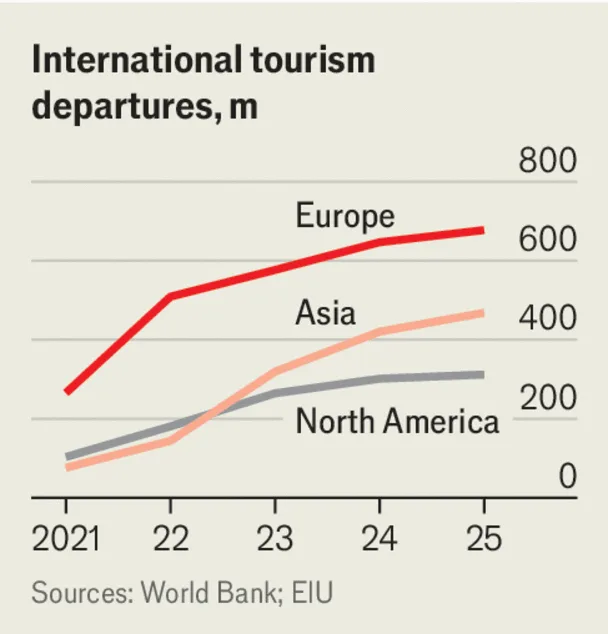
Tourism departures will fly to a new high of 1.6bn in 2025, boosting economies while irritating local residents. China’s outbound tourism, a tenth of the total, will finally surpass pre-pandemic levels. Thailand will benefit from having loosened visa requirements; Indonesia may follow. China will relax rules for inbound travellers. But its tourists’ love of overseas shopping will wane. Asia’s share of tourism spending will nonetheless hit 37%, on par with Europe’s.
Europe, though, will draw more than half of international arrivals. Protests against over-tourism will continue; crowded cities will restrict short-term rentals. The EU will improve surveillance by demanding that tourists from more than 60 countries, including Britain and America, pay $7 for a “visa waiver”. As Norway limits landings in Svalbard, visiting the Arctic will get harder. But some parts of the Middle East and Africa will welcome more travellers, as Saudi Arabia and Zambia invest in hotels.
From the EU to New Zealand “sustainable” travel will be in vogue. More airlines will join Corsia, an emissions-cutting pact. Britain will mandate greener aviation fuels. But the global tourism industry will vent 5-8% of greenhouse gases. China’s Comac will tout its C919 plane, taking market share from Airbus and beleaguered Boeing.
In 2025 the number of Indians travelling abroad will climb by 17% to 29m—one-fifth of China’s total but faster-growing. Many will visit the Middle East and America, but around 70% will stay in Asia thanks to visa exemptions. India’s tourists will shell out $1,400 per person, far above the world average of $1,033.
All industry forecasts cover 2025 unless otherwise indicated.
KEEP THE CONVERSATION GOING
A good story is worth sharing.
Send this story to someone who values the bigger picture.
See more from GlobeBriefly on Google
Choose us as a preferred source in your Google preferences.