Audio
Listen to the article
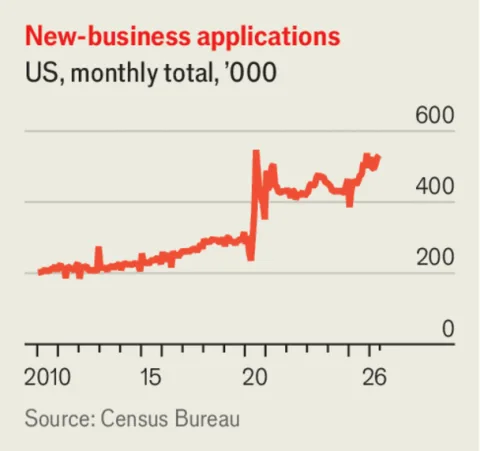
- America’s small-business boom began during the covid-19 pandemic and has gained momentum on the back of AI, low hiring rates and easy online shops.
- In June the Census Bureau recorded more than 531,000 new business applications, an 81% increase on the average month in 2019.
- AI could help one-person firms scale without hiring — and give people displaced by automation a route into self-employment.
For decades, polls have shown that about 60% of Americans aspire to self-employment. Yet in recent years, fewer than 10% have actually achieved it. That is now changing — and AI may be part of the reason.
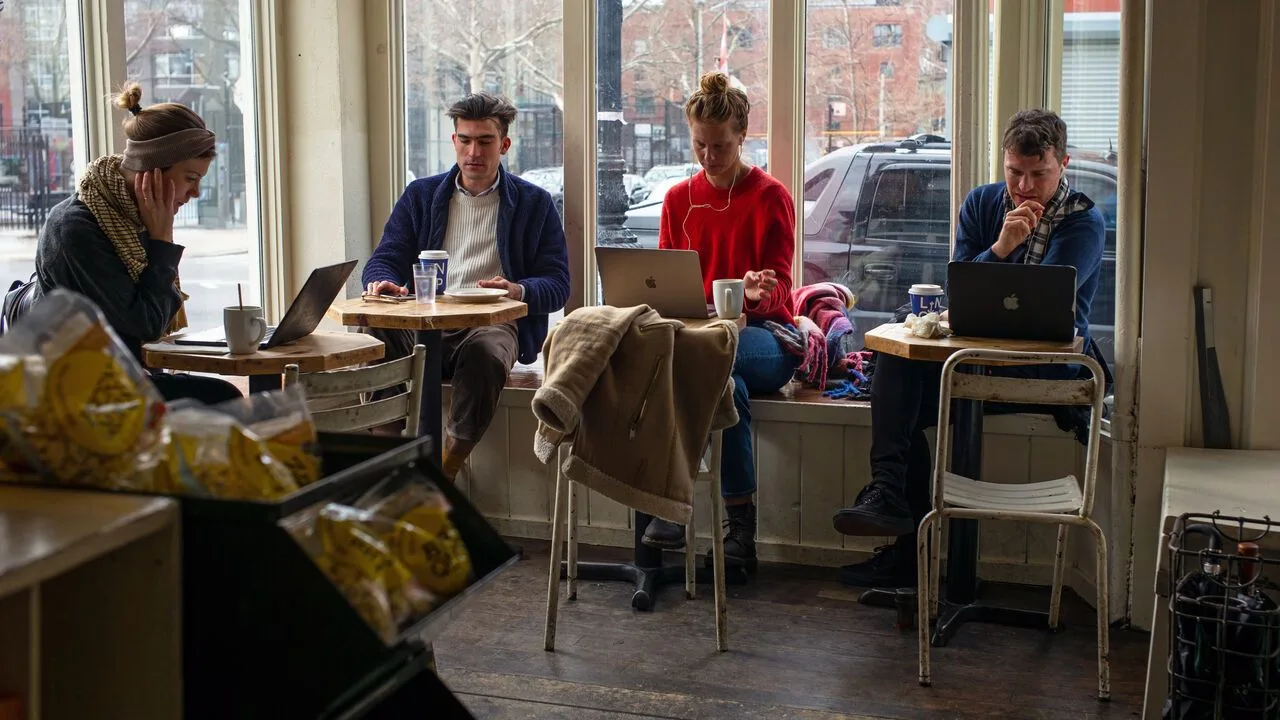
The desire to be one’s own boss is woven into the American character. It dates back to Thomas Jefferson, who believed the ideal citizen was a yeoman farmer, economically independent and thus able to participate in civic life.
America is in the middle of a startup boom
As we report elsewhere, America is in the midst of a small-business boom. It began during the covid-19 pandemic and has since gained momentum, driven by artificial intelligence, low hiring rates, and the ease of launching small online shops on platforms like Etsy, Shopify, and TikTok Shop. In June, the Census Bureau recorded more than 531,000 new business applications, an 81% increase compared to the average month in 2019. Similar factors have boosted self-employment in Britain and France, according to Stripe, a payments firm. But the trend is most pronounced in America, and it is a welcome one.
531,000
New business applications recorded by the Census Bureau in June — an 81% increase compared with the average month in 2019.
Small businesses are popular with politicians, but economists often turn up their noses. Many fail. Those that survive frequently suffer from low productivity: small American firms are only 70% as productive as big ones. In recent years, much innovation has come from large “superstar” firms. Small companies often lack the digital tools and administrative efficiency that come with scale.
How AI could level the playing field
Yet there are signs that AI can help small businesses become more sophisticated, even as it automates away some jobs with big employers. Basic chatbots can help firms register with local authorities, draft business plans, and market themselves to clients. AI agents can handle repetitive administrative tasks and make sense of sales trends and other data. Many of America’s new businesses are one-man bands, categorized by the government as unlikely to hire within their first few years of operation. They may be able to scale up anyway, using AI agents instead of employees.
All this raises the tantalizing prospect that self-employment could provide meaningful alternative work for some who lose their jobs to AI. Gloomy futurists in Silicon Valley warn that AI will create a “permanent underclass” of people who own little capital and, with the professional classes displaced, perform only menial jobs. A more hopeful possibility is that the technology democratizes the ability to put ideas into practice and become a successful business owner. There are some signs of such an effect: a rising share of new entrepreneurs are low-income, according to Bank of America.
True, becoming a “solopreneur” will provide neither the manufacturing jobs craved by populists nor a predictable 9-5 office life and a corporate ladder. The new startups are mainly services firms, many in tech, retail, or health care. But, when asked, their founders say they are happy with service work. It is an encouraging precedent that many of these new businesses have sprung up in places formerly hollowed out by the loss of manufacturing. Shopify reckons that the share of new businesses from rural areas has been rising.
What would Jefferson do?
The government could make life easier still for entrepreneurs. Although Obamacare, a health-care reform in the 2010s, helped, it is often still too hard for self-employed Americans to access health insurance. Employees should not have to cling to their jobs to stay covered. And swathes of the economy suffer from burdensome occupational-licensing requirements, which act as a barrier to entry for anyone looking to set up shop. They should be pared back.
Nobody knows how AI will reshape work, but across-the-board pessimism is unwarranted. An economy powered by individual entrepreneurship, with AI handling tedious back-end tasks, could yet prove fulfilling and lucrative for many people. It might even help more Americans realize Jefferson’s vision of self-reliance as a path to liberty. ■
KEEP THE CONVERSATION GOING
A good story is worth sharing.
Send this story to someone who values the bigger picture.
See more from GlobeBriefly on Google
Choose us as a preferred source in your Google preferences.