Audio
Listen to the article
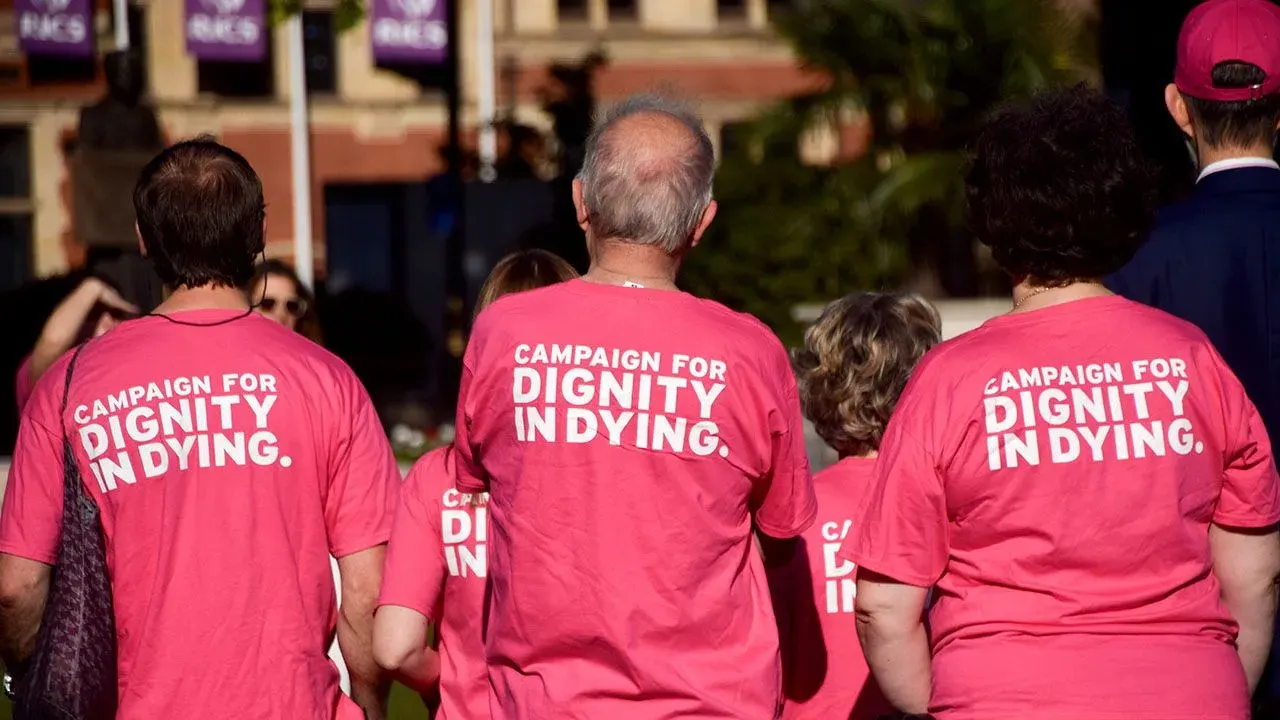
Britain’s assisted-dying bill is being held up in the House of Lords by just seven peers who have proposed hundreds of amendments. We asked readers what they thought about assisted dying and they responded in droves, overwhelmingly in favour of changing the law.
- Our Blighty newsletter reported the assisted-dying bill is being held up in the House of Lords by seven peers with hundreds of amendments.
- Readers responded in droves and were overwhelmingly in favour of changing the law.
- This is a selection of their letters, edited for brevity, on choice, suffering, safeguards and democracy.
Readers back choice at the end of life
I’m writing to share my frustration and fury that the assisted-dying bill seems to be being blocked by the House of Lords. There is no more fundamental right than to choose how one dies. Religion, ultimately, has stood in the way of progress here for too long, leading to unnecessary suffering on a horrifying scale. Lawmakers should be thinking creatively about how to improve the lives of all citizens, including end of life and death, based on their individual wishes rather than propping up a status quo that soothes those with specific, minority cultural values.
This doesn’t mean ignoring the concerns of the religious-minded, but it must mean finding a balance that includes freedom of choice for the majority who would want choice if and when circumstances sadly arise.
This is an issue that may affect every human on the planet and deserves a much broader discussion, but ultimately should not be blocked by a tiny minority of unelected individuals. I feel deep despair for those who die in agony against their will in the meantime.
Joe Marriott
In Canada assisted dying has been available for some time. At the age of 90 I still play doubles squash, ride a bicycle and fly a helicopter, but I draw great comfort from knowing that if a terminal disease afflicts me with horrid suffering I can bring matters to a well-supervised end.
My first wife, long divorced from me, but still a dear friend, chose assisted dying when she suffered from a progressive brain tumour. The children, in their 50s, and I sat with their mother while a doctor, trained and specialised, navigated us through the procedure. She departed this world happily and in comfort.
Daniel Owen
As a specialist in pain medicine and neurology I agree with the legislation. Prolonging life with marked suffering is not, in my opinion, ethical. The final decision to proceed must lie with the patient.
Dr Steven Scheiner
I am terminally ill. When the pain becomes such that it is no longer possible to lead any sort of normal life I would welcome the opportunity to be able to take something at home to kill me off. I have met some really caring cancer nurses who I am sure could, with love and understanding, instruct me in my task. The prospect of flying to Switzerland for the procedure or being interrogated by unfeeling judges and consultants and going to a large factory hospital fill me with despair.
Anthony Booth
Of course we should have the right to choose to die. Nothing prevents us from risking our lives in extreme sports. No one tells us we can’t cross the road, drive, refuse medical help, eat the wrong diet, or drink, or do any of a number of things that will shorten our life expectancy.
We’re allowed to terminate the lives of the unborn. Bearing arms for the state, we can kill others with impunity. We can affix a do-not-resuscitate notice to our medical notes. Any honest staff member of an old people’s home will tell you that a time comes when someone is allowed to die because their body simply shouldn’t be expected to carry on any more.
The idea that society holds human life to be absolutely and inviolably sacred is full of holes. To prevent someone choosing when to end their own life is busy-bodying hypocrisy.
My life is mine to determine, not yours.
Dr Mark Harper
Is the assisted-dying bill too restrictive?
I fully support the concept of assisted dying. But it doesn’t go far enough. My mother was diagnosed with inoperable terminal gastric cancer towards the end of covid restrictions. She bore her disease with fortitude. I don’t think that a time frame for death was given to her, but we all knew that her “time” was limited. It is really difficult to predict a lifespan in the face of “terminal disease”.
In the event, she died at home with her children surrounding her. It was probably only in the last few weeks of her life that she might have tried to avail herself of assisted dying. The bill as drafted currently is too restrictive to have been of use to her.
Assisted dying? Yes, please. Sensible conditions? Yes please.
David Derbyshire
I am among the majority who absolutely supports the bill now being held up in the House of Lords. It is not a case of wanting to end my life, but rather it is “ending my death”. Over the years medicine has allowed us all to live longer. But if the extra time is full of pain and misery then the extension should be one that we can terminate at our own will.
I sometimes wonder if the pharmaceutical industry, which gains from our increased longevity, should reimburse us and the state for our troubles, which they often cause.
It is a sad reflection on the influence of religion that so much of the vitriolic opposition comes from religious bodies and their adherents.
David Cunningham Green
Suffering, regulation and the hospice view
Ninety years ago Lord Dawson gave King George V morphine and cocaine to hasten and ease his passing. Before abortion was legalised, thousands of young women were admitted to hospital because of failed illegal back-street procedures. Many had life-long complications and sadly some died. Since the change in legalisation this is very rare.
The current situation is similar. If someone is determined to die the only choice is suicide. For the sufferer this can be messy and can fail. And surely far worse for the close family than dignified passing as seen in those countries where assisted dying has been legalised.
Richard Faber
I chair a hospice and it is clear that the majority of the public and our supporters believe in this bill. I find it strange that opponents keep insisting that no single person should be “killed” inappropriately as an argument not to address the thousands of people suffering and being deprived of the right to choose their death. The idea of a creeping scope of the procedure to where everyone who feels a bit down might be bumped off is frankly ridiculous. Parliament can monitor the outcomes and review the act in five years’ time.
Ian Cheshire
We need to accept that doctors already make decisions every day to withdraw care and there are cases where relatives feel that pain relief is administered above the normal dose to alleviate suffering. As such, assisted death is already happening. So, the choice is not whether we should permit assisted death. The choice is whether we should have assisted death with or without regulation.
Daniel Sokol, a medical ethicist, has written that “What is missing from the reasoning of the opponents of assisted dying is the realisation that a key purpose of medicine is the relief of human suffering. As technological advances allow us to delay death even in the most dire of circumstances, the issue of assisted dying becomes more pressing. Prolonging life can extend suffering.
The doctor who administers a fatal injection to a patient with end-stage motor neurone disease, who has asked clearly and repeatedly for an earlier death, is relieving human suffering. He or she should be no more criticised than the doctor who switches off the ventilator from a patient with full capacity who decides that ‘enough is enough’. Both are acting in accordance with the Hippocratic commitment to benefit the sick and alleviate suffering.”
Caroline Villar
One could argue that everyone obviously has a right to die. I support making it easier, not more difficult, to implement state–assisted dying. But limiting it to terminally ill people and with a six-month period makes such a right virtually unworkable. The requirement to have two doctors supporting the decision, as well as a separate panel, may well take up most of the very restricted time available. The continuous reference to the required protection of vulnerable people seems to imply we are a country full of imbeciles (not just in the House of Lords).
Henk Nijeboer
Objections to the assisted-dying bill
Life is sacred, from conception to natural death. Dying people (or their appointed representatives) should be free to reject medical care but hastening death is not morally right, especially if it is legally and financially supported by the public through government actions.
Peter Hadinger
The principle requirement of the legislation is the need for a doctor to certify that in their opinion the person’s life expectancy is no more than six months.
A doctor cannot accurately predict this. There are plenty of examples of individuals living years beyond the life expectancy given to them by the medical profession. On these grounds alone the bill should fail.
Richard Fry
House of Lords delay and democracy
I think it’s a disgrace that the House of Lords has sat on this bill for so long. Those seven peers who voted against it should be made to go and talk to people who want to end their suffering. What an inhumane country we will look like when we’re allowed to let our four-legged family members let go of their suffering but not other members. When there is such strong support from the public for this issue, how democratic is it to stand in voters’ way?
June Green
If the speaker of the Lords suspects obstructive manoeuvring, he should have the right to call a vote on setting a time limit for further debate.
Trevor Hawkes
With such a topsy-turvy House of Commons filled with government U-turns, surely it is important that the Lords can actually function even if the Commons doesn’t like it?
Norman Hamilton
This is a selection of readers’ letters, edited for brevity, responding to Blighty’s reporting on the assisted-dying bill.
You can sign up to receive the Blighty newsletter every week.
KEEP THE CONVERSATION GOING
A good story is worth sharing.
Send this story to someone who values the bigger picture.
See more from GlobeBriefly on Google
Choose us as a preferred source in your Google preferences.