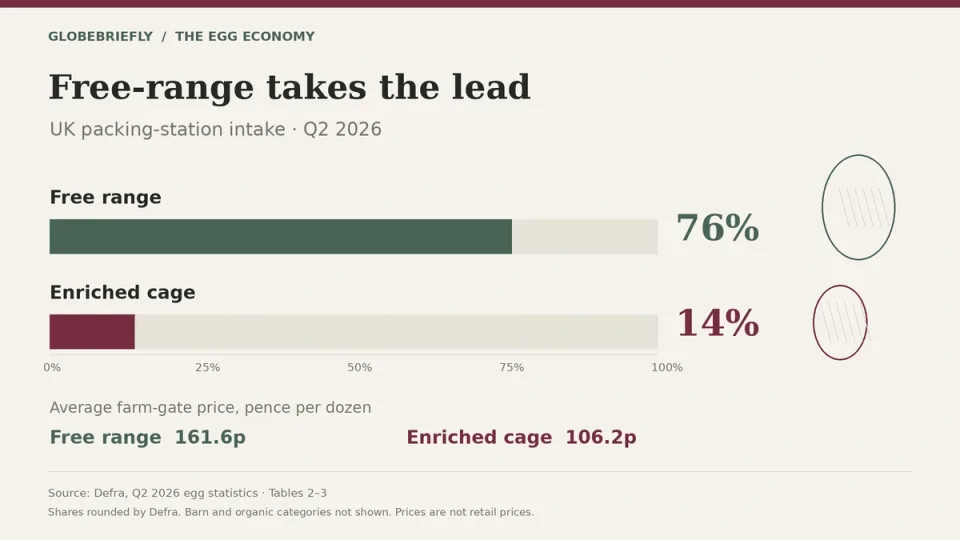
- Free-range eggs accounted for 76% of UK packing-station intake in Q2 2026, compared with 14% for enriched-cage eggs.
- The 2012 conventional-cage ban and retailers’ sourcing policies help explain the shift, but enriched cages remain a separate category.
- Free-range eggs fetched 161.6p per dozen at the farm gate, against 106.2p for enriched-cage eggs. These are producer prices, not supermarket prices.
Free-range eggs have moved well beyond parity with caged eggs. In the second quarter of 2026 they represented roughly three-quarters of UK packing-station intake, according to Defra’s Q2 2026 egg statistics, published on July 30. Law, supermarket sourcing and the prices farmers receive all matter to the market’s changing pecking order.
The law: what changed in 2012
The ban was on conventional, unenriched cages, rather than every cage system. Defra’s laying-hen welfare code records that keeping 350 or more laying hens in conventional cages has been banned in the UK since January 1, 2012. Enriched cages provide features such as nests, perches and scratching areas. Describing today’s entire caged-egg sector as tiny battery cages misses that distinction.
Changing tastes and supermarket sourcing
Retailer standards also shape which eggs reach shoppers. Marks & Spencer’s published farming standards, for example, say its free-range policy covers whole eggs, since 1997, and eggs used in prepared foods, since 2002. That is a specific company policy; it does not establish that every supermarket has eliminated caged eggs.
The production figures show a large gap. Defra’s Table 3 records 202.5 million dozen free-range eggs entering UK packing stations in Q2 2026, versus 36.3 million dozen enriched-cage eggs. Defra reports their rounded shares as 76% and 14%. This is a UK packing-station measure, including Northern Ireland, not a survey of household purchases or a measure of shoppers’ motivations.
Prices favour free-range, with an important caveat
In Table 2, the average farm-gate price was 161.6p per dozen for free-range eggs and 106.2p for enriched-cage eggs. The 55.4p difference is about a 52% premium, calculated from those figures. A higher selling price can encourage production, but it is not the same as a higher profit: the comparison does not measure each system’s costs.
Organic eggs are reported separately. Their packing-station intake was 9.9 million dozen in Q2 2026, compared with 9.8 million a year earlier. The bulletin withholds organic farm-gate prices as confidential. It therefore does not support the earlier claim that organic sales were falling or establish a current organic retail-price premium.
For another look at how shifts in food demand interact with production capacity, read our report on food trends and supply chains.
Correction and update, October 1, 2026: Replaced outdated parity and “third quarter of this year” claims with Q2 2026 figures, clarified farm-gate prices and the scope of the cage ban, and replaced the earlier images with an original sourced chart. Original publication date retained.
KEEP THE CONVERSATION GOING
A good story is worth sharing.
Send this story to someone who values the bigger picture.
See more from GlobeBriefly on Google
Choose us as a preferred source in your Google preferences.