Audio
Listen to the article
Has the moment arrived at last? After four years of sanctions-defying expansion, a group of think-tank economists is predicting an end for Russia’s wartime economy. A fresh study by the Kiel Institute for the World Economy says Russia confronts “structural exhaustion”. Charles Hecker of the Royal United Services Institute believes it “is probably already in recession”. Nigel Gould-Davies of the International Institute for Strategic Studies refers to “the coming crisis in Russia’s political economy”. Even official Russian data show GDP falling 0.2% year on year in the first quarter. The evidence below points somewhere less dramatic: strained, slower and far from collapse.
- Think-tank economists warn of “structural exhaustion”, a probable recession and “the coming crisis in Russia’s political economy”.
- Yet inflation-adjusted GDP per person rose 12% between 2022 and 2025, and unemployment stays near a historic low of around 2%.
- Tax rises, rainy-day funds, captive domestic lending and, as a last resort, seized rouble deposits keep the war financed.
A wartime economy that has defied the forecasts
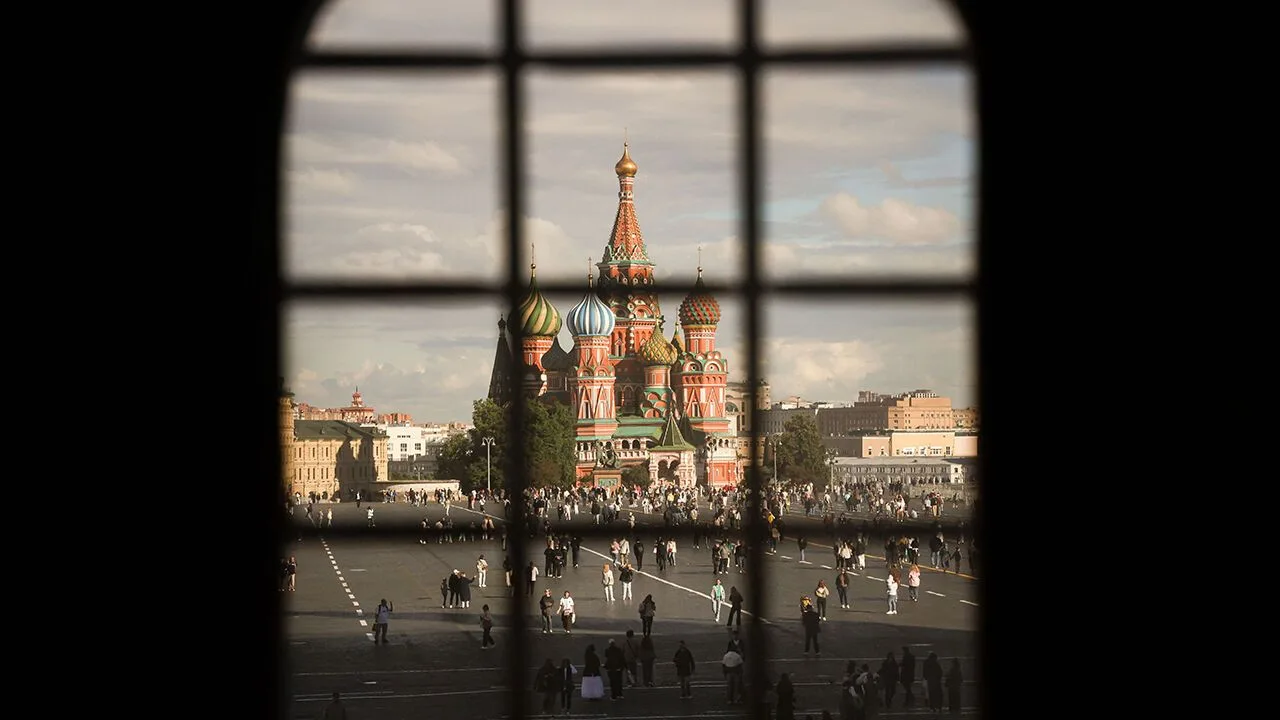
Since the 2022 invasion of Ukraine, Vladimir Putin’s Russia has shrugged off forecasts of economic disaster. It has sidestepped Western sanctions through expanded trade with countries such as China and India, while directing generous budget resources toward the military, infrastructure and welfare payments. Between 2022 and 2025 inflation-adjusted GDP per person increased by 12% — modest compared with other emerging markets, and inflated by military output that leaves households no better off, yet stronger than gloomy expectations implied.
Rise in GDP per person, 2022–25
Unemployment, near a historic low
Of GDP on the armed forces, last year
Why the official figures exaggerate the slowdown
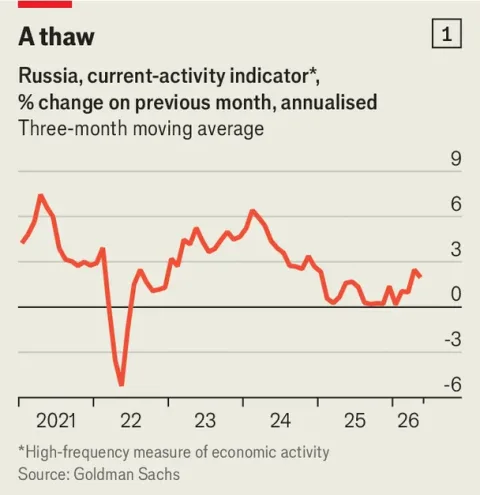
Begin with the soft official figures. They largely reflect a statistical illusion. An increase in value-added tax (VAT) in January, from 20% to 22%, prompted Russians to bring forward many purchases into late 2025, lifting growth in that quarter while depressing the following one. Early 2026 also contained fewer working days than the prior year, alongside weather that was severe even for Russia. A possibly more reliable measure of activity, compiled by Goldman Sachs, points to weak growth rather than a downturn (see chart 1). Figures from VEB, a state-run development bank, indicate GDP accelerated in March and April, helped partly by a jump in oil prices. Russia is almost certainly not in recession.
Mixed signals on confidence, jobs and exports
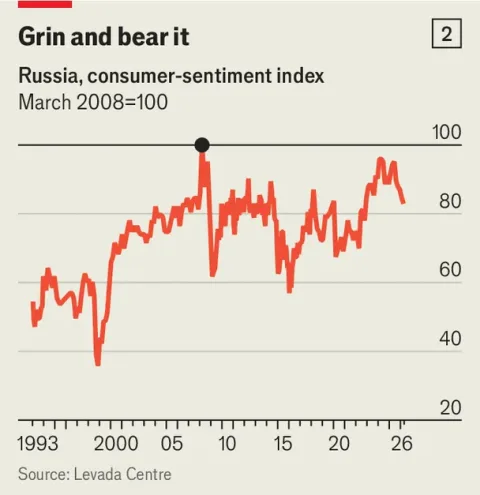
In other areas, signals are varied. Consumer confidence has declined, on a gauge monitored by the Levada Centre, an independent pollster. Yet that retreat started from nearly a record peak (see chart 2). Employment opportunities may have thinned slightly, but unemployment stays near an historic low of around 2%. Russia encounters greater trouble selling fossil fuels abroad as Ukraine intensifies strikes against its energy infrastructure, while crude prices sit below peaks reached during the Iran war. Still, total goods exports in April edged above the level of a year before, according to global commodity and market data.
Where the economy still looks strong
On several fronts the economy looks stronger. Inflation stands at half its recent high of over 10%. Real wages, already 25% above their 2019 level, continue to climb. Plenty of companies are performing well. Between January and May Aeroflot, the flag-carrier, carried passengers a cumulative 40bn kilometres, nearly 10% above the equivalent period last year. Oligarchs are faring better still. Sales of Western luxury cars brought in illicitly have risen; Lamborghini sales are up by 80% from 2025.
Why the Kremlin can still pay for the war
Much of this durability stems from large fiscal stimulus. Last year the government devoted 7-8% of GDP to the armed forces. Critics who anticipate a crisis contend such spending deprives the rest of the economy of workers and empties state coffers. Possibly. But the defence surge equals a rise of 3-4% of GDP versus the pre-war norm — significant yet insufficient to trigger vast spillover damage. The civilian economy is stagnating, not shrinking.
Meanwhile Russia’s budget troubles are not yet severe. To finance the war the government can lift taxes, as it did with VAT. It can cover the present deficit — currently some 3% of GDP — from its rainy-day funds. It can borrow from the captive domestic market. If needed, Mr Putin’s financiers can seize rouble deposits owned by corporations and households. That would be a final option carrying genuine side effects. But who would stop them?
What could still slow the war economy
Overall, Russia can anticipate GDP growth of 1% or so this year: roughly matching France or Canada. Tougher sanctions, such as those announced by Britain on June 16th, could trim that expansion somewhat. Falling oil prices would do the same if the decline persists, as would additional Ukrainian strikes on Russian oil infrastructure. Yet preventing Mr Putin’s war economy from chugging onward would require something far more drastic. ■
KEEP THE CONVERSATION GOING
A good story is worth sharing.
Send this story to someone who values the bigger picture.
See more from GlobeBriefly on Google
Choose us as a preferred source in your Google preferences.