Audio
Listen to the article
- Trump claims a Venezuela oil deal gives America “majority control” of 65bn barrels, about a fifth of Venezuela’s proven reserves.
- The US has not been gifted oil. Via the Pentagon it takes a 35% stake in the parent of North American Blue Energy Partners, with rights to buy 20% of future output at cost.
- Raising production will take years, props up an unelected leadership, and leaves contract durability in doubt if democracy returns.
Washington — Caracas
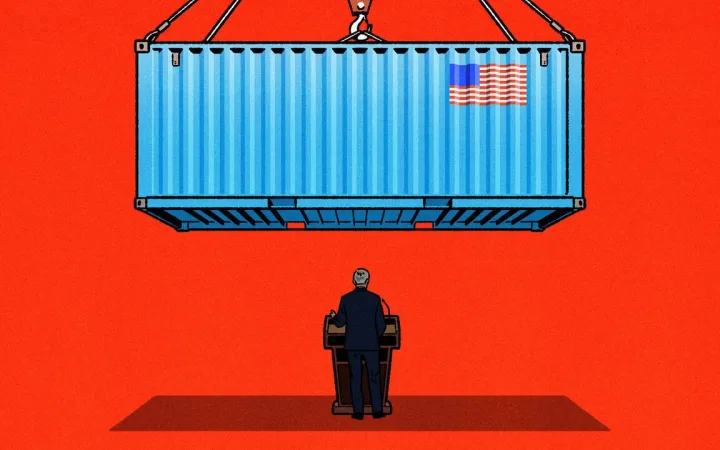
On August 28th Donald Trump unveiled what he billed as “the biggest oil deal in world history,” an agreement he said would hand America “majority control” of more than 65bn barrels of Venezuelan crude — roughly a fifth of the country’s vast proven reserves. The claim, central to Trump’s Venezuela oil deal, does not match the contract’s actual terms.
Trump lauded Delcy Rodríguez, Venezuela’s unpopular leader, as the “Highly Respected Interim President of Venezuela.” Ms Rodríguez returned the flattery, expressing her “deepest gratitude” to Donald Trump for a deal she said would bolster “our country’s economic growth.”
What the White House says the deal does
Mr Trump asserts the arrangement “more than doubles” American oil reserves. That is misleading. The United States, with its own reserves of around 46bn barrels, has not been “gifted” 65bn barrels of Venezuelan oil — as Mr Trump has claimed.
Instead, via the Pentagon, it is taking a 35% stake in the parent company of a private oil producer, North American Blue Energy Partners (NABEP). The Venezuelan government has granted NABEP concessions over 14 oilfields, plus three it already operates.
According to the White House, America will have the right to buy 20% of NABEP’s future production at cost, and will enjoy first refusal on its remaining output. It will also hold veto power over the appointment of any member of NABEP’s board of directors, the majority of whom must be US citizens.
The Trump administration says the contract will last 100 years and generate more than $200bn in royalties and tax revenue for the Venezuelan state. The Venezuelan regime counters that the deal runs for just 25 years.
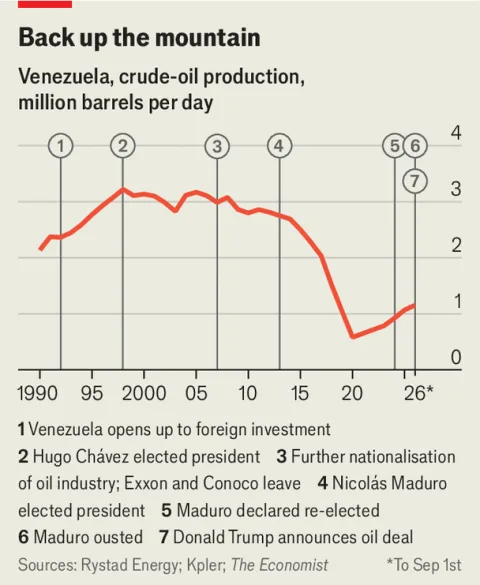
Mr Trump savours the deal’s imperialist overtones. “To the victor go the spoils,” he declared on September 1st. That referred to the raid on January 3rd by American special forces to seize Venezuelan strongman Nicolás Maduro and his wife in Caracas, Venezuela’s capital, and fly them both to the United States, where they face drug-trafficking charges. Mr Trump suggests that once the “spoils” of that action — a large chunk of Venezuela’s oil — are in American hands, it will diminish the relevance of Middle Eastern oil, lower fuel prices for American consumers, and enrich Venezuela.
Why extra barrels will not move oil prices soon
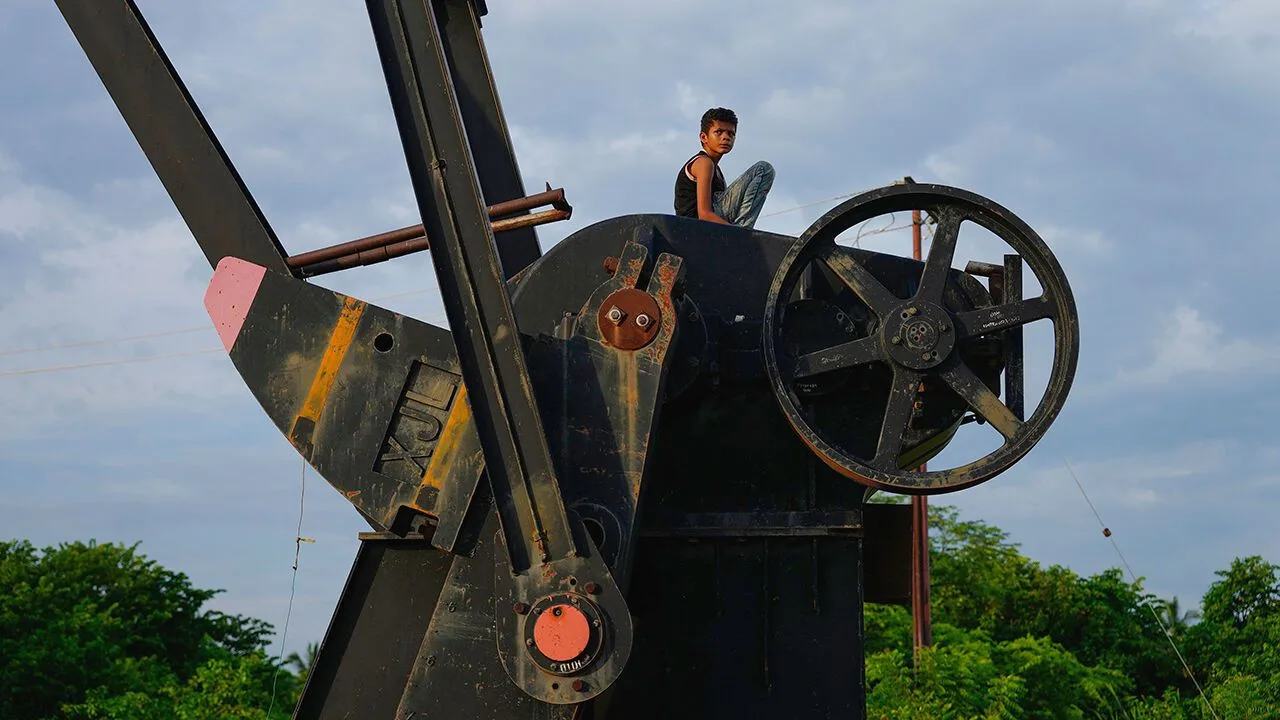
Significantly increasing production from Venezuela’s decrepit oil industry will take years. It is a rusting relic of what it once was after two decades of mismanagement and corruption under the administrations of the incompetent regime led by Mr Maduro and his predecessor, Hugo Chávez.
“Venezuela will be completely irrelevant in terms of the global oil market price for the next year or so,” says Francisco Monaldi, a Venezuelan oil expert at the Baker Institute at Rice University in Houston.
A deal with an unelected leadership
Then there is the snag that Mr Trump is striking an agreement not with Venezuela, but rather with its unelected leadership led by Ms Rodríguez, Mr Maduro’s vice-president, who has chosen to work with Mr Trump rather than suffer her ex-boss’s fate.
On the streets of Caracas the main complaint is not that the deal is a colonialist grab by the United States, but that it props up a regime which Venezuelans voted out by a thumping majority in 2024. That election, with the connivance of Mr Maduro’s cabinet, including Ms Rodríguez, was stolen. “This is all being done behind the people’s back, by people who are illegitimately in power,” says Xiomara, as she queues to fill her car with petrol.
The controversial business partner
That sense that Mr Trump is working with the latest incarnation of a rejected cabal is amplified by his choice of business partner. NABEP is controlled by Alejandro Betancourt, one of a group of Venezuelan businessmen who made fortunes on the back of lucrative contracts during the chaotic heyday of corruption under Mr Chávez.
In Venezuela his name is forever tainted by an enormous contract granted to one of his previous companies by Mr Chávez in the early 2000s, to upgrade state electricity power plants. Venezuela’s political opposition called that deal over-billed and under-fulfilled, pointing to power cuts that plague the country to this day.
Hold your nose
“Betancourt is probably the most controversial person you could do this deal with,” says a person with connections to Venezuela’s oil industry. “He’s associated with the fact that we have one of the worst electricity services in the world.” Mr Betancourt, who has been investigated in Europe for money-laundering, has consistently denied all wrongdoing and has never been convicted of a crime.
A US official calls him a man “who knows how to run this business” and pointed to his proven record in raising production in the three oilfields that his company already controls.
Who pays for a $100bn expansion
The American government insists that the deal with NABEP will involve no investment of public money. It therefore falls to the company itself to raise the $100bn it says is needed to quintuple its oil production to one million barrels a day. The fact that the US government has a stake in the firm, it is hoped, will give potential investors the security to commit.
The Trump administration is meanwhile pushing hard on many fronts the notion that Venezuela is ripe for investment. On September 2nd Mr Trump’s energy secretary, Chris Wright, was in Caracas for an announcement that Chevron, the only oil major to have remained in the country throughout the turmoil of the past quarter of a century, plans to invest $7bn in the next five years, in a deal separate from the NABEP one. But no other international oil company has made a similar commitment. Several have unhappy memories of Venezuela, losing billions when their previous joint-venture contracts were rewritten under the Chávez government in 2007.
Another source of their hesitation may be the question-mark still hanging over the durability of contracts. If a future democratic government comes to power, will it honour agreements forged under pressure with a government widely deemed illegitimate? “It will be a fiasco for all involved,” said Ricardo Hausmann, a former Venezuelan planning minister.
A shared incentive to stall democracy?
That in turn leads to a further troubling prospect. Both the Trump administration and the Rodríguez regime perhaps now share an incentive to stall democracy, given the risk it presents to their mutually cosy arrangement. “As the deal takes shape, the opposition’s role and influence could increasingly fade,” says Imdat Oner, a Turkish former diplomat who served in Caracas.
Already, the Trump team has strongly discouraged the popular opposition leader, María Corina Machado, who left Venezuela to travel to Norway to collect the Nobel peace prize last year, from returning home. She has remained conspicuously silent about the deal.
The American official roundly rejects this, insisting that the Trump administration is rescuing Venezuela’s economy in advance of a future election. The plan is for the next government to inherit a country with a solid economic foundation, not one in crisis, so as to be better able to move beyond the catastrophe of the past 25 years. “A stable democracy, a stable republic, that can conduct elections on a repeated basis,” says the official.
Maybe. It was a Venezuelan energy minister who, in 1975, described oil as “the devil’s excrement.” Perhaps no deal involving the black stuff — let alone any nation-building — was ever going to be clean. ■
Sign up to El Boletín, our subscriber-only newsletter on Latin America, to understand the forces shaping a fascinating and complex region.
KEEP THE CONVERSATION GOING
A good story is worth sharing.
Send this story to someone who values the bigger picture.
See more from GlobeBriefly on Google
Choose us as a preferred source in your Google preferences.