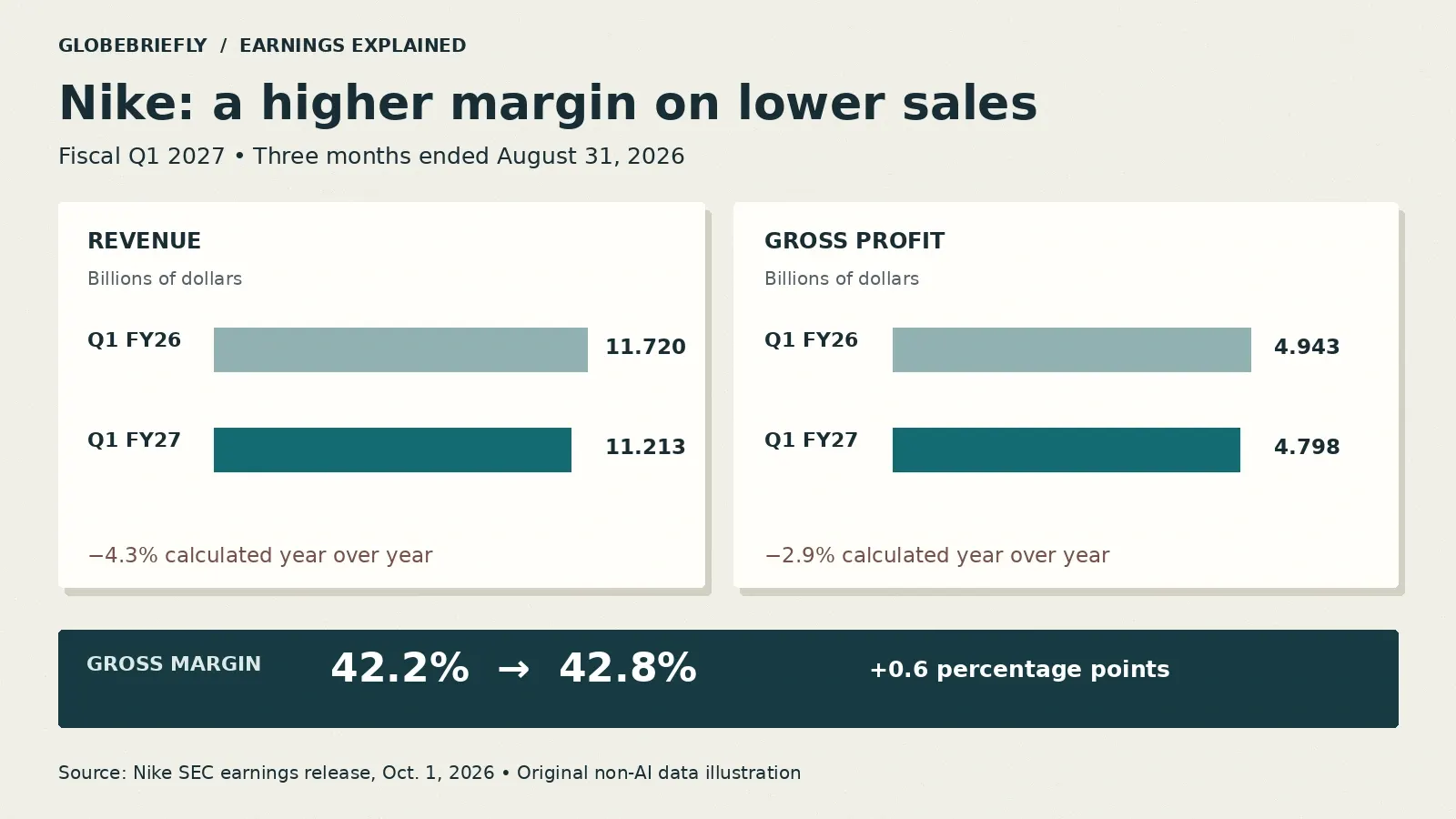
Nike reported fiscal first-quarter 2027 revenue of $11.213 billion and diluted earnings of $0.48 a share on October 1, 2026. Sales fell while the gross-margin rate improved. That combination explains why the report offers evidence of better cost efficiency without yet showing a return to revenue growth. The quarter ended August 31, 2026. Nike’s earnings release and financial tables
The numbers that matter
- Revenue: $11.213 billion, down 4% as reported and 5% excluding currency effects
- Gross margin: 42.8%, up from 42.2% a year earlier
- Net income: $712 million, compared with $727 million
- Diluted earnings per share: $0.48, compared with $0.49
Why a higher margin still produced less gross profit
Gross margin measures the share of revenue left after the cost of sales. Nike’s 60-basis-point improvement means an increase of 0.6 percentage points. The company attributed it primarily to lower warehousing and logistics costs.
But the sales base shrank. Revenue fell $507 million, or 4.3%, while gross profit fell $145 million, or 2.9%, to $4.798 billion. Those percentages are GlobeBriefly calculations from the release’s dollar figures; Nike rounds them to declines of 4% and 3%. The company kept more gross profit per dollar of sales, but generated fewer gross-profit dollars overall. Source: consolidated income statement
Where sales remained under pressure
Within the Nike Brand, Direct revenue fell 8% as reported to $4.142 billion, while wholesale revenue slipped 1% to $6.804 billion. Direct includes Nike’s own stores and digital sales. Greater China revenue dropped 22% as reported, or 26% excluding currency effects, to $1.180 billion. North America grew 2% to $5.127 billion. These are Nike Brand channel and regional measures, rather than the whole company’s revenue. Source: channel and divisional revenue tables
What the Pace savings target actually covers
Nike also announced Pace, a restructuring program covering supply-chain modernization, a new India campus, a move to three geographies and organizational streamlining. Nike expects about $2.5 billion in cumulative savings through fiscal 2031, before expected charges and any future reinvestment. It is a multi-year estimate, not a recurring annual earnings figure.
The company expects about $1 billion in pre-tax charges through fiscal 2031, including about $300 million in fiscal 2027. That is in addition to roughly $300 million of severance costs already recognized in fiscal 2026. Nike cautions that actual savings and costs may differ materially from its estimates. Source: Pace program disclosure
How to read the full-year outlook
Nike expects fiscal 2027 revenue to decline by a high-single-digit percentage. Its full-year adjusted diluted EPS guidance is $1.15–$1.35, excluding approximately $0.15 of Pace restructuring expenses. That forecast is a non-GAAP measure for the full year; the $0.48 reported above is GAAP diluted EPS for one quarter. Keeping the period and accounting basis clear prevents a misleading comparison. Source: outlook and non-GAAP explanation
The next useful test is whether sales stabilize while Nike maintains the margin improvement. Separately, our October 2 US jobs report guide explains the next broad employment release, useful economic context rather than a measure of demand for Nike products.
KEEP THE CONVERSATION GOING
A good story is worth sharing.
Send this story to someone who values the bigger picture.
See more from GlobeBriefly on Google
Choose us as a preferred source in your Google preferences.