Audio
Listen to the article
Euro-area bond yields are climbing again as traders return from summer breaks. Anyone buying sovereign debt in the euro area confronts 21 national borrowers to assess alongside bonds issued by the EU itself, thin August trading, and a familiar seasonal lift — the yield on the ten-year German Bund, the region’s reference asset, has a habit of climbing about 0.15 percentage points once August ends. This year the move came early and spread well beyond Germany.
- Global sovereign yields have leapt as investors dump government paper; euro-area yields are rising too, though still below 2008 peaks.
- Three strains drive Europe’s climb: energy-driven inflation from the Iran war, strained budgets in Germany and France, and a global battle for long-term capital.
- Heavy supply, a shrinking ECB portfolio and shifting demand from pensions to hedge funds mean relief looks distant.

Yields leap worldwide and Europe is caught up
Sovereign-debt markets around the world have turned feverish in recent weeks (see chart 1). Yields have leapt almost universally as holders have dumped government paper — prices drop when yields climb — alarmed by upside risks to inflation, doubts over economic expansion and no willingness to tighten belts.
Japan 10-year yield on Sept 1 — first time in 30 years
US 30-year Treasury — just below 19-year peak in mid-August
UK 30-year gilt — weakest since 1998
On September 1st the yield on Japan’s ten-year debt touched 3% for the first time in 30 years. American 30-year Treasuries sit only a little below the 19-year peak of 5.31% set in mid-August. Comparable British gilts, now yielding 5.9%, have not traded this weakly since 1998.
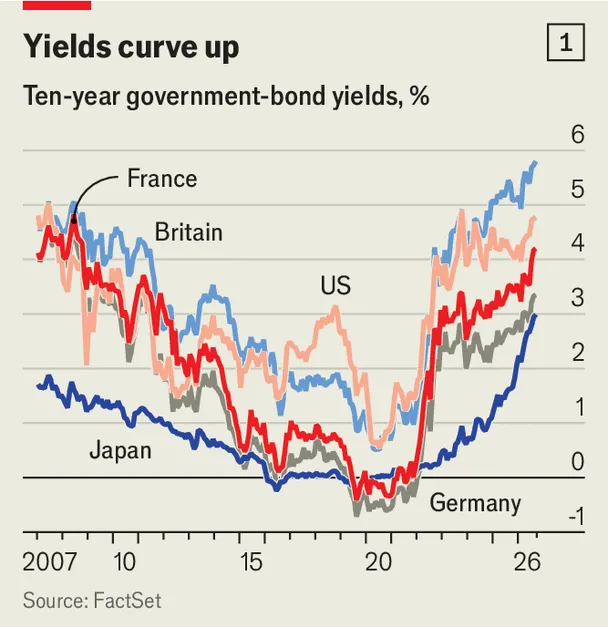
Europe has not yet reached such extremes. Yields on ten- and 30-year Bunds remain well under their 2008 crest. Matching French maturities are also no loftier than in that episode. Even so, governments issuing in Europe wrestle with distinct strains of their own.
Three strains pushing euro-area yields higher
1. Energy-driven inflation the ECB cannot easily tame
Unlike in America, where faster price growth mainly stems from buoyant internal spending, Europe’s pressure comes from supply, beyond the reach of rate-setters: the energy jolt delivered by the Iran war. Traders now anticipate the European Central Bank lifting its policy rate to 2.9% by mid-2027, against 2% before America and Israel struck Iran in late February.
When inflation danger is elevated and originates in supply, holders insist on greater reward for owning debt far into the future. Partly that reflects a required cushion against unpredictable price moves. Partly it reflects that, during a supply shock, equities and bonds often slump in tandem instead of offsetting one another. That weakens bonds as a hedge inside a mixed portfolio, so yields have to increase to attract purchasers.
2. Strained public finances in Germany and France
Germany’s fresh enthusiasm for borrowing to invest plus France’s chronic largesse have lifted borrowing costs since 2025. That, in turn, has swollen the bill for servicing liabilities.
Fitch, a credit-rating agency, estimates France will devote 6% of state income to coupon payments in 2028, versus 3% in 2019. For Italy the ratio will rise from 7% to 8.8% over the same span.
Since the tax burden in Europe is far larger relative to GDP than in America, pushing levies still higher to close budget shortfalls is difficult. Reducing outlays is politically toxic, above all with populist challengers gaining ground across the continent.
3. Global competition for capital and duration risk
Apart from inflation, upward pressure on yields reflects expansion and capital spending beyond Europe, diverting funds elsewhere. The US economy is powering ahead, aided by construction of artificial-intelligence infrastructure. The big technology groups driving that boom are forecast to lay out over $5trn on AI data centres between 2025 and 2030. Comparable outlays in Europe are minuscule. Although profitability is ebbing partly through too little investment, European companies remain net savers (see chart 2).
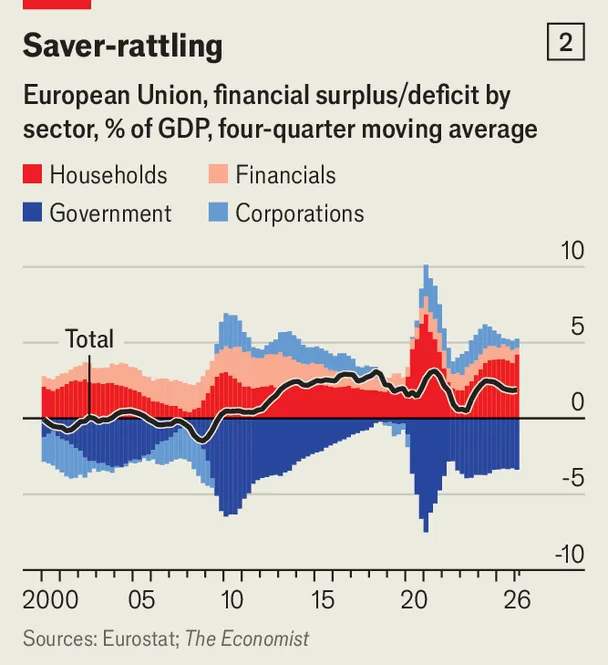
Yet although European firms stand apart from the AI contest, Europe’s sovereign borrowers still feel its pull. The American tech giants are marketing their own long-maturity bonds to pay for the splurge — $250bn this year and $400bn in 2027, calculates Goldman Sachs, a bank. Such wealthy corporate sellers carry credit standing on par with states, hence they vie with governments for buyers’ cash. They account for almost a tenth of euro-denominated corporate-bond issuance this year, according to the ECB.
Greater worldwide borrowing means an abundance of long-dated paper. That obliges investors to take on additional “duration risk” — how much a bond’s price shifts when interest rates shift. Supply in Europe is larger still because the ECB is shrinking its portfolio, down by €1.2trn since 2022 and falling further.
Meanwhile appetite among major holders is cooling. Pension funds that loaded up on long maturities to back defined-benefit retirement schemes are migrating toward defined-contribution plans that chase higher gains through racier holdings such as equities. Newcomers filling the gap, like hedge funds, bargain much tougher.
Reduction in the ECB’s bond portfolio since 2022 — adding to supply of long-dated paper that investors must absorb.
Why relief looks distant
“We are in a new global macro regime.”
Freya Beamish · TS Lombard, a research firm
That assessment sums up the market mood. With energy-driven inflation expectations, heavier sovereign funding needs and intense competition from US corporate borrowers all pushing in the same direction, investors see little reason to expect yields to retreat soon. As Beamish puts it, debtors should simply adjust to the reality.
For more expert analysis of the biggest stories in economics, finance and markets, sign up to Money Talks, our weekly subscriber-only newsletter.
Sources
Market data and charts: The Economist; Japanese, US and UK sovereign yields as of early September; Fitch ratings estimates for France and Italy debt servicing (2028 vs 2019); ECB on euro-denominated corporate-bond issuance and portfolio runoff; Goldman Sachs estimates for US tech AI bond issuance.
Audio: The Economist — Finance and economics: Bond yields.
KEEP THE CONVERSATION GOING
A good story is worth sharing.
Send this story to someone who values the bigger picture.
See more from GlobeBriefly on Google
Choose us as a preferred source in your Google preferences.