Audio
Listen to the article
Photograph: Getty Images
Miami
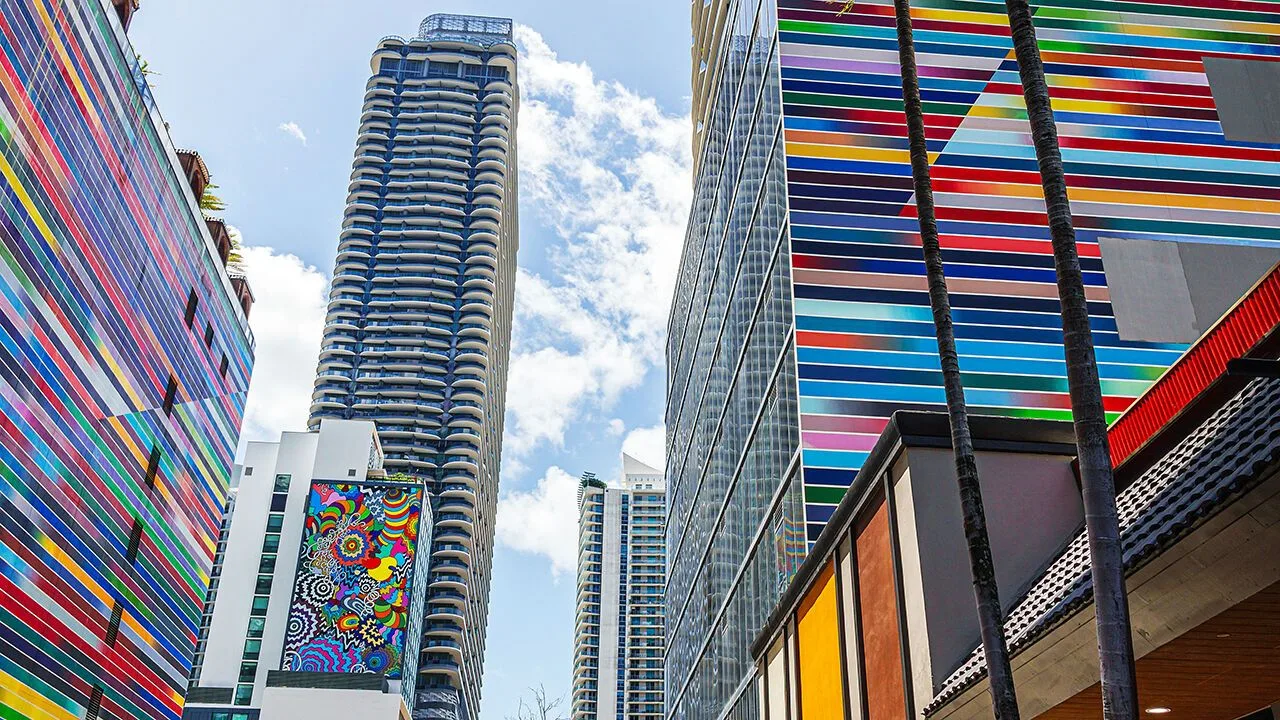
On a Friday evening in Miami, a high-end broker steps out of an upscale bar beside a tower to toast a $50m home sale to an anonymous buyer. Upstairs at 830 Brickell — where the base looks slightly worn but the upper floors command some of America’s priciest office rents — tenants include Citadel, a Peter Thiel family-office investment vehicle and two elite law firms. Both scenes capture a city awash in money and political gravity, and the question of how long it can stay that way.
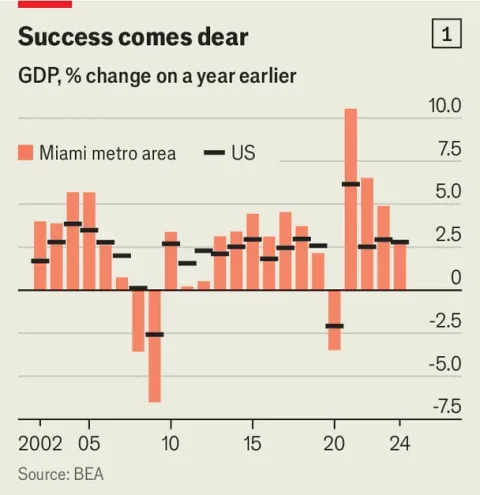
- Metropolitan Miami GDP rose 23% from 2020 to 2024, versus 13% nationally, lifting the central Miami economy from about one-quarter to one-half the size of Manhattan’s.
- Three waves fuelled the surge: Gulf and Latin American capital, domestic firms and high earners seeking lower taxes, and Donald Trump’s Mar-a-Lago-centred political orbit.
- The boom now faces three tests — living costs that push out non-wealthy workers, thin research and graduate talent, and severe hurricane and flood exposure.
How Miami pulled ahead of America
From 2020 to 2024, the latest year with data, metropolitan GDP expanded 23%, compared with 13% nationally. Wealthy newcomers include Citadel chief Ken Griffin, Amazon and Blue Origin founder Jeff Bezos — the space company that builds and launches rockets in Florida — and Meta boss Mark Zuckerberg. The engine is political as well as economic: Donald Trump now spends more time in the vicinity than anywhere except Washington, DC, chiefly at Mar-a-Lago. Palm Beach has become a meeting point for officials and diplomats.
“Fifteen years ago,” the estate agent says, “the only people who thought it was smart to be rich here were Cubans, DJs and golfers.” That is an overstatement: Miami was already a regional centre. Yet its economy leaned on proximity to Latin America and a sometimes flashy nightlife sector. Central Miami’s economy measured about one-quarter of Manhattan’s. That proportion has reached one-half and keeps climbing.
Miami metro GDP growth 2020-2024 vs America
Homes sold for $50m+ in 2025 (0 in 2020)
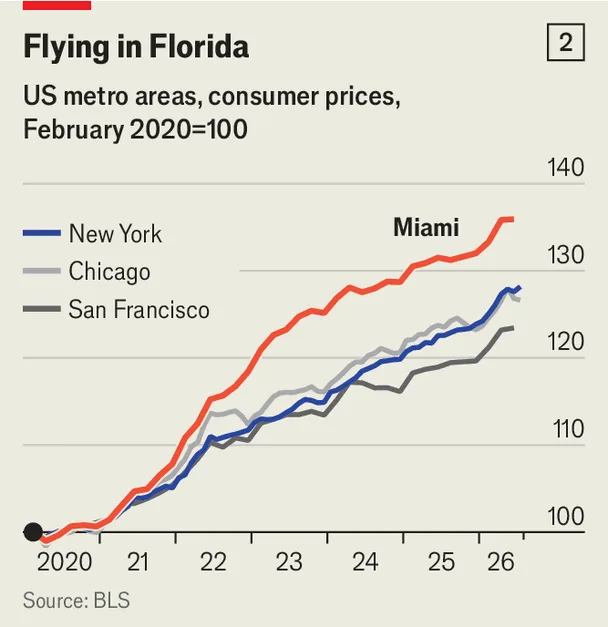
Miami consumer prices since early 2020 vs 28% nationally
No Miami home sold for $50m in 2020. In 2025, 17 did, close to half the American total. Many relocating billionaires and companies say they came because they expect the city soon to rank alongside New York, Chicago and San Francisco among the largest US economies. Whether the surge proves durable remains open to debate. For the moment it rides a potent blend of financial and political clout.
Three waves that washed over South Florida
1. Overseas capital
The first surge carried foreign money. Francis Suarez, Miami’s Republican mayor until 2025, toured globally seeking investors, winning particular traction in the Persian Gulf. Hotels fill with hedge-fund managers, traders and advisers from that region. Several have relocated permanently since Mr Trump’s war on Iran began. Saudi Arabia has opened an office; Gulf states have backed ventures spanning hotels to crypto exchanges. Meanwhile additional Latin American investors arrived after several right-wing governments there eased capital controls.
2. Domestic tax and policy migrants
A larger surge has arrived domestically: individuals and firms frustrated by steep taxes and progressive policies elsewhere. Florida imposes no state income tax; New York City’s top earners pay 14.8%. Levies on the costliest houses sit below 1%. Affluent Americans long came to Florida for leisure, whether all-night clubs or upscale retirement communities. Recently many have stayed. People earning a combined roughly $40bn yearly relocated there in 2025, Internal Revenue Service figures show.
For businesses, different tiers of Florida government provide tax relief and inducements, including breaks for employers paying above the statewide average wage. Miami officials court companies aggressively. When Mr Griffin started criticising crime and taxes in Chicago, Citadel’s former base, Mr Suarez called to pitch a southern move. At least 150 financial firms have shifted, including Wells Fargo’s private-wealth operation, a giant bank, and fellow investment houses such as Elliott Management. Technology is strongly present too. Palantir, a controversial AI-analytics company holding many government contracts, relocated from left-leaning Denver in 2026. Newcomers from San Francisco include three Mr Thiel-linked firms.
3. Mar-a-Lago as a political command post
The third surge has been driven by south Florida’s best-known wealthy newcomer. Mr Trump has made the area a political command post. From October to March he spent one-quarter of his time there. Several Floridians sit in his inner circle, among them chief of staff Susie Wiles; attorney-general Todd Blanche; and secretary of state Marco Rubio. A Ms Wiles staffer says he spent lots of time at Mar-a-Lago in his first term, “but we’re making a lot more of the real decisions from Florida this time around.”
At Mar-a-Lago Mr Trump received foreign leaders, and chose to blockade Cuba’s oil supplies and to capture Venezuela’s dictator Nicolás Maduro. His team met CEOs there ahead of the spring federal budget and health-care providers before the president changed Medicare (a scheme for the elderly) in July. “Look,” says one official, “in the president’s view, a lot of the smartest people in the country are already members at Mar-a-Lago.”
With politics moving south, cash has trailed it. Ballard Partners, America’s largest lobbying firm (founded in Florida), now operates its biggest office in Palm Beach. Numerous foreign governments have dispatched additional officials. “Our border guard and defence ministry”, says one consul-general, “need to be able to reach Palm Beach.” Officials from three European countries say their Miami consulates employ more people than those in New York.
Where the boom shows up
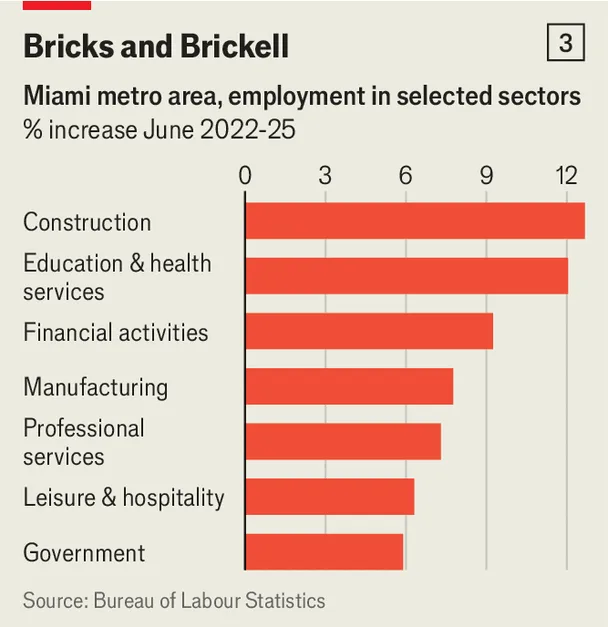
Real estate is thriving. In 2025 it represented 18% of Miami’s economy, up from 14% in 2014. Construction employment is up 12% since the pandemic. Mr Griffin is investing about $2bn in a fresh 54-storey tower.
Finance is flourishing as well: survey evidence suggests back-office employment has climbed 20% since 2019, aided by Wall Street arrivals. Corporate services such as law and consulting have gained two percentage points of local GDP share.
Hospitality, the traditional pillar, is also prospering. It provides a tenth of metropolitan Miami’s jobs, among the highest proportions nationwide. Miami alone fields a franchise in each of America’s four major sports leagues, hosts a premier motor race and stages a leading tennis event, the Miami Open. Of four business-conference addresses Mr Trump delivered in 2025, two were in Miami. “We’ve always been spectacular,” says an entertainment agent at Faena, a luxury hotel, “but the new guys give us exclusivity.”
Three barriers to lasting growth
Will Miami’s boom mature into durable growth, or simply fade? Thriving cities depend on network effects: in finance, tech or lobbying, companies cluster where clients and skilled staff are assured; workers go where desired jobs exist. For Miami to advance, it must clear three barriers.
1. Costs that push out non-wealthy workers
Wealth inflows have driven living costs to extraordinary levels. The Bureau of Economic Analysis, a government agency, reports residential rents exceed the national average and even surpass New York. Consumer prices have climbed nearly 40% since early 2020, versus 28% across America. As high-end food stores proliferate, cheaper retailers have been displaced. Elevated costs are pushing the poorest out. Millionaire numbers have almost doubled since 2014; yet between July 2024 and July 2025 Miami’s population fell by 10,000. Low-income districts, home to hospitality workers, are hollowing quickest.
2. Thin intellectual capital
New York, Seattle and San Francisco function as knowledge economies, pulling in masses of skilled talent and funding to exploit it. Despite recent gains in brains and money, Miami lags far behind rivals. Companies and universities in Florida, which holds the fourth-largest economy among America’s states, spent only $13bn on research in 2023, below every other top-ten state. Florida has fewer graduates, relative to population, than the national average. Most money invested by Miami’s newly enriched venture capitalists still backs San Francisco startups.
Mr Griffin pledges that many more staff will be based in Miami by 2031. Currently 400 work there, although most are not advising on investments. Excluding back-office positions, finance accounts for no greater slice of Miami’s economy than ten years ago. The city’s financial sector, largest among its white-collar industries, stands at just one-eighth of New York’s size.
3. Climate and insurance exposure
South Florida, situated on a low-lying peninsula, faces severe weather. An AccuWeather meteorologist, a forecasting company, has said that no American city is more likely to be damaged by hurricanes. In August another scholarly paper, in Scientific Reports, predicted that if global temperatures exceed 1.5°C above pre-industrial levels, storms will flood Miami regularly. Florida already ranks as the costliest state for insurance on mortgaged homes.
Hurricane and flood risk is a core economic variable for South Florida. Even with strong demand, insurance costs and physical exposure shape hiring, construction and long-term relocation decisions.
Can momentum become an enduring economy?
Still, Miami’s momentum is undeniable. An optimistic local politician believes that, like the Gulf before the Iran war, it can become a place where the world does business and parks wealth. A year ago Mr Trump hosted 33 of America’s leading business figures for dinner at Mar-a-Lago. At least half the guests (including Mr Trump and Ms Wiles, and their spouses) owned Florida property.
Mr Trump’s term ends in 2029 and Florida’s political draw may then weaken. Perhaps the city can keep thriving by continuing to lure the wealthy. Or perhaps it requires more — deeper talent pools, broader industry depth and resilience to heat, storms and cost pressures that the past five years have not yet solved.
For more expert analysis of the biggest stories in economics, finance and markets, sign up to Money Talks, our weekly subscriber-only newsletter.
Sources
Bureau of Economic Analysis for metro GDP and rents; Internal Revenue Service migration data for 2025 income moves; Scientific Reports, August paper on flooding above 1.5°C warming; AccuWeather on hurricane risk.
Photography: Getty Images. Audio via source file. Charts 1–3 as captioned.
KEEP THE CONVERSATION GOING
A good story is worth sharing.
Send this story to someone who values the bigger picture.
See more from GlobeBriefly on Google
Choose us as a preferred source in your Google preferences.