Audio
Listen to the article
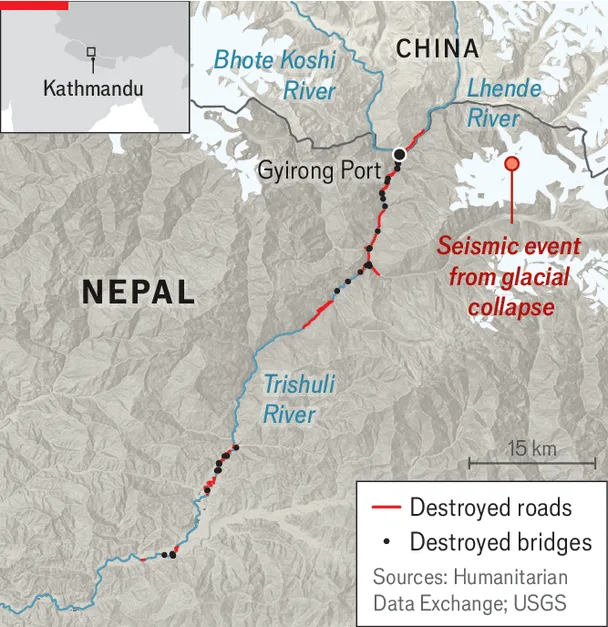
Seven days after the disaster, the scale of what slammed into the Himalayas on August 26th remained difficult to assess. Its trigger, though, can be timed with unusual accuracy: at 8.37am a disintegrating glacier and an ice-and-rock avalanche thundered down and blocked the Lhende river on the Nepal-Tibet frontier. Within three minutes that barrier failed, sending a torrent of water, stone, silt and ice down Nepal’s Bhote Koshi and Trishuli rivers through Rasuwa.
- Confirmed fatalities had topped 1,000 seven days on, with more than 4,000 people still unaccounted for.
- Roughly 80 bridges and 40km of roadway were obliterated, and damage to 14 hydroelectric facilities erased 10% of Nepal’s electricity output.
- Nepal’s area is warming faster than the planet overall, with glaciers thawing at double their 2000 pace.
A wall of water, and minutes to escape
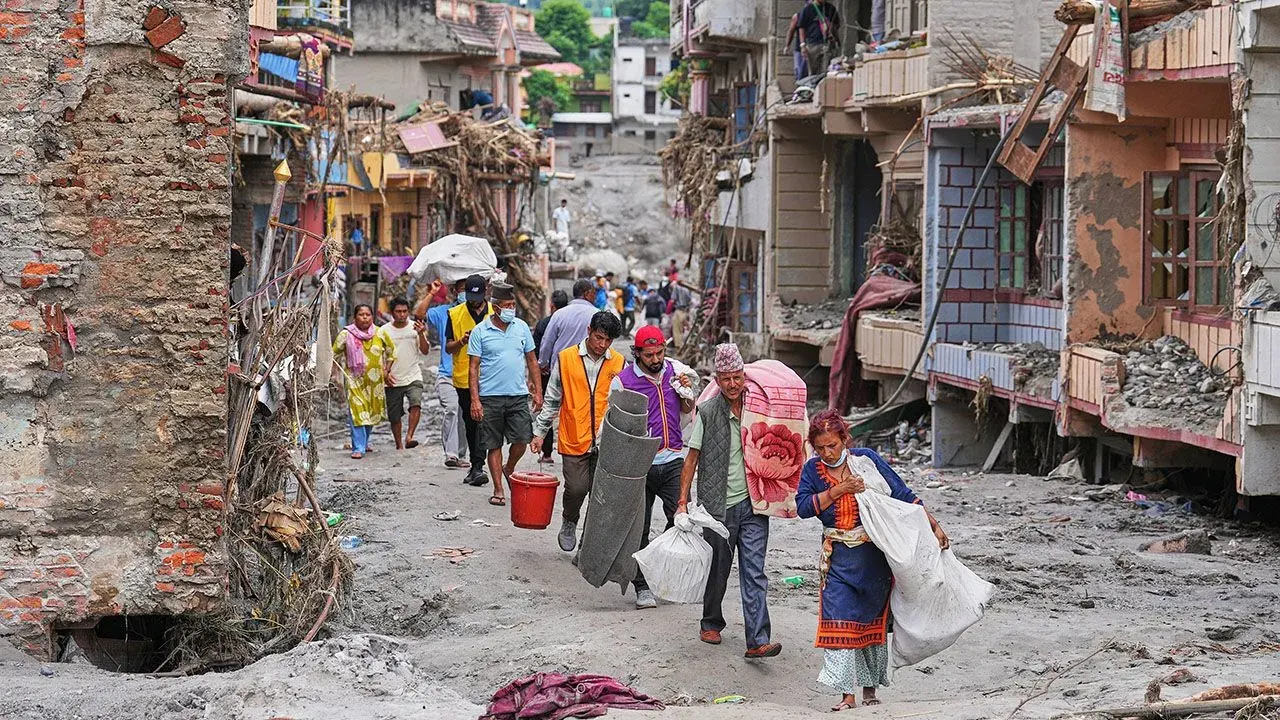
Shibu Giri watched the surge flatten a whole bridge. Moments before it hurled his truck aside, he sprinted toward the woods. After a night sheltering in a cavern, an army helicopter airlifted him out the following day. Others fared far worse: entire settlements were engulfed by the sudden flooding.
Seven days later, fatalities confirmed had topped 1,000 while over 4,000 people remained unaccounted for. The toll encompassed some hundreds of foreign nationals, including coachloads of Hindu devotees travelling toward Kailash, a sacred peak in Tibet.
Roughly 80 bridges plus 40km of roadway had been obliterated. Damage to 14 hydroelectric facilities, partly still being built, erased 10% of Nepal’s electricity output.
Where two continents collide
Nepal lies at the collision zone of the Indian and Eurasian tectonic plates, where warm monsoon air confronts frigid Himalayan winds and unstable hillsides. That convergence ranks it among Earth’s most hazard-exposed countries. Its area is warming more rapidly than the planet overall, with glaciers thawing at double their 2000 pace. Additional glacier failures and further bursting of lakes therefore look probable in coming years.
Aid is shrinking as the bill arrives
Among the poorest states globally, Nepal appears alarmingly unready to handle the catastrophes that shift implies. Prime minister Balendra Shah, a 36-year-old ex-rapper, has held office for just six months, after Nepalese youth torched parliament twelve months earlier and ousted the former leadership. His administration may need up to $5bn for rebuilding, just as richer countries once counted on for assistance are slashing overseas-aid spending.
is what America has promised in aid — under 3% of what it gave Nepal after the catastrophic 2015 earthquake.
The United Nations’ climate fund does not have enough cash to fulfil even current appeals from lower-income states. Beyond constraining urgent humanitarian relief, the funding gap wrecks ambitions to reconstruct more robustly, through spending on climate-proof highways, crossings and settlements.
Glaciers without gauges
At the same time, Himalayan governments remain too miserly and mutually distrustful to steward their common landscape together. The Hindu Kush-Himalaya holds over 63,700 glaciers yet just 38 monitoring stations — merely seven of them up to worldwide benchmarks.
Glaciers in the Hindu Kush-Himalaya
Monitoring stations
Of them up to worldwide benchmarks
Pema Gyamtsho, who leads the International Centre for Integrated Mountain Development, a Kathmandu-based research and policy body, says Nepal must depend on better-resourced neighbours to furnish the area with improved sensors and gauges plus live exchange of data. Yet China generally regards hydrological-flow figures as a national-security secret, threatening to leave downstream neighbours caught unaware.
What money and data cannot fix
No alert network might have bought Nepal sufficient lead time against flooding this abrupt and violent. But enduring the ruin its mountains and rivers will inflict in future years will demand greater finance and fuller transparency across borders.
For exclusive coverage of Asian politics, economics and security, sign up to Asia Bulletin, our weekly subscriber-only newsletter.
KEEP THE CONVERSATION GOING
A good story is worth sharing.
Send this story to someone who values the bigger picture.
See more from GlobeBriefly on Google
Choose us as a preferred source in your Google preferences.