Audio
Listen to the article
Odesa
Russian strikes on Ukraine’s grain ports around Odesa are happening almost every day, threatening to trap a bumper harvest. A guard at an Odesa port depot gestures to a blackened patch of grass where a rocket hit seven days earlier, then sirens wail, the ground trembles, anti-aircraft fire cracks and an interceptor drone shrieks overhead.
- 90% of Ukraine’s grains and oilseeds move via Odesa, Chornomorsk and Pivdenne, now under sustained missile and drone attack from Crimea.
- At least 56 attacks this month have killed 26 port workers and sailors, halted terminals and diverted major shippers to Romania.
- A projected 81m-tonne harvest, farm exports worth nearly 60% of Ukraine’s exports, and a shrinking rural workforce leave the crop with nowhere to go.
Tonnes: projected grains and oilseeds harvest
Attacks on ports this month
Port workers and sailors killed
Why three ports carry 90% of Ukraine’s grain
In recent weeks Moscow has intensified strikes against Ukrainian harbours, endangering farm shipments with potentially severe effects. A full 90% of Ukrainian grains and oilseeds move via Odesa plus neighbouring Chornomorsk and Pivdenne. Launched from Crimea, Russian missiles and drones are striking port infrastructure and vessels.
At least 56 attacks have occurred this month, leaving 26 port workers and sailors dead. Several terminals have halted work, among them a Chornomorsk sunflower-oil facility torched on July 14th.
Daily bombardment and thinning defences
Ukrainian forces are doing all they can. Commander Dmytro Pletenchuk says certain air defences have shifted offshore, with patrol boats fitted with heavy machineguns. He reports that a naval helicopter recently shot down seven Shahed drones in one sortie. Yet Russia is overwhelming them through sheer volume.
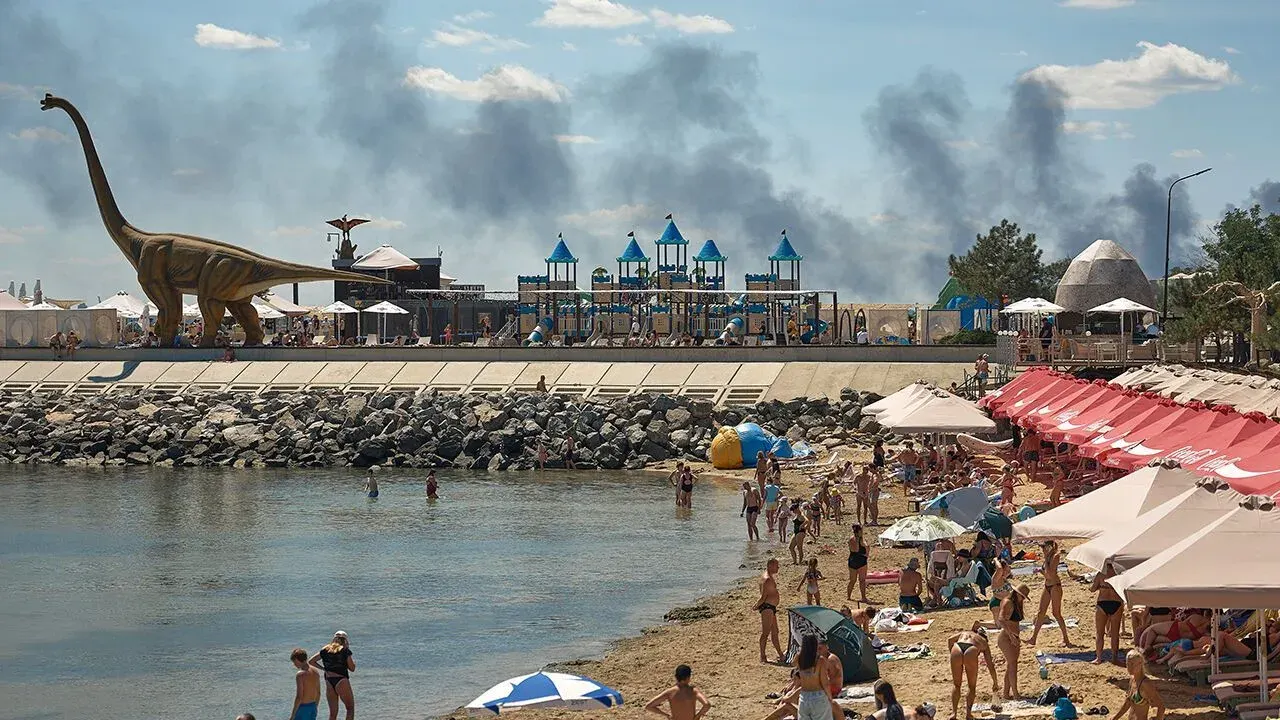
On July 19th the Golden Leo, a Turkish-owned grain carrier, suffered cruise-missile hits in view of sunbathers on Odesa’s beaches. Ten sailors were killed.
On July 29th VesselFinder, a tracking service, recorded zero arrivals at the ports during the prior 24 hours, although vessels switching off transponders escape its notice.
Shippers divert to Romania as insurance costs soar
Danish shipping giant Maersk declared on July 22nd that its ships would discharge at Constanta, in Romania, instead of Chornomorsk.
Oleksiy Smolyar, director of an Odesa-based maritime-services company, notes major carriers have steered clear of Ukraine since spring: war-risk insurance costs combined with possible forfeited business exceed port fees. Opportunistic Middle Eastern operators have filled the void, having acquired their first vessels — “maybe not so new and not in such good condition” — when Russia began its full-scale invasion four years ago.
His firm, Trident Maritime, now focuses on inspection work for the “convenience states” — Guinea-Bissau, Togo and similar registries — whose flags the newcomers fly.
A record harvest with nowhere to go
Bombardment is striking as Ukraine gathers a crop projected at 81m tonnes of grains and oilseeds, versus 80m tonnes last year. Farm products account for nearly 60% of Ukraine’s total exports.
If attacks double or triple, it’ll really be a challenge.
Taras Vysotsky · Agriculture minister, on shipments that fell by a quarter in May and June
Agriculture minister Taras Vysotsky cautions shipments fell by a quarter in May and June, adding that if attacks double or triple it will be a major challenge.
Farms under fire: workers hunted, machines wrecked
His ministry counts agricultural labourers killed by Russian first-person-view drones. “Every week we hear that three, four, five farmers have been killed,” says Mr Vysotsky. “It’s obvious that they deliberately hunt people.” Machinery is also under assault: 820 items of equipment, ranging from harrows to irrigation systems, have been wrecked this year.
In the fields: full silos and a missing workforce
A two-hour drive north of Odesa, Anatoliy Artemenko surveys a field scattered with round bales. Farming 2,000 hectares, he cultivates rice and amaranth alongside wheat and maize. He expects a bumper harvest this season. His difficulty lies in disposing of it. Without exports there are no purchasers, while his storehouses sit almost full of unsold output, though more than half the crop remains unharvested.
Manpower is his other major difficulty. Mobilisation regulations let firms classed as vital to the war effort exempt up to half their staff. Yet deferments require renewal each six months, with eligibility standards tightening.
“A lot of men, when they realise that I can’t reserve them, either run away or go into hiding,” says Mr Artemenko. From roughly 50 workers before the war, he has shed 30 through enlistment or evasion. Local women, he says, refuse to train as lorry or tractor drivers. So he compensates his remaining male employees for double shifts.
The highway toward Kyiv runs through vast wheat and sunflower fields. Harvesters operate amid halos of chaff dust. The soil is remarkably black, Ukraine’s celebrated chernozem. Yet Mr Artemenko asks what value a strong yield holds without any route to market? ■
To stay on top of the biggest European stories, sign up to Café Europa, our weekly subscriber-only newsletter.
KEEP THE CONVERSATION GOING
A good story is worth sharing.
Send this story to someone who values the bigger picture.
See more from GlobeBriefly on Google
Choose us as a preferred source in your Google preferences.