Audio
Listen to the article
Zerbst · Saxony-Anhalt
- The AfD leads polls ahead of Saxony-Anhalt’s September 6 vote and its candidate Ulrich Siegmund aims to become Germany’s first nationalist-right state premier since the second world war.
- Its 258-page governing programme puts schools, universities, public broadcasting and culture first — with no costings.
- Legal protections, a €2.2bn funding shortfall and lack of governing experience would constrain implementation.
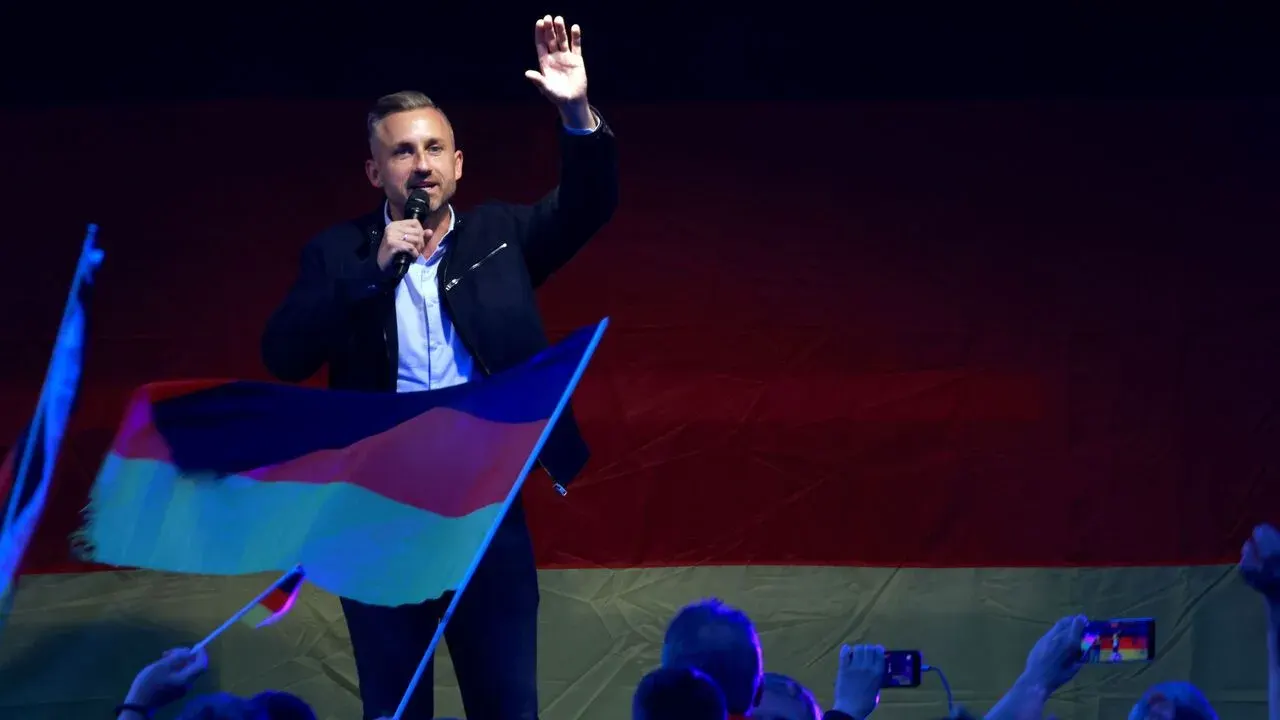
On a sweltering afternoon in Zerbst’s market square, in eastern Saxony-Anhalt, Ulrich Siegmund kept smiling broadly. For three hours, Mr Siegmund (pictured), the populist-right Alternative for Germany’s front-runner for the September 6th Saxony-Anhalt vote, autographed shirts and posed for photographs with supporters who had waited at length in fierce heat. The bitterness that used to characterise AfD gatherings was absent.
“This is not a party, it’s a movement!” exclaimed Phillipp-Anders Rau, the area’s AfD candidate. People in the audience brushed aside claims of sinister intentions. “The AfD is not radical, it just stands for freedom of opinion,” said Heike Schmidt, a resident.
AfD poised for historic win on September 6
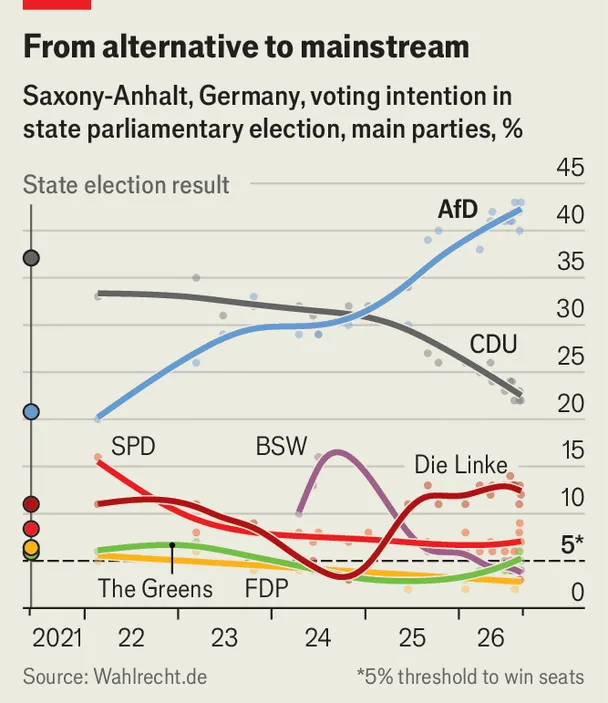
With the upbeat motto “Everything is possible!”, Mr Siegmund aspires to become Germany’s first nationalist-right state premier since the second world war. Polling points to a strong AfD triumph over the incumbent Christian Democrats (CDU) on Sunday (see chart).
Whether it can govern alone will hinge on how many rival parties clear the 5% threshold. Should it miss an outright majority, Mr Siegmund sees alternative paths into office, possibly through CDU defectors — though he told your correspondent he was uninterested in such a route.
The detailed 258-page governing platform for Saxony-Anhalt ranks among the boldest ever drawn up by a party realistically positioned to enter government. It sketches a transformed kind of state, viewed by party figures as a template for all of Germany. Still, the document lacks costings and at times lacks seriousness. Certain ideas, like ending asylum rights or repairing ties with Russia, lie beyond any state government’s powers.
What the 258-page programme would change
Many other proposals, however, fall within state competence. Education, media and culture come first.
Schools and universities
On schools, the AfD proposes pulling disabled pupils and refugee children out of mainstream classes, a move specialists say breaches European and international law. It seeks expanded Russian-language instruction and renewed partnerships with Russian schools. It intends to scrap Schulpflicht, the requirement to attend school, allowing sceptical parents to teach offspring at home. Syllabuses would be rewritten to purge progressive ideology and honour German historical accomplishments.
Schulpflicht is Germany’s legal requirement to attend school. The AfD would replace it with homeschooling permission for sceptical parents. The programme also proposes removing disabled pupils and refugee children from mainstream classes.
“More Bismarck, less Hitler”
Hans-Thomas Tillschneider · AfD’s leading thinker in Saxony-Anhalt and main drafter of the manifesto
Hans-Thomas Tillschneider, the regional party’s leading thinker and main drafter of its manifesto, contends that Germany’s reckoning with the Nazi era has produced a collective “identity disorder”. His prescription is “More Bismarck, less Hitler”.
German universities as presently constituted are despised by the AfD. Mr Tillschneider has described humanities academics as the “legitimising whores” of social change. The party aims to overhaul university administration, pull out of European degree standards and create a professorship in population studies plus an institute devoted to “critical Islamic studies”. Much of that agenda will be hard to deliver: constitutional guarantees shield academic freedom. Yet because states provide most university funding, a combative administration could exert financial pressure.
Media, language and culture
Mr Siegmund has vowed to supplant the public broadcaster, a long-standing target of Germany’s populist right, with a “neutral” substitute.
The AfD platform also attacks Saxony-Anhalt’s #moderndenken (“think modern”) motto and its homage to Dessau-based Bauhaus architecture of the 20th century. Bauhaus, in the party’s eyes, embodies the rootless culture it hopes to eliminate. Its counter-slogan, #deutschdenken, celebrates Martin Luther, Friedrich Nietzsche and the Holy Roman Empire, and suggests “patriotic tourism concepts”.
Legal, fiscal and staffing constraints
Population of Saxony-Anhalt
State debts (about $29bn)
Yearly shortfall for AfD childcare and lunch pledges — Halle Institute for Economic Research
Carrying out all of this presumes administrative skill that even some within the AfD doubt exists. Running German states demands hundreds of administrators and employees, and apart from a handful of municipalities and districts the AfD has never governed. Two close associates of Mr Siegmund previously belonged to a neo-Nazi youth organisation; hardly ideal credentials for managing a state.
A “Black-Red-Gold” academy founded last year is schooling party officials in governance, and the AfD has consulted Austria’s populist-right Freedom Party, experienced in state and federal coalitions. But preparations still appear inadequate.
Budget limits will further restrain the AfD, observes Petra Dobner of the University of Halle. Saxony-Anhalt, an impoverished region of 2.1m people, carries debts of about €25bn ($29bn) and depends on massive transfers from elsewhere in Germany. Generous pledges on child care and school lunches in the AfD programme would open a yearly funding shortfall of €2.2bn, the Halle Institute for Economic Research calculates.
Perhaps recognising this, the AfD’s latest 100-day governing programme concentrates on symbolic gestures such as displaying German flags and abolishing gender-neutral language.
How an AfD government would try to exercise power
Still, bodies in the party’s sights are taking the threat seriously. For months universities, judges and NGOs have been devising contingency plans for AfD rule. Earlier this year legislators in Saxony-Anhalt altered procedures for choosing judges and the parliament’s president. A major worry is that the AfD might ram through a stream of unconstitutional measures knowing judicial reversals would require years, demoralising opponents.
An AfD administration is focusing attention across Germany too. Citing its closeness to Russia, interior ministers from the 15 other states have considered barring it from certain joint ministerial talks. Georg Maier, Thuringia’s interior minister, supports building “Chinese walls” so vital national-security information is withheld from the party’s ministers.
The AfD, for its part, anticipates resistance from the “deep state” inside Saxony-Anhalt. Mr Siegmund says he would aim to swap out as many as 200 state workers, and has warned of “administrative measures” against others obstructing him. The party could issue a small number of political appointments, and dismiss certain officials. It would certainly remove the leader of the state’s intelligence agency, which in 2023 labelled the Saxony-Anhalt AfD “right-wing extremist”.
The bulk of civil servants cannot simply be sacked. Yet Friedrich Zillessen, a legal expert on judicial resilience in the state, notes an AfD government could use different tactics: natural turnover as officials retire, elevation of sympathetic figures or fostering intimidation.
Why Saxony-Anhalt is vulnerable — and why governing could backfire
Saxony-Anhalt is far from robust. It records the highest median age of Germany’s states alongside some of its deepest poverty. The AfD pledges to substitute “culturally alien” specialists by luring departed Germans back home. But its approach seems likely to achieve the reverse. Rumours abound of employees who could depart should the AfD assume power. Potential newcomers, particularly foreigners, will likely reconsider.
The AfD has even promised to turn down its portion of a national infrastructure fund created last year by Friedrich Merz, the chancellor. “What happens when all of us leave because we can’t stand it here any more?” asks Sophie Jungnickel, a manager for a local business.
Many AfD opponents appear content to stand back and let Mr Siegmund fail, hoping a flop in a small state punctures the party’s aura of invincibility. People living in Saxony-Anhalt see it otherwise. “It’s easy to say these things in Berlin or southern Germany,” says Lennart Birth, a political activist who recently left the state. “But not for those who have to live with it every day.”■
To stay on top of the biggest European stories, sign up to Café Europa, our weekly subscriber-only newsletter.
Sources
Poll chart: The Economist. Programme details: AfD Saxony-Anhalt 258-page governing platform and 100-day programme. Fiscal estimate: Halle Institute for Economic Research — €2.2bn yearly shortfall. Academic and legal assessments: Petra Dobner, University of Halle; Friedrich Zillessen. Reporting from Zerbst market square.
KEEP THE CONVERSATION GOING
A good story is worth sharing.
Send this story to someone who values the bigger picture.
See more from GlobeBriefly on Google
Choose us as a preferred source in your Google preferences.