Audio
Listen to the article
World Cup rule changes are needed because three things are certain at this year’s tournament: one nation’s supporters will taste ecstasy while supporters in 47 others (up from 31 previously) will end up devastated, there will be flashes of immortal brilliance and notoriety, and there will be an abundance of turgid contests that linger in no one’s memory.
- Across the past three editions there have been only 2.6 goals per game in normal time, dropping to 2.3 in the quarter-finals, semi-finals and final, below the Premier League’s 2.8.
- Defensive football succeeds for outsiders: six teams ranked outside the top third reached the semi-finals since 1998, while New Zealand were unbeaten in 2010 with twice scored across three draws.
- To lift scoring and tempo, FIFA should trial Arsène Wenger’s “clear daylight” offside and limit VAR to team challenges, as is common in other sports.

Perhaps there will be a strike as spellbinding as Diego Maradona’s solo dribble against England, a piece of skill as exquisite as Johan Cruyff’s turn against Sweden or a stop as miraculous as Gordon Banks’s against Pelé; a spot-kick miss as heartbreaking as Roberto Baggio’s against Brazil, a handball as cynical as Luis Suárez’s against Ghana or a headbutt as startling as Zinedine Zidane’s against Italy.
Yet despite all the excitement over sweepstakes, sticker albums and occasional screamers, the World Cup habitually serves up an unattractive version of the beautiful game. Significantly, those flashes of brilliance and ignominy occurred in otherwise cagey games. In only one did a team score multiple goals, and that was because Maradona punched one in with the “Hand of God”.
Goals, shots and fouls show how cagey the World Cup gets
Goals tell part of the story: across the past three editions, there have been only 2.6 per game in normal time, dropping to just 2.3 in the quarter-finals, semi-finals and final. Over that span, the English Premier League, the world’s richest domestic competition, has averaged 2.8.
Goals per game, past three World Cups
Goals in quarter-finals, semis and final
Premier League average over same span
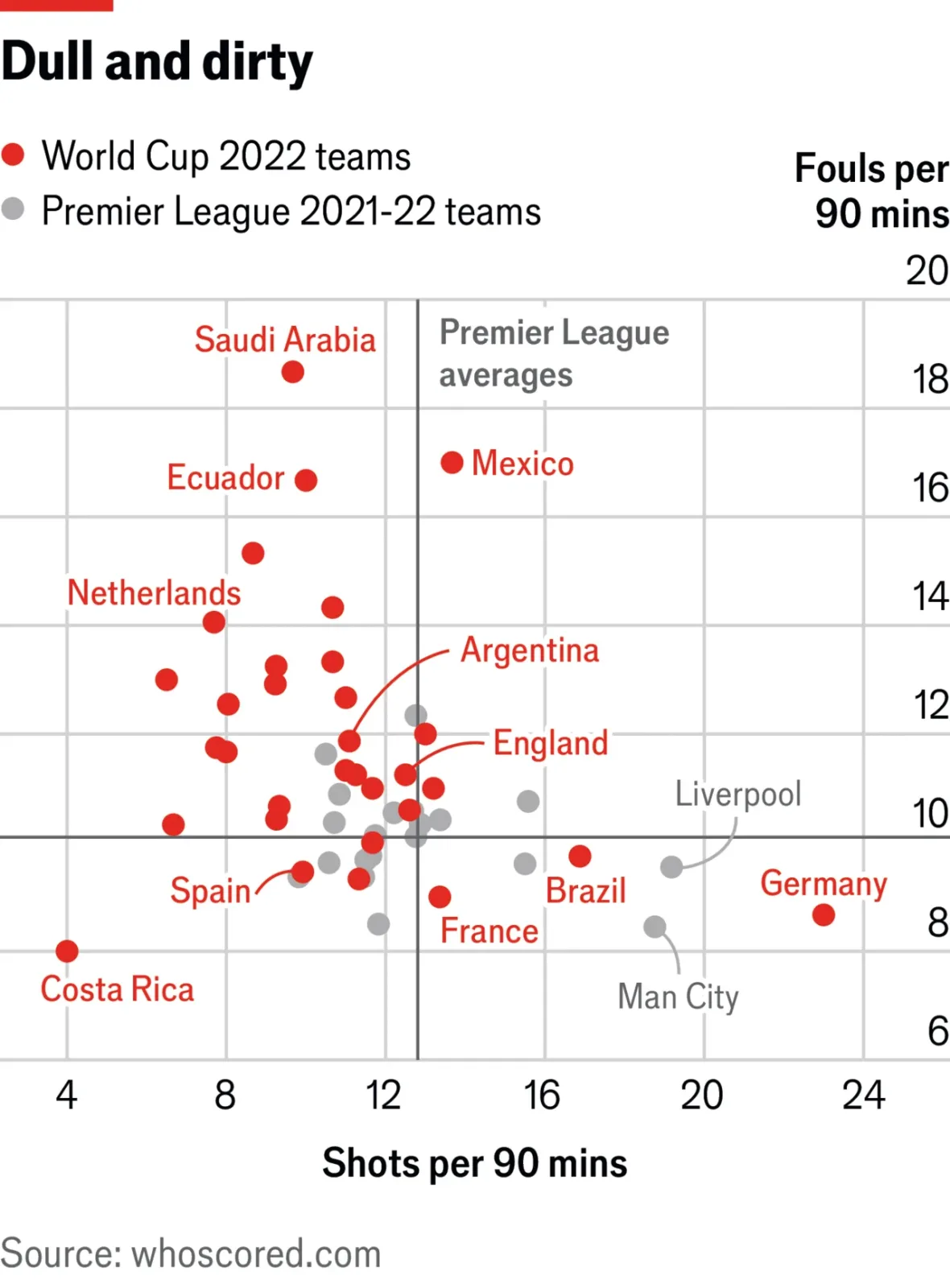
Other data underline that grinding character. Relative to the preceding season of the Premier League, the last World Cup produced 16% fewer shots per 90 minutes and 17% more fouls. One match featured 18 yellow cards and a red.
Fatigue plays a role, with footballers drained after a lengthy campaign. The heatwaves expected in the upcoming matches will not help. Players also seldom practise alongside international teammates, producing fragmented performances. Pressure matters as well, with everlasting fame at stake.
Why parking the bus pays — especially with 48 teams
Dull football has a further cause: for middling and weaker nations, it succeeds. Since the World Cup expanded to 32 teams in 1998, six ranked outside the top third by bookmakers have reached the semi-finals: Croatia (1998 and 2022), South Korea (2002), Turkey (2002), Uruguay (2010) and Morocco (2022).
Those journeys to the semis averaged a scoreline of 1.1 versus 0.7 in normal time. New Zealand, ranked last by bookies in 2010, were the only unbeaten team that year, scoring twice across three draws. In short, outsiders are rewarded for “parking the bus” and praying — a calculation that will carry even greater force with 48 teams.
The group phase may bring more one-sided thrashings, yet also more Davids hacking down Goliath in the knockouts.
Other sports changed rules to lift scoring and tempo
The chance of lifting the World Cup is so heady that audiences in the billions would tune in even if each match finished goalless. Yet football vies in a worldwide contest for attention, where rulers of rival sports seek to sharpen their “product”.
Occasionally that involves quickening contests, as Major League Baseball has done by introducing a 15-second limit for pitchers. Frequently it involves raising scores, as both codes of rugby have done by refereeing the “ruck” more favourably to the attack, and the Indian Premier League has in cricket by adding a 12th “impact player”. Meanwhile, Formula One has increased unpredictability by changing several rules for constructors: this season Lewis Hamilton and Max Verstappen, champions in ten of the past 12 seasons, have yet to win a race.
Officials have a lengthy record of adjustments of this kind. America’s National Basketball Association introduced a shot clock to force more attacking play in the 1950s, when matches averaged 160 points (it is now 230). But the pace of experimentation is quickening today, amid fears that broadcast deals have peaked and that younger audiences are watching more highlights and fewer matches.
Honestly, sides in most sports turn cautious in play-offs, so administrators who refuse to innovate risk an anti-climax while rival leagues build toward a crescendo. Certain authorities even employ outside analysts to model how changes in gameplay and the behaviour of fans might affect their businesses.
Two World Cup rule changes FIFA should try
Football has historically resisted such thinking. Its laws remain largely untouched from 30 years ago — with changes few in number and mostly minor — although enforcement has tightened: today you’ll get a red card for raking someone’s shin, with the video assistant referee (VAR) adding extra scrutiny to every decision.
Lately, though, FIFA, world football’s governing body, has recognised that it too might need to innovate, to maintain the sport’s share of the attention economy — and, perhaps, to grow it in America, which will host 78 of this year’s 104 matches.
Offside: only punish clear daylight
Arsène Wenger, a venerated former manager who now works for FIFA, has suggested relaxing the offside law to apply only when there is “clear daylight” between the attacker and defender. This is being trialled in the Canadian league. The aim is to restore many goals currently being chalked off by VAR, though officials will still have to draw a line somewhere, so the debate over whether someone’s shoelace was offside will never end.
VAR: use limited challenges
Because supporters dislike VAR so intensely — in a recent survey of British fans, 72% said it makes watching football less enjoyable — repairing it should sit at the top of FIFA’s agenda. Confining it to occasions when sides lodge “challenges”, each side receiving a limited number, as is common in other sports, should mean that only howlers get checked, while shifting some blame to the teams if something gets missed.
Such a reform, alongside Mr Wenger’s offside tweak, could mean more goals and fewer refereeing delays. For supporters in the 47 eliminated countries that won’t lift the World Cup trophy, that would be a victory to celebrate.
James Tozer is a co-founder of Prospect, a sports analytics firm that works with governing bodies, teams, coaches and others. He was a data journalist with The Economist from 2014 to 2022.
KEEP THE CONVERSATION GOING
A good story is worth sharing.
Send this story to someone who values the bigger picture.
See more from GlobeBriefly on Google
Choose us as a preferred source in your Google preferences.