Audio
Listen to the article
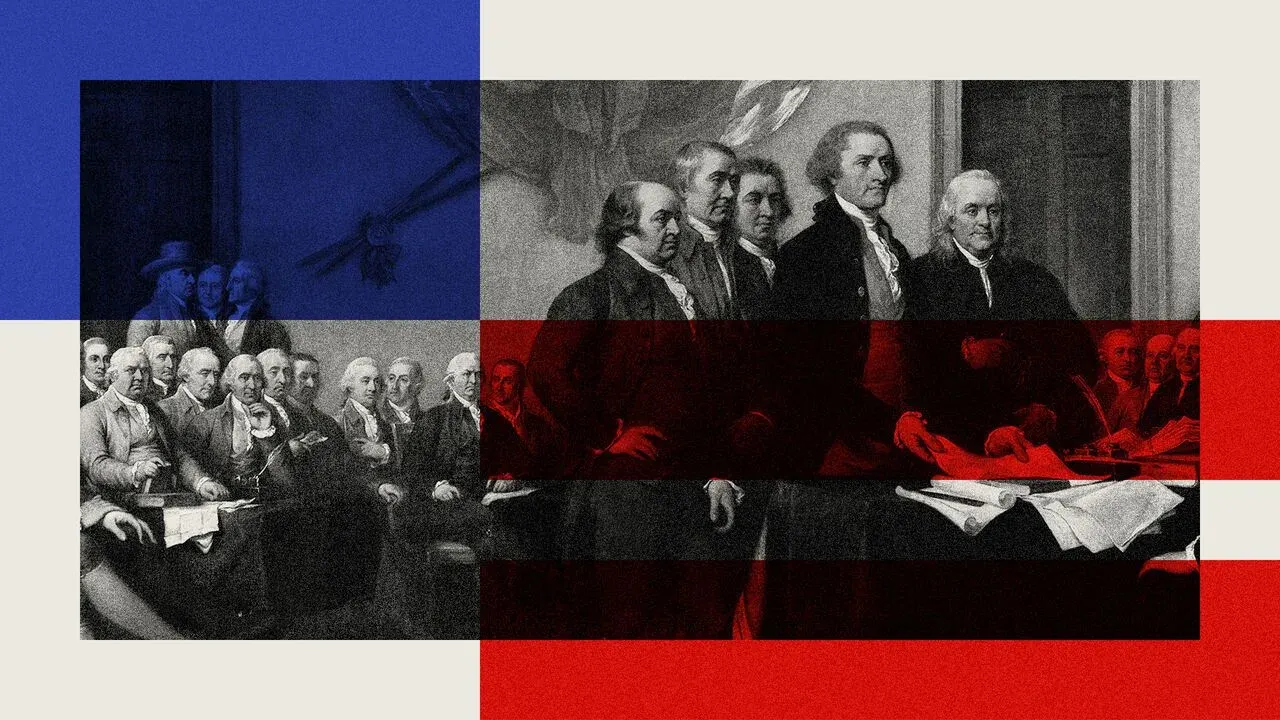
Illustration collage depicting America’s founding fathers
- Six books — from Pulitzer-winning narrative history to a family history of slavery — together explain the founders’ ideals and contradictions.
- The 1790s collaborative experiment, the election of 1800 and the revolution’s social rupture show how a republic was imagined and then built.
- Samuel Adams, John Adams and Thomas Jefferson emerge as distinct, flawed drivers of independence — not a single heroic consensus.
The best books on America’s founding fathers make familiar names feel human again. This guide to six essential reads — from lively introductions to demanding histories — is a shortcut through their ambitions, quarrels and lasting influence, and through the gap between imagining a perfect republic and actually building one.
The architects of the United States are famous by name, yet their lives and lasting impact remain hazily grasped by many confident commentators. The titles below span different founders and different judgments about their historical imprint, and can be read in any order.
1. Founding Brothers: The Revolutionary Generation — Joseph J. Ellis
Founding Brothers: The Revolutionary Generation. By Joseph J. Ellis. Knopf; 304 pages; $24 and £12.99
Winner of the Pulitzer prize, this volume traces how the private bonds and public careers of seven American founders — George Washington, John Adams, Aaron Burr, Alexander Hamilton, Thomas Jefferson, Benjamin Franklin and James Madison — overlapped.
Mr Ellis narrates with lively zeal, organising the story around self-contained episodes including Washington’s farewell address and the Burr-Hamilton duel. Concentrating on the 1790s, it invites both its protagonists — and its audience — to consider the distance between the founders’ aspirations and their accomplishments, and between imagining a perfect republic and actually building one.
2. The Radicalism of the American Revolution — Gordon Wood
The radicalism of the American revolution. By Gordon Wood. Knopf; 464 pages; $23 and £17.50
These days it is trendy to portray America’s revolution as a narrow, slavery-defending enterprise staged by privileged white elites. Mr Wood delivers a forceful rebuttal.
In his telling, the revolution amounted to a transformative rupture that forged a distinct society and social hierarchy. He depicts late-18th-century America as profoundly stratified, governed by inheritance rules and clerical power. Underneath, though, republican principles flowed powerfully, undermining traditional notions of rank and authority. Demanding yet deeply worthwhile, the book suits anyone probing America’s philosophical roots, alongside Alexis de Tocqueville.
3. The Revolutionary: Samuel Adams — Stacy Schiff
The Revolutionary: Samuel Adams. By Stacy Schiff. Little, Brown; 421 pages; $23 and £16.99
Samuel Adams “wired a continent for rebellion”, stoking opposition to taxation, stage-managing the Boston Tea Party and emerging as the earliest voice to demand independence outright.
While fellow Founding Fathers turned into “giants” once the revolution ended, Adams slipped toward oblivion. Stacy Schiff’s enthralling study restores his place, opening with Paul Revere’s celebrated overnight journey to alert Adams that British troops intended to seize him. “Without the character of Samuel Adams,” his cousin John Adams later said, “the true history of the American revolution can never be written.”
4. John Adams — David McCullough
John Adams. By David McCullough. Simon & Schuster; 704 pages; $30 and £14.99
John Adams too was frequently disregarded — until David McCullough became fascinated. McCullough’s life story argues for John Adams as “the real driver” behind American independence, blending personal detail with a sweeping portrait of his public development.
Built from Adams’s journals and correspondence, it covers all from his thorny competition with Thomas Jefferson to his hazardous ocean crossings in wartime. For deeper immersion in the era, we likewise suggest McCullough’s “1776” (Penguin; 386 pages; $23 and £16.99), a battlefield narrative of the months before the Declaration of Independence.
5. A Magnificent Catastrophe: The Tumultuous Election of 1800 — Edward J. Larson
A Magnificent Catastrophe: The Tumultuous Election of 1800, America’s First Presidential Campaign. By Edward J Larson. Free Press; 335 pages; $22 and £18.99
Poisonous language and biased press coverage are regularly described as failings of contemporary American voting. Edward Larson reminds us both are old.
His vivid and perceptive history recounts America’s fourth race for the presidency. In 1800 John Adams of the Federalist Party faced Thomas Jefferson of the Democratic-Republican party. Adams held office at the time. The outcome may already be familiar, yet its echoes of present-day American politics will likely startle.
6. The Hemingses of Monticello: An American Family — Annette Gordon-Reed
The Hemingses of Monticello: An American Family. By Annette Gordon-Reed. W. W. Norton; 802 pages; $28 and £16.99
During the 1990s Annette Gordon-Reed, historian and legal academic, chided colleagues for sidestepping an uncomfortable reality in full view. Scholars had often noted the “paradox” of Thomas Jefferson, who declared that “all men are created equal” while holding more than 600 slaves.
But Ms Gordon-Reed marshalled written proof — afterwards reinforced by DNA testing — that Jefferson very likely sired as many as six children with one enslaved woman, Sally Hemings. This sequel examines the Hemings family in its own right.
Their experience belongs to the larger story of American slavery and forms an essential thread of the “perplexing and exasperating” Jeffersonian puzzle. At Jefferson’s estate at Monticello, she writes, “that we can find the absolute best, and the absolute worst, that we have been as Americans”. ■
Publishers, page counts and prices are as listed at publication: Knopf, Little Brown, Simon & Schuster, Free Press, W. W. Norton and Penguin. Dollar and sterling prices shown where provided.
For additional coverage of new books, movies, television, music and disputes, subscribe to Plot Twist, our weekly newsletter available to subscribers
KEEP THE CONVERSATION GOING
A good story is worth sharing.
Send this story to someone who values the bigger picture.
See more from GlobeBriefly on Google
Choose us as a preferred source in your Google preferences.