Audio
Listen to the article
- Five listed neoclouds including CoreWeave reached $18bn in yearly revenue, up from $3bn in 2024, with 1.5-2.5GW of capacity against 20-24GW for Alphabet, Amazon, Microsoft and Meta.
- That growth rests on $61bn in balance-sheet debt plus $18bn in operating leases; none earns an operating profit and interest took a fifth of revenue at Nebius and a quarter at CoreWeave last quarter.
- About 200 neoclouds now face hyperscalers, Meta, Oracle and SoftBank’s SB Neo, leaving credit shocks and slowing AI demand as the two central risks.
Neoclouds such as CoreWeave, which buy specialised AI chips and lease access to them, rank among the AI sector’s quickest-expanding businesses. Like the 1960s traders who acquired IBM mainframes and hired them to banks and defence contractors, and the dotcom speculators who registered web domains and flipped them for profit, they are intermediaries minted by a technology wave — and unusually exposed.

Why neoclouds grew so fast
Two forces have powered neoclouds in recent years. First, AI demand has outpaced the ability of America’s hyperscalers to add computing capacity. Several neoclouds began as cryptocurrency miners before converting their data centres. By concentrating solely on AI instead of a wide cloud portfolio, they focused spending more sharply.
Consequently, model developers such as OpenAI have become major clients, alongside the hyperscalers themselves, which frequently rent spare capacity from neoclouds. Second, Nvidia, the dominant AI-chip supplier keen to lessen dependence on hyperscalers’ custom silicon, has provided various forms of financial support to encourage larger chip purchases.
$18bn in revenue built on $61bn in debt
Over the past 12 months, yearly revenue across the five biggest listed neoclouds — CoreWeave, Nebius, IREN, Applied Digital and Core Scientific — climbed to $18bn, compared with $3bn in 2024. They remain much smaller than hyperscalers, yet are narrowing the distance.
Dell’Oro, a research firm, puts collective neocloud data-centre capacity at 1.5-2.5 gigawatts (GW), against 20-24GW combined for Alphabet, Amazon, Microsoft and Meta. However, neocloud capacity is approximately doubling annually, or roughly three times the hyperscalers’ pace.
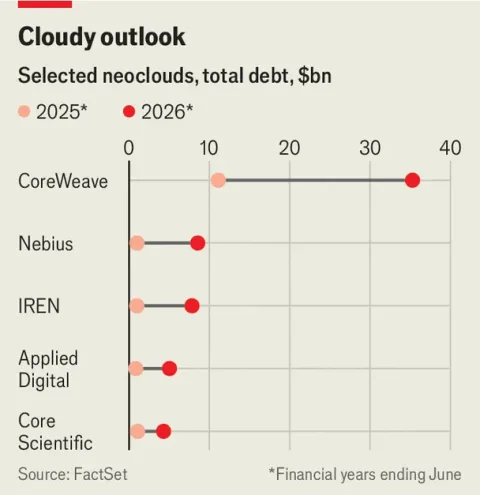
Such growth rests on enormous borrowing. Balance-sheet debt at those five listed neoclouds now totals $61bn, four times the level of just 12 months ago, alongside $18bn of operating leases. None earns an operating profit, and interest charges push all of them deep into loss. Last quarter, interest payments equalled a fifth of revenue at Nebius; at CoreWeave they reached a quarter.
Neoclouds wager that sustained torrid growth will ultimately deliver earnings. Possibly. Yet competitive pressure shows no sign of abating. Beyond the incumbent cloud giants — plus Meta, which is considering launching its own third-party service — about 200 neoclouds worldwide are now contesting contracts.
Competition is intensifying on all sides
A growing set of mid-sized suppliers adds to the fight. Oracle, once principally a database company, has invested heavily to enter the hyperscalers’ ranks with its own cloud operation. Its capital expenditure, largely debt-financed, is expected to hit $77bn this year.
In July SoftBank, a heavily indebted Japanese conglomerate, unveiled a cloud operation called SB Neo. The group also holds a majority stake in SB Energy, an infrastructure company that has partnered with OpenAI to construct a huge data centre in Ohio, and which filed on September 1st for an initial public offering.
Two risks: a credit shock and slowing AI demand
Intense competition magnifies the two principal hazards confronting neoclouds. One is a credit-market shock that lifts borrowing costs and compresses margins further. Investors already look nervous: the yield spread between neocloud bonds and junk bonds overall is widening.
An even larger threat is a renewed balance between supply and demand. Enormous infrastructure is currently being constructed on the premise that use of the technology will continue to soar. Should adoption decelerate, though, both model-makers and hyperscalers could rapidly conclude they no longer require neocloud capacity.
Survival means becoming more than middlemen
Either shock would prove devastating for the sector. Only neoclouds offering customers more than raw capacity would escape failure. Accordingly, some are marketing themselves as dependable infrastructure partners for Western governments increasingly wary of America’s tech giants.
Others, including CoreWeave and Nebius, are attempting to add software services for clients. To endure, neoclouds may have to become more than middlemen. ■
To track the trends shaping commerce, industry and technology, sign up to “The Bottom Line”, our weekly subscriber-only newsletter on global business.
KEEP THE CONVERSATION GOING
A good story is worth sharing.
Send this story to someone who values the bigger picture.
See more from GlobeBriefly on Google
Choose us as a preferred source in your Google preferences.