Audio
Listen to the article
Government debt in advanced economies stands near 110% of GDP, close to an all-time high, and bond markets are pushing back against continued borrowing. Rich countries keep running large deficits even as higher interest rates make old debts far more burdensome.
- Gross public debt in advanced economies is near 110% of GDP, with average deficits over 4% of GDP this year and over 6% in America.
- Ten-year and 30-year bond yields have risen because investors demand compensation for lax budgeting, inflation risk and political resistance to tightening.
- Stabilising debt-to-GDP needs belt-tightening above 2% of GDP in Britain and America and above 3% in France, before ageing, defence and climate pressures.

Government debt is one of humanity’s great inventions. It allows societies to store wealth, fight crises and build for the future. After Britain’s superior access to credit helped it defeat Napoleon in 1815, one historian likened the country’s credit lines to Aladdin’s lamp.
Two centuries later, during the covid-19 pandemic, much of the world looked on with similar astonishment as rich countries borrowed freely to pay for support for households and health care.
The magic of borrowing comes with a temptation — one that David Hume and Alexander Hamilton worried about in the late 18th century. If a country is sufficiently creditworthy to cover its existing debts, it can borrow more. Having manageable debts means it can manage more debt. And so debt easily grows.
If that continues too long, governments face pushback. The bond markets that meet their need for debt start to charge them more. New borrowing gets harder — and so does rolling over old debts. If governments do not then tighten their belts, creditworthiness erodes in a way that can easily spiral.
Public debt near 110% of GDP — and deficits still large
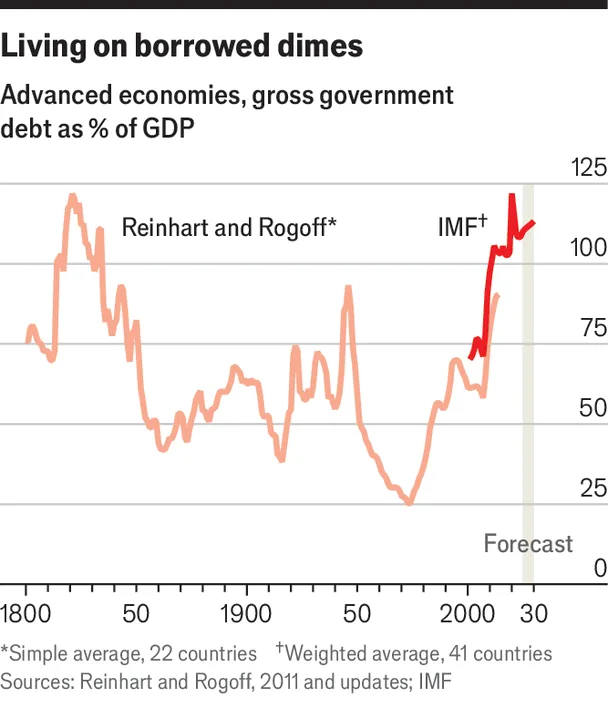
Gross public debt to GDP
Average deficit, advanced economies
Deficit in America
A rise in interest rates since 2022 — initiated by central bankers to control inflation that was caused in part by government spending sprees — has made debts far more burdensome. Rich countries as a whole now spend half as much again on interest as they do on national defence. And they keep on borrowing.
A series of crises helps explain high debts: the financial crash of 2007-09, the covid-19 pandemic and Russia’s invasion of Ukraine. Long-running short-termism of the kind Hume and Hamilton feared is also to blame. Governments adopted mechanisms to constrain debts, such as America’s “pay as you go” rules in Congress and the EU’s Stability and Growth Pact. But politicians suspend, abuse or evade them almost as they please.
There is little political appetite for belt-tightening. America has spent whatever windfall it will raise from President Donald Trump’s tariffs, and possibly more, by renewing and expanding Mr Trump’s deficit-financed tax cuts from 2017. The White House is entertaining still more tax cuts.
France goes through annual political crises as proposals to trim the budget even modestly generate blowback: they are the main reason the country has lost five prime ministers in two years. Japan’s incoming prime minister favours expansionary fiscal policy despite sky-high debts. Britain’s government will give at least the impression of austerity on November 26th, when it will almost surely raise taxes. But the changes will keep the country only just inside a hyper-forgiving fiscal framework.
Why long-term bond yields are rising
Bond markets are responding. For short-term debt, buying a bond is mainly a bet on the path of interest rates set by the central bank over the period the bond will be held — the trick is to get a higher yield than can be expected from cash in the bank.
But the longer the duration of a bond, the more investors must pay attention to the risks posed by lax budgeting. It is therefore telling that in most big rich economies, ten-year government bonds yield more today than they did when central banks started cutting short-term interest rates again in 2024. Investors are demanding higher long-term rates because they sense danger.
Shocks, inflation risk and bond markets
The prospect investors must worry about is not just — or even mainly — default. There is another weapon that can hurt them over long horizons: inflation. Debts are typically fixed in nominal terms, meaning higher prices can erode their real value. Voters dislike high inflation, and it destabilises economies. But as debts mount, inflation becomes relatively more appealing, and the danger that politicians will pressure central banks to bring it about goes up.
The effect on the bond market can be marked. In September Britain’s 30-year bond yield hit its highest point since 1998 in part because investors want compensation for the riskiness of its budget. Japan’s hit its highest level ever, having surged over a percentage point this year. The country used to be the best example of low rates making high debts sustainable, but now looks wobbly.
France’s long-term debt carries yields almost as high as Italy’s. In the spring of 2025 America’s “yippy” bond market appeared to be the main constraint on President Donald Trump’s chaotic policymaking, as the 30-year Treasury yield nearly touched highs not seen since 2007.
Stabilising debt looks easy on paper, hard in practice
The irony of the world’s fiscal mess is that economic conditions are benign. No major economy is in a recession. Public debts have fallen slightly in real terms since their pandemic peak, due to inflation. And though interest rates have risen, in many countries they remain below the rate of economic growth.
That means that if the “primary” budget, which excludes interest costs, is in balance, GDP would rise faster than debts would mount. In fact, using five-year bond yields and IMF growth forecasts, The Economist calculates that most rich countries could still run small primary deficits and keep debts stable as a share of their economies, even if they had to refinance all their debt immediately at today’s rates.
Primary budget — the budget balance excluding interest costs. The largest primary surplus required to stabilise debt is in Britain, at just 0.3% of GDP.
That is not large for countries in a pinch. In the late 1990s Italy ran primary surpluses of 3-6% of GDP to bring down debts before joining the euro.
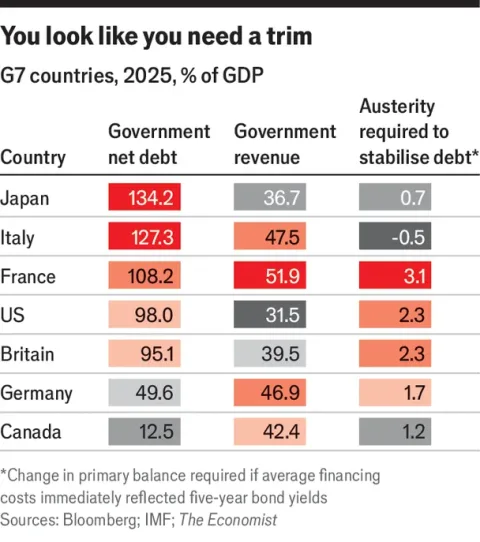
Unfortunately even modest budget targets are hard to hit if you start far away from them. In Britain and America, deficits are large. The belt-tightening needed to stabilise the debt-to-GDP ratio exceeds 2% of GDP; in France it is greater than 3% of GDP.
Another problem in Europe is that taxes are high as a share of GDP, limiting the scope to raise them without doing excessive economic damage. Of the G7 group of big rich economies only Canada enjoys low debt, a small necessary adjustment and the space to raise taxes. France looks bad by all three measures.
Ageing, defence, climate and higher refinancing costs
Things look worse still when the coming wave of spending on ageing populations, defence and the climate transition is considered. Higher debt interest costs to come are not yet fully accounted for. About half of outstanding debt with a fixed interest rate in the OECD club of rich countries costs less than 2% a year to service — a legacy of having issued the debt when rates were low.
American debt worth a quarter of the country’s GDP will come due between 2025 and 2027. Reissuing it at 2024 yields would increase the interest rate paid by about two percentage points.
The IMF has estimated that debt interest, pensions, health, defence and climate change in Europe’s advanced economies will create additional annual spending “pressure” worth nearly 6% of GDP by 2050. In Britain, Spain, Portugal and Switzerland the figure is above 8% of GDP. America is ageing less than Europe. But the Penn Wharton Budget Model, a research group, estimates that America would need to raise taxes and cut spending, by 15% in both cases, to eliminate the future gap between spending and taxes.
The danger of optimistic forecasts and ChatGDP
Critics pooh-pooh dire fiscal forecasts. Who knows the future? But the problem with budget projections is that they tend to be too optimistic. Britain’s fiscal watchdog found this year that, when asked to forecast deficits five years in the future, it had underestimated them by 3.1% of GDP. The IMF has reached a similar conclusion across rich countries.
If history is any guide, the trajectory of debt will be worse than any of us project today, and considerably so.
Gita Gopinath · then of the IMF, in a speech last year
One reason is that forecasters tend to be too optimistic about growth. Perhaps, with the help of breakthroughs in artificial intelligence, that could change. But the AI boom is concentrated in America, and faster growth there tends to mean higher global interest rates, making debts more expensive to service.
And even when policy has been aimed at stabilising debt-to-GDP, the ratio has ratcheted higher due to crises. It would be naive to think that such shocks — like another pandemic or war — will not strike again.
How the global budget mess ends
There is no law of economics that says the debt-to-GDP ratio can rise to a certain level and no further. It is up to markets and voters. If investors doubt an electorate’s mettle for servicing their country’s debts and start selling off bonds, governments can be forced into excruciating choices.
Interest costs can rise so much that only enormous primary surpluses, requiring deep austerity, can restore economic stability. The other option for a country in such a crisis is to default or to inflate away debts.
The drift towards crisis could be arrested if budgets were fixed today. But one reason that looks so unlikely is the subject of the next chapter: the increasingly sorry condition of welfare states.
Sources
Debt, deficit and growth calculations: IMF forecasts and five-year bond yields, as cited in the report.
Budget pressure and forecast bias: IMF, Britain’s fiscal watchdog and Penn Wharton Budget Model.
KEEP THE CONVERSATION GOING
A good story is worth sharing.
Send this story to someone who values the bigger picture.
See more from GlobeBriefly on Google
Choose us as a preferred source in your Google preferences.