Audio
Listen to the article
A continent-wide review of Europe’s drone incursions now points to Moscow, with the International Institute for Strategic Studies linking hundreds of flights over bases, ports and airports in 2024-25 to a co-ordinated Russian campaign. The stakes were clear by the morning of July 1st, when WOLF1 and Wolf2 were already operating above the Irish Sea as KRAKEN began flying tight, low-altitude circuits off Dublin, with Volodymyr Zelensky, Ukraine’s president, inbound by air and the trio of Irish Air Corps aircraft leaving nothing to chance.
- From 144 filtered incidents between August 2024 and February 2026, almost half were above defence installations and a quarter affected critical national infrastructure, including ports and energy installations.
- The IISS report, published on July 2nd, says the pattern points to a co-ordinated campaign by the Kremlin, probably using Russia-linked vessels to launch and retrieve petrol-engine military drones.
- Supporting cases include a drone jammed after lifting off the Zhigulevsk toward the Charles de Gaulle in Malmö in February, and an unidentified hull inside Dublin Bay last December.
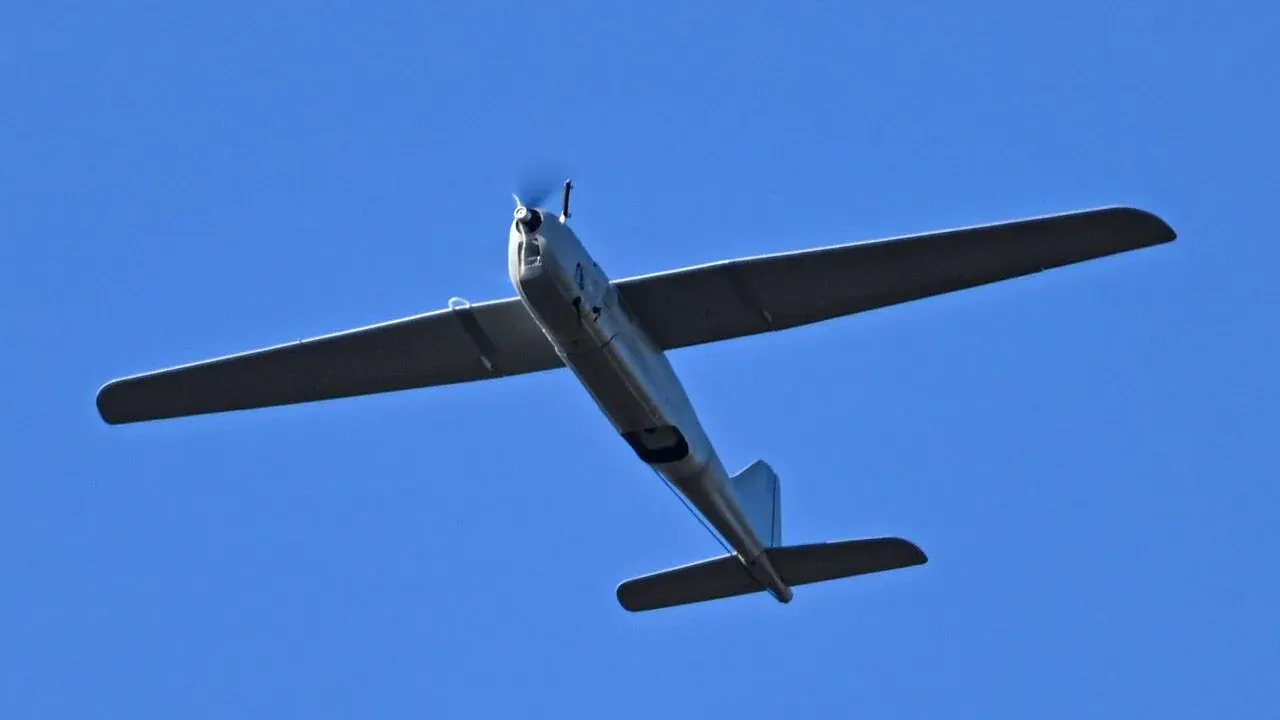
Dublin patrols show stakes of drone wave
Caution ran high over Dublin because, during an earlier trip by Mr Zelensky last December, four or five bulky “military-style” drones had intruded into a no-fly zone along his aircraft’s approach route. Personnel aboard an Irish naval vessel followed them, yet held their fire over the danger to people below.
That Irish episode belonged to a much wider pattern of hundreds of drone penetrations around Europe during 2024-25. Numerous craft entered airspace over defence sites, among them France’s principal ballistic-missile-submarine base plus military airfields in Britain and Germany.
Other events disrupted civil aviation. Drone reports prompted Danish authorities to shut the country’s main airport near Copenhagen briefly in September.
While Moscow’s hand was broadly suspected, several national inquiries ended without a verdict. In June, Danish police shut their investigation, stating they could neither verify that any drones had existed nor identify who dispatched them. That conclusion drew surprise: earlier that month, the Danish armed forces had reported that seasoned soldiers distinctly recognised a drone above a training base and fired upon it.
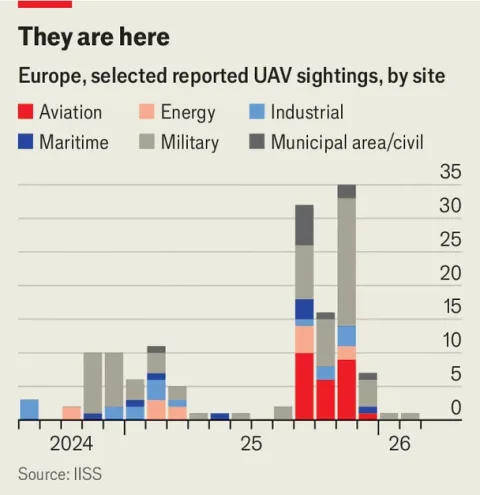
What the continent-wide IISS analysis found
A comprehensive new examination of sighting records alongside the locations of Russia-connected vessels at the relevant moments now strongly indicates that all formed part of a co-ordinated campaign by the Kremlin. The International Institute for Strategic Studies (IISS), a European think-tank, published the report on July 2nd.
Unlike national inquiries confined to incidents inside their own borders, this study mapped the continent-wide picture, and “it’s only when you begin to look at the pattern that you begin to understand that there is something more than coincidence happening,” says Charlie Edwards, a British former security official and one of the report’s authors.
To assemble its dataset for sightings between August 2024 and February 2026, the IISS drew on information from the Armed Conflict Location & Event Data Project (ACLED), a monitoring group. It then filtered out cases blamed on hobbyists, commercial operators or spillovers from the war in Ukraine. From the remaining 144 incidents, almost half occurred above defence installations, while a quarter affected critical national infrastructure, including ports and energy installations.
Russian-linked vessels as suspected launch platforms
Among the report’s most striking conclusions is that vessels tied to Russia were probably employed for launching and retrieving drones, above all the bigger military models powered by petrol engines observed in several episodes. Those machines might be versions of the Orlan-10, deployed widely by Russia against Ukraine in missile and drone attacks, or the Merlin-VR, a reconnaissance drone able to take off by catapult and land by parachute, a combination well suited to shipboard use.
Support for that hypothesis came in February this year, when the Swedish navy jammed a drone seen lifting off from the Zhigulevsk, a Russian spy ship. The craft headed toward the Charles de Gaulle, a French aircraft-carrier berthed in Malmö, a Swedish port city.
A ship with Russian ties was observed lingering off Ireland’s shoreline last December while Mr Zelensky visited. More alarming was an unidentified hull inside Dublin Bay at approximately the same period. Required under international regulations to broadcast its position and identity, the vessel transmitted nothing and appeared solely via satellite.
Such an encounter helps clarify why the Irish Air Corps mounted such vigilant patrols on this latest occasion, determined that no possible ghost ship launching drones would pass unnoticed amid Putin’s escalation logic.
Sources
International Institute for Strategic Studies report published July 2nd; Armed Conflict Location & Event Data Project sighting data for August 2024 to February 2026.
KEEP THE CONVERSATION GOING
A good story is worth sharing.
Send this story to someone who values the bigger picture.
See more from GlobeBriefly on Google
Choose us as a preferred source in your Google preferences.