Audio
Listen to the article

It is rare for a reform panel to publish proposals while begging legislators to shelve them. Yet that is what Minnesota’s Blue Ribbon Commission on Special Education did. Facing a budget gap running into the billions, lawmakers directed the panel to find $250m in savings in special education — a category where outlays are projected to climb by nearly $1bn between 2022 and 2027. In August the commission issued interim proposals and voted unanimously for the legislature to adopt none of them, citing risks to pupils.
- Nationwide, districts are diverting resources from mainstream instruction to finance legally required services for pupils with special needs.
- IDEA authorised — though it did not compel — Washington to cover up to 40% of average national per-pupil spending on each disabled child; from 2005 to 2021 federal support averaged merely 15.5%.
- Examining almost 6,000 districts with 2020 data, Bellwether identified a $24.1bn gap between real special-education outlays and the state and federal money designated for that use.
A national squeeze: more pupils need special education
The impasse in Minnesota captures a countrywide bind: schooling for disabled children enjoys broad backing, yet the sums demanded by present statutes are staggering. Nationally, overall pupil enrolment is falling, but special-education rolls are expanding. Between 2014 and 2023 they increased by 1.4m, climbing from 11.6% of all pupils to 14.7%.
In a handful of states — including Indiana, Massachusetts, Minnesota, Pennsylvania and Wyoming — the share reaches about one in five. With bills mounting, states face thorny choices over who foots the cost, how effective programmes are and what must be cut to meet the tab.
The federal promise Washington never funded
Half a century ago, more than half of the country’s disabled children were reckoned to get inadequate schooling. In response, Congress in 1975 approved what evolved into the Individuals with Disabilities Education Act (IDEA), among a set of statutes that jointly ensure disabled children a “free appropriate public education”.
Every qualifying child gets an Individualised Education Programme (IEP) detailing services the district is obliged to deliver. Those can span from infrequent speech therapy to a dedicated classroom aide or a place at a specialist school, which may cost districts hundreds of thousands of dollars each year.
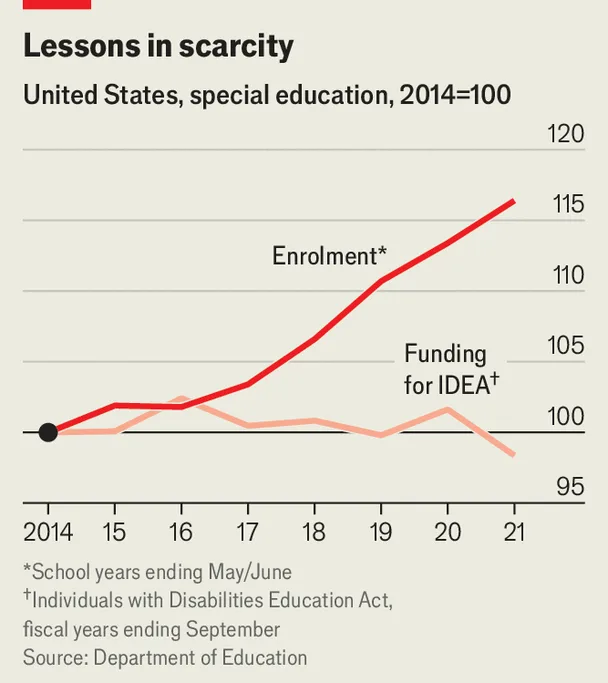
Lawmakers in Congress originally anticipated Washington would absorb a large share of the expense. IDEA authorised — though it did not compel — Washington to cover up to 40% of average national per-pupil spending on each disabled child. In practice, from 2005 to 2021 federal support for IDEA dropped by 12% in real terms (see chart), averaging merely 15.5% of total funding. States and local districts have been left to supply the remainder.
A report from Bellwether, an education think-tank, calculated that in 2020 districts paid on average nearly two-thirds of their special-education bill. Districts typically finance schools through local property taxes, which are hard to lift without triggering backlash. States usually fund schools from broad revenues like sales and income taxes, but almost all face balanced-budget requirements that are difficult to satisfy.
Why special-education enrolment keeps rising
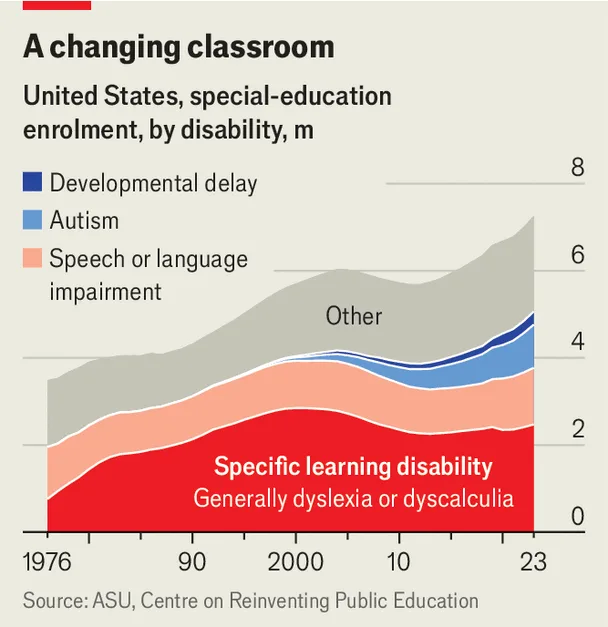
The heaviest pressure comes from growth in special-education enrolment, which more than doubled between 1976 and 2023, reaching 7.3m nationally, based on figures from the Centre on Reinventing Public Education, a research group at Arizona State University (see chart).
In part that reflects wider acknowledgement of disabilities once overlooked. Pupils with autism rose from a little under 5,000 in 1991, when the condition became a federal disability category, to just under 1m in 2023. Developmental delay, a classification added in 1997, expanded from roughly 1,900 students that year to about 300,000 in 2023. Definitions of the conditions have widened; improved identification and deliberate moves to assess children sooner have probably played a role, too.
Why districts cannot simply cut costs
As demand grows, districts fill the shortfall from their general budgets. Bellwether, examining almost 6,000 school districts with 2020 data, identified a $24.1bn gap between real special-education outlays and the state and federal money designated for that use.
Because such services are legally required, economising is difficult. A school cannot simply trim an IEP at will. Districts “overspend and overcommit”, says Maggie Cicco Rault, a researcher at Georgetown University, instead of chancing breaches of the rules or inviting lawsuits. Certain states operate so-called “hold-harmless” provisions that shield districts from any reduction in special-education funding even when enrolment shifts would otherwise lower it.
States hunt for fixes as federal help looks unlikely
States are testing remedies. Minnesota’s commission floated scrapping the state’s “hold-harmless” provision and urged study of whether litigation expenses tied to IEP disputes can be reined in. In 2025 Connecticut lawmakers enacted a measure to police billing by private special-education providers. That same year Texas reworked its funding formulas to align them more closely with the severity of a child’s needs, seeking to help districts plug a $1.7bn shortfall.
A further avenue is to seek greater sums from Washington. Legislators from both parties “agree that the feds need to pony up some more for special ed”, says Cheryl Youakim, a state representative from Minnesota. Yet the Trump administration seems unlikely to comply. It has taken apart the Department of Education and moved oversight of special-education services to the Department of Health and Human Services.
Still, elected officials hesitate to appear to be denying help to disabled children. Even Linda McMahon, the secretary of education, has described IDEA as a “generational achievement” and floated lifting its budget by $439m, a modest amount against national needs. In Minnesota the subject is so sensitive that deferring action may turn out to be the Blue Ribbon Commission’s simplest proposal to adopt.
Stay on top of American politics with The US in brief, our daily newsletter with fast analysis of the most important political news, and Checks and Balance, a weekly note on the state of American democracy.
KEEP THE CONVERSATION GOING
A good story is worth sharing.
Send this story to someone who values the bigger picture.
See more from GlobeBriefly on Google
Choose us as a preferred source in your Google preferences.