Audio
Listen to the article
- IEA expects $3.4trn in global energy investment this year, with $2.2trn for clean energy against $1.2trn for fossil fuels.
- A record 693GW of new renewable capacity was added in 2025, still well short of the 1,200GW annual average needed between 2026 and 2030 to meet the Dubai consensus.
- The Trump administration halted wind permits on federal lands and waters and cut planned US offshore-wind capacity by a third since early 2025, yet American clean-energy investment remains at record levels.
Oliver Morton, our senior editor, examines why American clean-energy investment remains at record levels even as Donald Trump stalls wind projects, as New York Climate Week coincides with the city-clogging UN General Assembly.
For good or ill, annual events can take on an aura of sameness. Shuttling between the plethora of events that make up New York Climate Week — deliberately timed to coincide with the UN General Assembly — it feels as though, if you were to skip through time rather than space to a roundtable or briefing being held last year, or next year, it would be distressingly easy not to notice.
But over time things do change.
How global energy investment flipped since 2015
In 2016, to track what was happening in a world reshaped by the Paris agreement on climate change, the International Energy Agency (IEA) started producing annual reports on global energy investment. The first was published just before that year’s Climate Week.
It found that, in 2015, total energy-sector investment had been $1.8trn, 8% less than in 2014. Over half of it — $1trn — went into kit for providing and burning fossil fuels.
A decade on, the IEA’s findings look very different. Since 2020 the total has been growing quickly: this year it is expected to be $3.4trn. And the character of the investment has flipped, too.
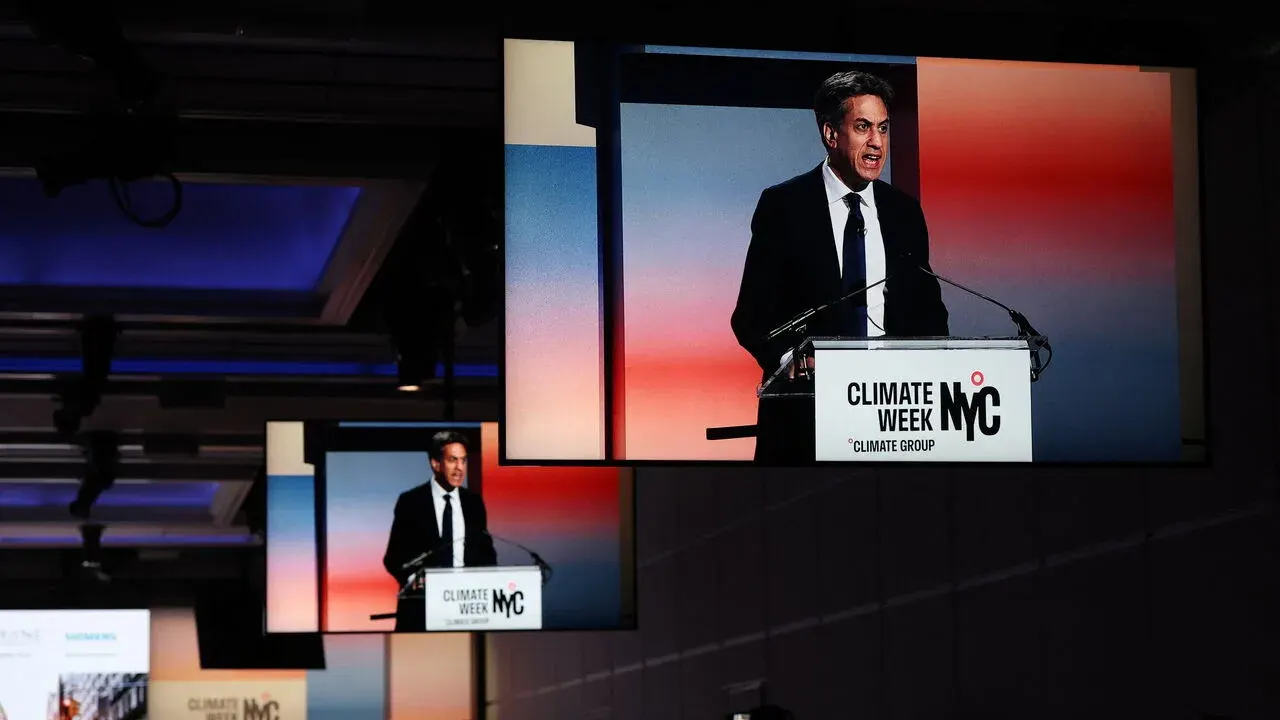
When Ed Miliband, Britain’s foreign secretary, wanted some good news with which to start his address in Manhattan this Monday, it was to these figures that he turned. “In 2026 we’re going to see $2.2trn dollars in clean energy against $1.2trn in fossil fuels—I think that deserves a round of applause, ladies and gentlemen.” It got one.
There was a little sleight of hand there — the $2.2trn includes investment in efficiency, grids and electrification which, though good for reducing emissions, are not clean energy per se.
And in the past couple of years investment has slackened off, largely because of reduced investment in China’s solar sector. But investment figures are still, for glass-half-full habitués of climate events, an impressive token of progress over the longer term.
Dubai renewable targets are slipping despite record growth
The glass-half-empty brigade, for their part, could point to a report released during Climate Week on progress towards the renewable energy and energy-efficiency gains called for at the UN climate meeting which took place in Dubai in 2023.
That “Dubai consensus” called for renewables capacity to triple and the rate at which energy efficiency improves to double by 2030. The new report finds that the 693GW of new renewable capacity added in 2025 — a record-breaking amount — still fell well short of what was needed.
To hit the target, 1,200GW has to be added annually, on average, between 2026 and 2030. Efficiency improvements are running at only half the rate required.
How the Trump administration stalled US wind projects
And what of the who-cares-let’s-just-smash-the-glass-already brigade? Its adherents tend not to trouble themselves with New York Climate Week, but its leader, President Donald Trump, used his address to the UN General Assembly on Tuesday to ignorantly and maliciously characterise climate change as a hoax (again).
Since his inauguration in 2025 he and his administration have fought against the investment tide Mr Miliband celebrated, putting particular emphasis on scuppering offshore-wind projects.
Offshore wind permits halted
As my colleague Annie Crabill reports in this week’s paper, Mr Trump’s administration temporarily halted permits for wind deployment on federal land and waters. The five offshore-wind projects likely to come online before 2035 were all granted their permits before Mr Trump’s second term; the administration has spent billions of dollars to encourage those behind other projects to abandon them.
The planned new capacity for offshore wind is down by a third since the beginning of 2025. BloombergNEF estimates that by the end of Mr Trump’s second term America will be adding at least 4GW of wind less per year than it might have done.
Onshore wind faces Pentagon block
It has been an ill wind for land-based projects, too. All new installations need approval from the Department of War (sic), and the department no longer approves them. According to the most recent market report from the American Clean Power Association this has, in effect, stalled at least 155 projects.
The commissioning of the massive 3.65GW SunZia wind plant in New Mexico pushed the land-based wind capacity added in the second quarter to almost 5GW, a record. But if the Pentagon continues to abuse its power the rate will slow.
Why US clean-energy investment remains at record levels
This will not change the overall picture. Mr Trump has hindered it, but American investment in clean energy remains at record levels. Solar and, especially, batteries are being piled on hand over fist.
Clean energy investment worldwide, though down on its 2024 peak, is still impressive compared to a decade ago. And — which matters most, for the climate — the amount of clean energy that investment buys has shot up.
The IEA reports that the amount of solar capacity you can buy for a dollar has increased fourfold since its first investment report in 2016. The change over sometimes indistinguishable years adds up.
What do you make of the president’s efforts to disrupt renewable energy? Write to us at climateissue@economist.com.
KEEP THE CONVERSATION GOING
A good story is worth sharing.
Send this story to someone who values the bigger picture.
See more from GlobeBriefly on Google
Choose us as a preferred source in your Google preferences.