Audio
Listen to the article
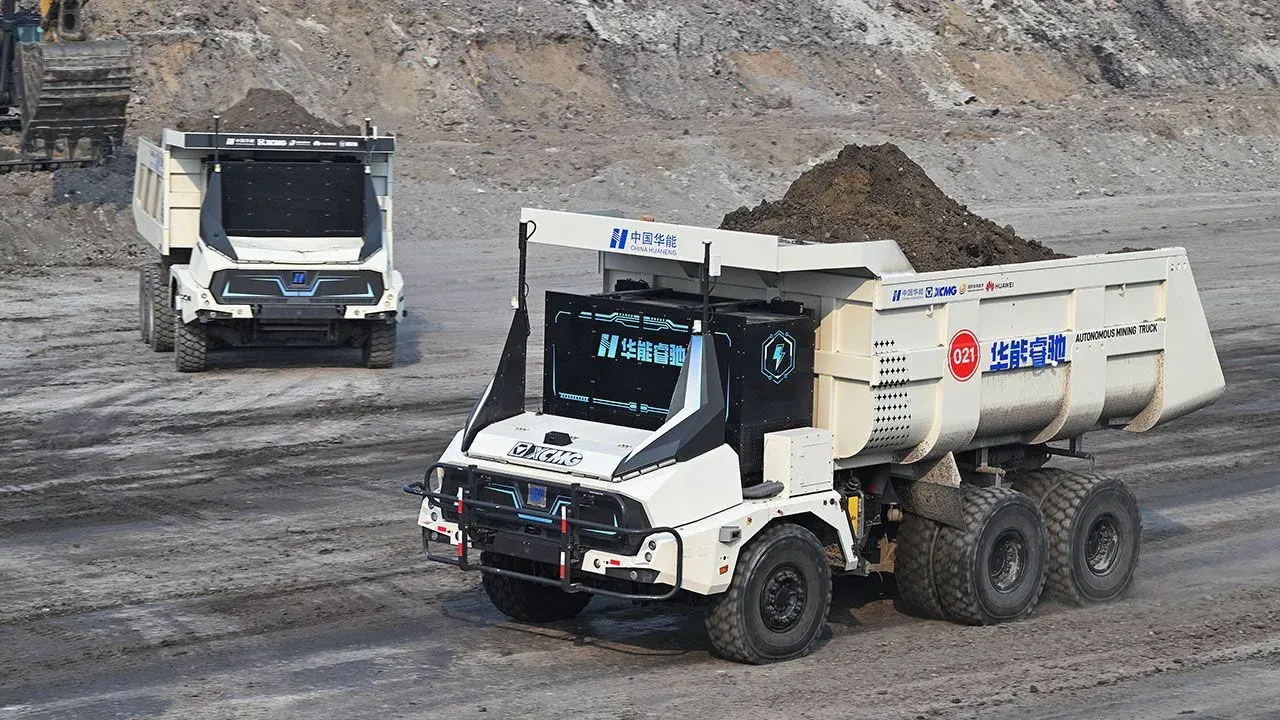
Self-driving cabs have grown familiar on urban streets across China, and parcel drones are increasingly routine overhead. Yet for one of the weightiest driverless deployments anywhere, the destination is grassland in the far north-east, at Yimin, an open-pit coal operation covering 42 square kilometres.
- At Yimin, roughly 100 trucks able to haul 90 tonnes of coal run with nobody behind the wheel, with 300 more planned within three years.
- Huawei’s enterprise arm formed juntuan, or army corps, in 2021 after American sanctions, directing 5G, AI and software at mines, airports and oil-and-gas firms.
- First-half 2026 net profits dropped 37% year on year while revenue rose 10%, as R&D absorbed a quarter of revenue.
Driverless trucks at the Yimin coal mine
Down at the pit floor sit roughly 100 trucks, each able to haul 90 tonnes of coal, with nobody behind the wheel. Where cabs would normally stand are bulky black battery packs.
According to Zhao Yaozhong, a manager with operator Huaneng, the state-owned power group, introducing the automated fleet allowed 120 employees to move to jobs beyond the excavation, away from its dust and hazards. Output has also risen sharply without human operators.
The trucks keep running overnight and through bad weather, even swapping batteries by themselves. The plan is for people largely to leave the pit within three years, when 300 more self-driving trucks join the fleet.
Inside Huawei’s enterprise army corps
Yimin illustrates the broadening reach of Huawei’s “enterprise” arm, part of a Chinese tech group more familiar for telecoms gear and consumer devices. In 2021, after American sanctions struck its main operations, Huawei said the arm would form fresh units — called juntuan, Chinese for army corps — to direct know-how and tools from around the company toward particular business clients, spanning airport managers to oil-and-gas firms.
juntuan — Chinese for army corps, the name Huawei gave in 2021 to fresh enterprise units aimed at particular business clients.
Its mining corps demonstrates that joined-up method. Huawei base stations dotted across Yimin blanket the site in 5G, enabling the trucks’ self-driving setup to operate. That setup derived from technology in Huawei’s automotive business, then adapted for the trucks’ scale and mass plus mining conditions.
Mine management is directed through an interface built on MineHarmonyOS, an operating system from the same unit behind Huawei’s smartphones and other consumer gadgets. In several underground pits, a Huawei cloud artificial-intelligence model helps analyse geological information and oversee machinery remotely.
Why the corporate arm matters after US sanctions
Because Huawei remains privately owned, judging the enterprise arm’s performance is difficult. Sales were most recently disclosed separately in 2022, when they represented a fifth of overall revenue and formed the group’s quickest-expanding segment. Andy Wu, head of the mining business, says his operation makes money, though margins are razor-thin.
Even so, the corporate arm looks increasingly central to Huawei’s future. On August 31st Huawei reported that first-half 2026 net profits dropped 37% year on year, while revenue rose 10%. Profitability in its consumer arm has been pinched by soaring memory-chip costs tied to the data-centre boom.
Huawei has also poured vast sums into research and development — absorbing a quarter of revenue during the first six months of the year — as it seeks substitutes for lost American technology, including the most advanced semiconductors.
Worries that Beijing might exploit Huawei gear for espionage have prompted restrictions across many Western governments, and overseas revenue has contracted over the past decade. Domestic expansion has therefore become still more urgent, especially with China’s 5G roll-out now mostly complete.
To Huawei’s benefit, Beijing is vigorously promoting practical AI uses across manufacturing, transport and electricity-grid management. Huawei’s enterprise corps are positioned to supply them. ■
To follow developments in commerce, industry and technology, subscribe to “The Bottom Line”, our weekly subscriber-only newsletter on global business.
KEEP THE CONVERSATION GOING
A good story is worth sharing.
Send this story to someone who values the bigger picture.
See more from GlobeBriefly on Google
Choose us as a preferred source in your Google preferences.