Audio
Listen to the article
- Sweden’s 38-tonne CV90, built by Hagglunds (a unit of Britain’s BAE Systems), has become northern Europe’s preferred infantry fighting vehicle.
- Its performance in snow and its record for protecting crews in Ukraine help explain the demand.
- Wartime damage has pushed field repair forward — including 3D-printing a ramp hinge in about a day inside a containerised micro-factory.
North-east Sweden
Recall your earliest lesson behind a steering wheel. If your memory resembles mine from 35 years back, it involved damp hands, confusion over the clutch, mistakenly pressing the throttle instead of the brake — plus concentrated effort to avoid colliding with anything. My recent encounter with Sweden’s CV90 infantry fighting vehicle felt only marginally less nerve-racking.
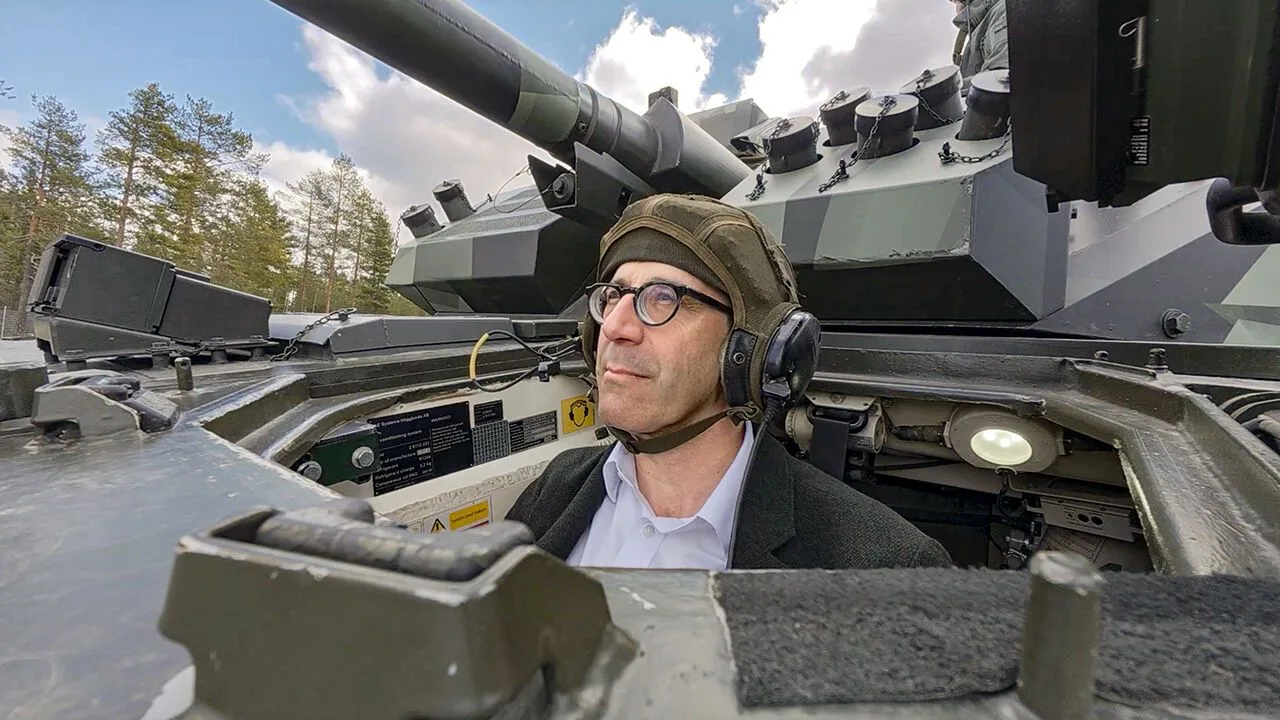
Close to the Hagglunds plant that builds the 38-tonne CV90, a calm instructor wedged me, a middle-aged journalist, into its rather tight driving compartment and dispatched me around a proving circuit.
What it is like to drive 38 tonnes of steel
Those who have operated such machines professionally will recognise the enjoyment and the startling speed with which 38 tonnes of armour, tracks, turret and cannon can pick up pace. Still, I hope they will not laugh too hard at my anxiety about the embarrassment of demolishing the boundary fence, or something worse.
Why northern Europe favours the CV90
Produced by a unit of the British defence firm BAE Systems, these machines are fast emerging as northern Europe’s preferred IFV. One reason is their strong performance in frigid, snow-covered terrain. Another is the record for protecting crews earned in Ukraine.
That wartime service is also yielding surprising insights and inventive fixes. One example concerns rapid field repairs to return battered vehicles to action swiftly, a skill European forces must master to prevail in a grinding war of attrition should Russia strike. Read more on Sweden’s bleak 50-year plan for confrontation with Russia.
What Ukraine has taught Hagglunds about protection and repair
In Ukraine, where the IFVs have been ferrying soldiers to and from positions while taking fire — situations where moments count — the operational tempo has exposed unexpected failure points as well as the imperative to shift repair capability as near as feasible to the combat zone.
The ramp hinge — and a printed fix in about a day
At the back of the CV90 sits a steel ramp that lowers for troops to enter and exit. In Ukraine, drivers occasionally engage reverse before the ramp has fully raised, wrecking its huge hinge. Yet producing a fresh hinge conventionally generally requires months.
Bjorn Hellholm, chief innovation officer at Hagglunds, therefore demonstrated how the business has been learning to “print” a substitute within roughly a day.
The big advantage is that the user can make the parts in the field.
Bjorn Hellholm · chief innovation officer, Hagglunds
A micro-factory in shipping containers
The company has compressed a workshop containing an additive-manufacturing (or 3D-printing as it is popularly known) machine and similar gear into a transportable “micro-factory” housed in shipping containers. Positioned nearer the front line, these units can keep maintenance going even when supply chains break down.
One such factory has already been supplied to Sweden’s defence-procurement agency, and the firm is now developing digital “recipes” for various components.
3D printing spreads beyond Sweden
Hagglunds is hardly the only company exploring additive manufacturing to accelerate spares output. Last year Britain’s Royal Air Force installed a 3D-printed part on a Typhoon jet for the first time, while the US Navy is employing the method to fabricate submarine components.
What fascinated me most were the takeaways from Ukraine, both over the unforeseen ways troops can damage equipment and over the imperative to shift repair capability for military hardware as near as feasible to the combat zone.
If you hold amusing anecdotes about operating armoured vehicles, or considered views on how emerging technologies are transforming battlefield logistics, please write to us at thewarroom@economist.com. Defence-related queries are also welcome — whether you seek further detail on Donald Trump’s war with Iran, the “neglected” war in Sudan, or perspective on China’s expanding threat in the South China Sea. Finally, my colleague Richard Cockett wrote a bonus edition of this newsletter on Friday about sieges. It’s definitely worth a read.
Sources
Test drive and reporting near Hagglunds plant, north-east Sweden; Bjorn Hellholm, Hagglunds; BAE Systems; field observations from Ukraine.
KEEP THE CONVERSATION GOING
A good story is worth sharing.
Send this story to someone who values the bigger picture.
See more from GlobeBriefly on Google
Choose us as a preferred source in your Google preferences.