Audio
Listen to the article
- Only a third of women in South Asia and only a fifth in the Middle East and north Africa are in the labour force.
- The World Bank estimates removing barriers to women working would raise income per person by a fifth in many countries.
- Legal reform, shifting social norms, safer work and the pull of extra household income can open the door.
All around the world, women have struggled for equal treatment in the workplace. But in some countries the struggle over women working is more basic: to be allowed into the workplace at all.
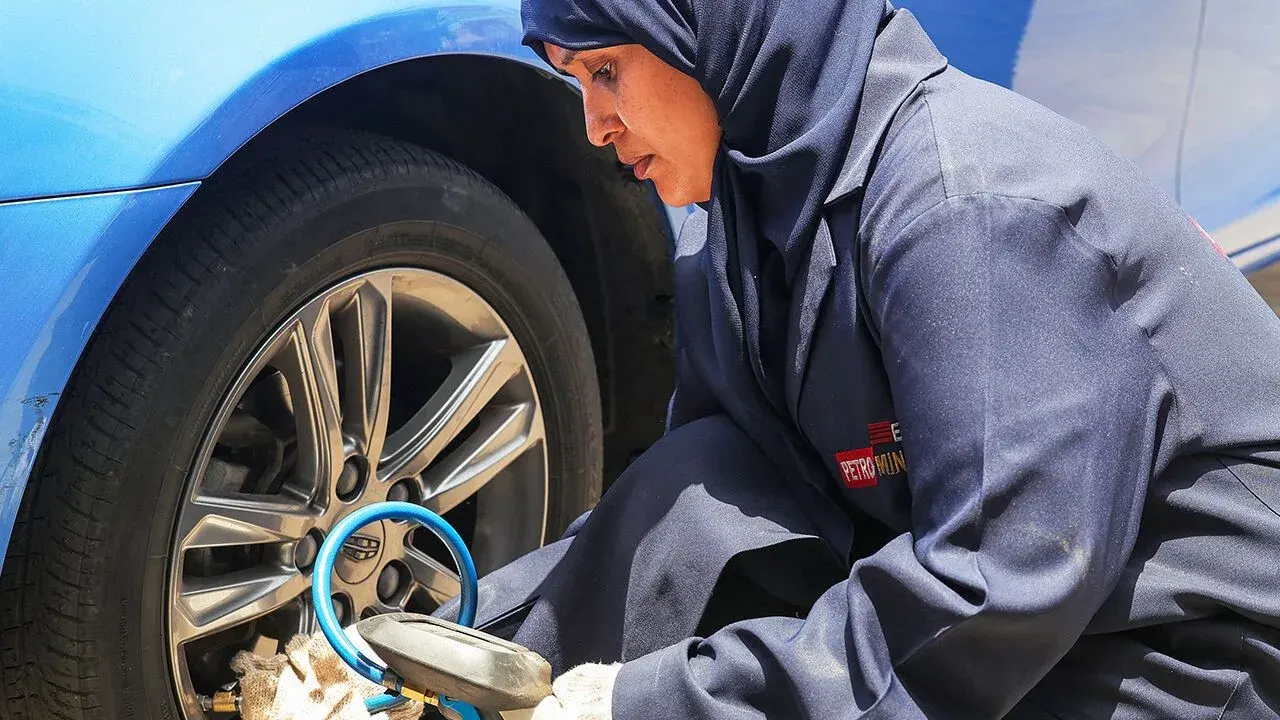
In an experiment, married mothers in Egypt were offered free or cheap child care near where they lived, to make it easier to go out and find jobs. Only 11% took up the offer. The obstacle, for many, was husbands who thought it wrong for women to work outside the home. And although 90% of Egyptian women disagree, the weight of tradition can be hard to defy — as can the literal heft of a reactionary husband.
Why so few women are in the labour force
In much of the Middle East, north Africa and South Asia, many men believe their family’s honour depends on female seclusion. They fear that if a wife goes out to work any farther away than the backyard vegetable plot, she might meet a man to whom she is not related and bring disgrace on her kin.
This backward belief may be enforced with threats. In India violence against women is so normalised that nearly 40% even of women think a husband is sometimes justified in beating his wife. In Mali the figure is nearly 70%.
Such attitudes make whole populations poorer. In South Asia only a third of women are in the labour force; in the Middle East and north Africa, only a fifth are. Since 1990 the share of labour income that accrues to women has risen from 35% to 44% in liberal France; in patriarchal Pakistan, from 1.5% to a still-woeful 9%.
A fifth
The rise in income per person in many countries if barriers to women working were removed, estimates the World Bank — a bigger economic benefit than avoiding a typical civil war.
Why paid work makes families more equal
That is more than enough reason to care about female seclusion. But there is another. When women earn, the balance of power at home shifts.
The Economist analysed data from 27 countries and found that, after correcting for how sexist a country is and how well-off a household is, women who work for pay have more say on everything from how to divvy up the family budget to whether they can go and visit a friend without asking their husband’s permission. Paid work, in short, makes families more equal.
So opening the glass front door should be a priority in all countries where it is currently shut. Alas, it has several complicated locks.
Three locks on the glass front door
- 1Law: scrap formal legal inequality.
- 2Norms: make working women visible and work safer.
- 3Money: let the honour/income trade-off do its work.
1. Legal equality for women workers
The first key to insert is legal. By the World Bank’s count, 540m women live in countries where formal equality before the law is not merely imperfect but “distant”. Yet even the most sexist laws can be scrapped, as Saudi Arabia has shown.
Before a series of reforms that started in 2011, women there were barred from all but a handful of jobs and not even allowed to drive. Now they are free to work, drive and shun the hijab if they choose. The share of women in the labour force has nearly doubled since 2010, from 18% to 34%. That is startling progress for a kingdom many thought hopelessly stuck in the past — even if there is still a long way to go.
2. Shifting social norms about women working
Another key is social norms. These are often assumed to be intractable, yet history shows they can change rapidly. Until 1975, British banks could refuse a woman a mortgage if she lacked her husband’s consent; until 1997, Germany did not criminalise marital rape. Since then British and German cultures have evolved so that such rules are unthinkable; indeed, few young Britons or Germans are aware they ever existed.
Norms can shift with a shove from above, as in Saudi Arabia, or by a process of social contagion. Few people resolve moral questions by reasoning from first principles. Mostly, they reckon something is fine if they see lots of people they know and respect doing it. So pioneers play an essential role: the first woman in a conservative Pakistani village to brave the gossip and find work in a nearby town paves the way for others to follow.
Schools, NGOs and policymakers can nudge the process along. One experiment in India found that if you show men that women they know are working in a local factory and that it is clean and not dangerous, they are more likely to consent to their own wives working. Anything that makes work safer — such as India’s women-only buses for late-night commuters — can erode the misconception that women must be kept at home for their own protection.
Digital technology can help, too. Via small screens in their hands, women in the most repressive countries can see — and therefore imagine — a different way of life. This need not mean copying the most liberal societies. More often, it means learning from the somewhat less sexist country next door, as when an Iraqi housewife sees women doing high-status jobs in Turkish soap operas, and starts to question her lot.
Mostly, people reckon something is fine if they see lots of people they know and respect doing it.
GlobeBriefly · Social contagion and norms
3. Money and the honour/income trade-off
The last key is money. It is useful stuff, as even reactionary men agree. One economist talks of the “honour/income trade-off”: at some point, the extra cash a working wife could bring in starts to look so tempting that her husband asks whether it would really be such a terrible blow to his honour to allow it. Thus, the love of money, though much derided in scripture, can be a force for social change. ■
Sources
World Bank estimates on income per person and count of women facing distant legal equality; The Economist analysis of data from 27 countries on paid work and household say.
KEEP THE CONVERSATION GOING
A good story is worth sharing.
Send this story to someone who values the bigger picture.
See more from GlobeBriefly on Google
Choose us as a preferred source in your Google preferences.