Audio
Listen to the article
Defence is being re-energised. Now industry must produce more, better and faster, write Ursula von der Leyen and Mark Rutte.
- Europe’s era of outsourcing defence is over, with spending, factories and shifts rising across NATO allies and EU states.
- Gaps remain in jets, ships, air and missile defence, drones and stockpiles, while production still cannot meet demand.
- The authors call for NATO-EU industrial co-operation at scale and speed to ensure credible deterrence.
Europe’s era of outsourcing defence is over
We both grew up in the shadow of the cold war, when Europe was protected, watchful and invested in peace. “Never again” was the watchword for our generation. After centuries of conflict, Europe was shaped by the conviction that economic co-operation was essential for lasting peace.
When the monuments to a divided continent crumbled with the collapse of communism, the fear of war faded. Defence budgets shrank and our armed forces dwindled. Many of the defence industries that had supplied them were shuttered. Europe came to rely more heavily on America, through NATO, for the capabilities it would need if security was threatened.
Over time, many in Europe became accustomed to this arrangement and the outsourcing of many of the continent’s defence and security abilities. The stark reality and dangers of today’s world have ended this way of thinking.
Europe’s era of outsourcing much of its defence is now over. European NATO allies and EU member states are relearning that if we want to prevent war, we have to be ready for it. They are rearming and re-energising the defence industrial base so that we can protect our citizens, our freedom and our security. Defence spending and production are both rising: new factories are opening, and existing ones are adding shifts and production lines.
If we want to prevent war, we have to be ready for it.
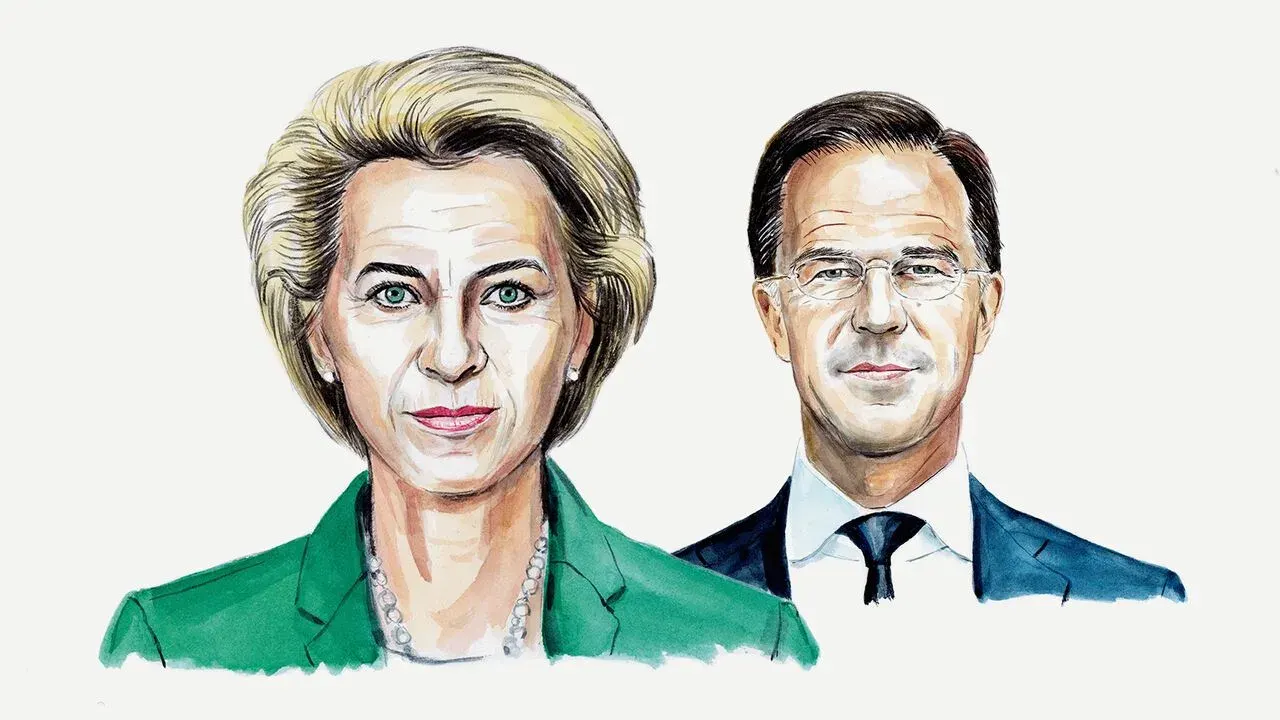
Ursula von der Leyen and Mark Rutte
Innovation is reshaping wartime production
It is not just traditional defence companies ramping up. Increasingly we are seeing massive innovation in the sector. New companies are developing the tools and technologies that modern warfare calls for. Drones, unmanned ground vehicles, electronic-warfare systems — these are all necessary for our armed forces to deter, protect and defend.
The mindset has shifted. Even civilian car manufacturers are repurposing factories to produce components for the defence sector, including air defence and long-range drones.
We are seeing the impact this shift in mindset has on the defence ecosystem with the ramp-up in production. New, innovative methods mean we can produce more, we can produce faster and we can produce cheaper.
NATO capability gaps production cannot yet meet
This pragmatism and sense of urgency is at the front of minds, but we have more to do. There are still gaps in our defence capabilities. NATO allies and EU member states need more fighter jets, air-to-air refuellers, ships and submarines, air defence and missile defence, drones and counter-drone systems.
The support we are sending to Ukraine and the conflict in the Middle East have put extra pressure on military stockpiles, including interceptors and anti-drone capabilities. Our current production capacity can’t keep up with demand.
Russia, China, Iran and North Korea expand arsenals
Moscow invests more than 40% of its state budget in defence, the authors write, as Russia’s economy is geared to wage war.
As Europe takes increasing responsibility for its own defence, Russia, China, North Korea and Iran continue to enhance their co-operation and expand their defence industrial capacities. Russia’s economy is quite simply geared to wage war. It churns out military equipment around the clock to wage its brutal war against Ukraine, and it would be naive to think that this war machine will slow down the day after there is peace.
Since 2022, Iran has provided drones and technology to Russia. The threat posed by Iran’s missile and potential nuclear capabilities has long been a concern to the EU and NATO. Looking further east, China’s defence industry is booming. Seven of the 15 largest defence-related firms in the world are Chinese state-owned enterprises. Beijing’s nuclear arsenal also continues to grow.
What NATO and EU co-operation must deliver
In this more dangerous world, a stronger European defence industry capable of producing at scale and at speed is crucial to credible deterrence. The only way to get there is through co-operation: combining the efforts of countries and industries, allies and partners.
This is a true endeavour on both sides of the Atlantic. Our defences are unmatched when we leverage assets, expertise and innovative capabilities from California to Kyiv, Copenhagen to Warsaw, Oslo to Ankara. Our network of partners, including those in the Indo-Pacific, can and should contribute as well. Together, our industries can enhance innovation and accelerate the production of essential capabilities and technologies.
What we are proposing is ambitious, but it is also achievable. Together, NATO and the EU have everything we need to succeed: economic might, the most creative and innovative minds, a sophisticated financial sector, and cutting-edge defence and tech industries. It is our shared priority to ensure that the industrial base across Europe and North America delivers more, better and faster — because that is how we ensure our security.
Ursula von der Leyen is the president of the European Commission. Mark Rutte is the secretary-general of NATO.
KEEP THE CONVERSATION GOING
A good story is worth sharing.
Send this story to someone who values the bigger picture.
See more from GlobeBriefly on Google
Choose us as a preferred source in your Google preferences.