Audio
Listen to the article
illustration: dan williams
Ukraine’s president, Volodymyr Zelensky, has called for a face-to-face meeting with Vladimir Putin in a renewed bid to end the war with Russia. His offer comes as serious talk emerges in Europe about appointing its own peace envoy to deal with Moscow.
- Mr Putin and Dmitry Medvedev respect only power, so the debate about envoys is a distraction unless it is anchored in a peace-through-strength strategy.
- Europe has begun to fill the gaps left by a disengaged United States, but Germany, France and Britain have not gone far enough.
- Three tasks would give any negotiator real weight: constrain Russia’s war economy, rebuild Ukraine’s infrastructure before winter, and make clear that Ukraine’s future lies in the EU.
- Accession is the one security guarantee Moscow cannot veto.
Ballistic missiles Russia produces a year
Patriot interceptors America makes
Ukraine’s generation at times, against almost 60 GW before the war
After having met both Vladimir Putin and Dmitry Medvedev, Russia’s former president, I can assure you: they respect only power. The debate about envoys risks becoming a distraction if it is not anchored in a peace-through-strength strategy.
Europe has, to its credit, begun to fill the gaps left by a disengaged United States. I write as a lifelong transatlanticist who worked with several American presidents. But the conclusion is now unavoidable: Washington is no longer coming to Europe’s rescue.
Germany in particular has shown real leadership, with serious money, weapons and political commitment. France and Britain have put together a “coalition of the willing” for Ukraine. Yet this is far from enough. Before further discussion on the appointment of a negotiator, Europe should ensure that a potential envoy can operate from a position of strength. There are three things it can do.
Constrain Russia’s war economy
First, it must further constrain Mr Putin’s war economy. Stuck on the front line, he still harbours hope that he can break the will and economic infrastructure of Ukraine by throwing missiles and drones at its cities and electricity grid.
European governments should back Ukraine, technologically and industrially, in its deep strikes against Russia’s war economy. They should also apply targeted sanctions against the countries and companies supplying Russia’s ballistic-missile programme with critical components and materials. Russia’s missile production has two Achilles heels: the chemical precursors for its solid rocket fuel, drawn from China and Uzbekistan, and the Western microelectronics that reach it through China, Hong Kong and Central Asia. Both supply chains can be disrupted with the legal and diplomatic tools Europe already possesses.
Stopping delivery of those inputs matters because the raw numbers do not favour Ukraine. Russia produces roughly 850 ballistic missiles a year; America makes about 600 Patriot interceptors and is now focused on replenishing its own stocks. The best European contribution to Ukraine’s air defence, then, would be to limit Russia’s capacity to produce these missiles in the first place.
Crucially, Russia’s shadow fleet can still exploit gaps to ship exports in exchange for cash. The more we align legislation and grant interdiction powers, the less the fleet can serve as a source of money for the Kremlin. Nearly half of Russia’s seaborne oil exports leave through the Baltic Sea, often in tankers already under sanction, and through chokepoints controlled by European Union and NATO members.
Rebuild Ukraine’s infrastructure before winter
Second, Europe must accelerate the rebuilding of Ukraine’s critical infrastructure. The front line this winter will not only be in the trenches; it will be in every Ukrainian boiler room, water plant and power station. Mr Putin is hammering the grid with one purpose: to break Ukrainian society before any negotiating table is set. Ukraine has at times had a mere ten gigawatts of generation available, against almost 60 before the war.
Europe must repair what Russia is breaking. Dozens of decommissioned coal and gas plants across the EU sit idle with serviceable equipment; reinstalling them in Ukraine can be done at speed and modest cost. Every megawatt restored in Kyiv, Kharkiv or Odessa before winter is leverage in any future negotiation. Europe should treat the dismantling, shipment and reassembly of these plants with the same urgency it applied to gas-storage targets in 2022.
Make clear that Ukraine’s future lies in the EU
Third, Europe must make clear that Ukraine’s future lies in the EU. This is the most powerful signal it can send to Mr Putin that any hope of subjugating Ukraine is futile. Accession is the one security guarantee Moscow cannot veto. It would be a game-changer—in itself a form of defeat for Russia, and a lasting reward for Ukraine.
This will require the political courage to overcome the veto games of those member states that allow themselves to drift towards Moscow’s orbit, as Hungary did under Viktor Orban. His successor, Peter Magyar, is likely to drop the veto against Ukraine joining the EU but is against fast-tracking the process. One way to speed up Ukraine’s accession would be to move away from the current unanimity required in the bloc’s foreign-policy and defence decisions, towards qualified-majority voting. It would also require setting out concrete steps along which Ukraine will progress: integration into the EU’s single market, defence-industrial base, energy grid, agriculture, transport networks and digital infrastructure.
I would say to the European institutions which have large banners with “Democracy” emblazoned on them in Brussels this month, let’s not forget that hundreds of thousands of Ukrainians have died defending values that are recognisably European: democracy, the rule of law, the right of a free people to choose their own alliances. To leave this country dangling indefinitely in a grey zone, with half-promises never delivered, would be a betrayal of those sacrifices and a green light for Mr Putin to try again.
The envoy question answers itself
If Europe does these three things, the envoy question answers itself. Whoever sits across from Russia will speak for a continent that has already done the hard work: leading where America has left a gap, blunting Mr Putin’s winter assault and binding Ukraine into the European future. Without that work, and a clear mandate, no name—no matter how prestigious or experienced—will have any chance of negotiating a fair and lasting peace.
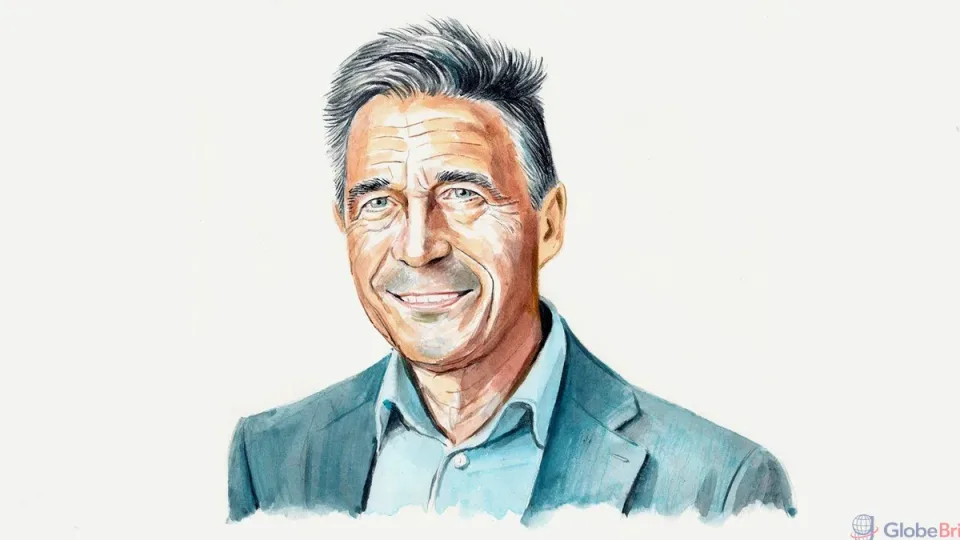
Anders Fogh Rasmussen was prime minister of Denmark from 2001 to 2009 and secretary-general of NATO from 2009 to 2014. He is the founding chairman of Rasmussen Global.
This is a signed opinion article. The arguments are the author’s, as set out in the biography above.
KEEP THE CONVERSATION GOING
A good story is worth sharing.
Send this story to someone who values the bigger picture.
See more from GlobeBriefly on Google
Choose us as a preferred source in your Google preferences.