Audio
Listen to the article
- More than 50m cases await a verdict, nearly a third pending for more than five years and around half delayed by at least three years.
- India ranked 131st out of 142 countries on judicial speed, with 75% of prisoners awaiting trial and delays costing at least 0.5% of GDP a year.
- Clearing the backlog would need full staffing plus a 40% productivity increase over five years, alongside management reform.
India’s justice system delivers judgment so slowly that it resembles the afterlife. Earlier this year in the central city of Bhopal, a newspaper revealed that a case filed in 1959 was still winding its way through a local court — despite the accused and witness having died many years ago.
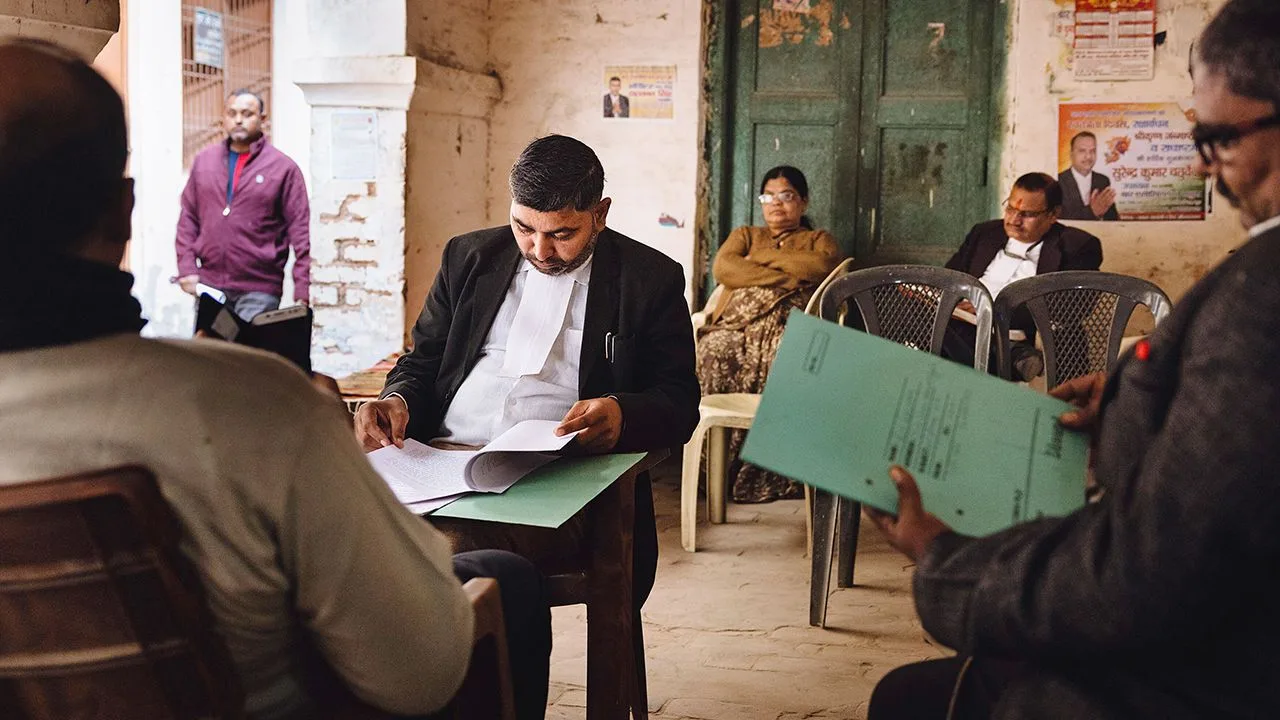
For Bhushan Gavai, the Supreme Court judge who was appointed as India’s chief justice on May 14th, this is a familiar problem that has vexed all his predecessors. Across the country more than 50m cases are awaiting a verdict.
How bad is India’s court backlog
Of those more than 50m cases, nearly a third have been pending for more than five years, while around half have been delayed by at least three years.
Outside a district court in Saket, a suburb of Delhi, Seema Chauhan, a 34-year-old, arrives for a hearing in a domestic-violence case, only to find out that there has been an adjournment from the judge for a later date. But for Ms Chauhan, that is not news: her case started in 2016.
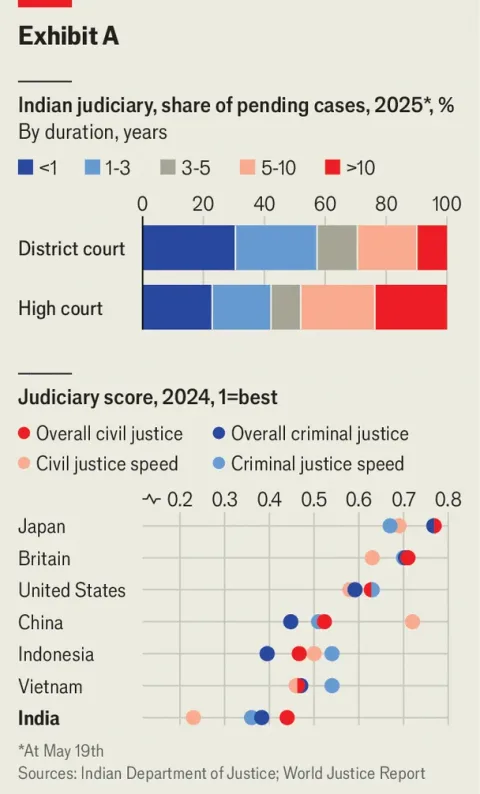
All this has meant India has consistently fared worse on composite measures of justice than several of its peers, including Indonesia, China and Vietnam, according to the World Justice Project, a research outfit. On a specific indicator of judicial speed, India ranked 131st out of 142 countries, below Pakistan and Sudan.
According to the India Justice Report, a non-profit, the courts’ backlog is expected to increase by at least 15% by 2030. India’s judiciary is not in a “mere state of stasis but a downward spiral”, says Gautam Patel, a former judge of the Bombay High Court.
Cases awaiting verdict
Of 142 on judicial speed
Days to enforce a contract
Why judges are overworked, understaffed and weakly managed
Several factors explain the judiciary’s malaise, but they all are rooted in weak management. At every level, judges are hindered by archaic rules.
Mr Gavai, the new chief justice, will only have six months in his role before mandatory retirement rules force him out. His successor will only enjoy the post for around a year. Mr Patel, the former high court judge, complains that he has had to assess district judges on their punctuality and courteousness, despite never seeing them in court.
The judiciary is also overworked and understaffed. Nearly a third of judge positions and a quarter of support staff roles in high courts are vacant. But filling vacancies alone is not enough.
Even at full strength, the caseload would never be cleared because of new cases constantly being filed. In 2024 the lower courts disposed of 23m cases, even as 25m were added. Our calculations suggest clearing the backlog would also require a 40% productivity increase, sustained over five years.
What judicial delays cost people and firms
The consequences of this malaise are vast. Around 75% of India’s prisoners are awaiting trial, the sixth-highest share in the world.
Judicial delays also have enormous economic impact. In addition to legal expenses, people like Ms Chauhan face the opportunity cost of forgone wages. These alone amount up to at least 0.5% of GDP in a year, according to work by DAKSH, an Indian legal think-tank.
Firms are even bigger economic victims. Many are dragged into long disputes, often over basic contracting issues. In 2019 the World Bank estimated that enforcing a contract in India can take roughly 1,500 days (a little less than four years), compared with less than 500 in the rich world and China.
India’s courts are no longer an instrument for resolving disputes between parties, but one for buying time, says Arghya Sengupta, founder of the Vidhi Centre for Legal Policy, another think-tank.
Clogged-up courts could lead to corruption. In March, officials responding to a fire at the house of Justice Yashwant Varma, a judge in Delhi’s High Court, discovered among the burnt items currency notes worth 150m rupees ($1.8m). Mr Varma is under investigation by the Supreme Court for possible corruption, but denies any impropriety. Critics, however, think that graft thrives in dysfunctional systems.
How to fix court delays without changing the constitution
One solution is to outsource the court’s administrative work away from judges to management specialists. Other countries with similar common-law systems, such as Australia, Britain and Canada, have used agencies to improve judicial performance.
In Kenya, reforms introduced in 2011 — which instructed judges to organise more pre-trial conferences and set case deadlines — have reduced the country’s backlog. Crucially, such reforms do not require constitutional changes, nor do they compromise the judiciary’s independence.
Another solution, which has been implemented, is specialised courts. But these too are already burdened with the same problems. For instance, more than 200,000 cases, involving claims of at least 18trn rupees, are piled up in various debt-recovery tribunals across the country.
Meanwhile alternative dispute mechanisms, such as arbitration and mediation, that let parties settle matters between themselves outside court, are still under-developed.
Defining independence
Little has changed because judicial delays are not a big political issue, according to Dr Sengupta. “We’ve long assumed courts will manage themselves,” he says.
In 2014 the ruling Bharatiya Janata Party (BJP) tried to involve the government in judicial appointments, which are controlled entirely by the courts and long considered opaque. The BJP’s proposal triggered a backlash from judges and was eventually struck down by the Supreme Court on the ground that it undermined the judiciary’s independence. But independence, Dr Sengupta points out, should not mean “insulation”.
And although the judiciary has resisted government intervention in judicial appointments, critics argue it is hardly insulated from political influence. Lately, several decisions have seemingly favoured the government. In a recent interview, Prashant Bhushan, a Supreme Court lawyer and anti-corruption activist, claimed that “post-retirement jobs awarded to judges by the government” severely undermined judicial independence by creating perverse incentives for sitting judges.
Why southern courts and technology offer hope
Still, there are reasons to be optimistic. For all its faults, Indians are more confident in their courts than Americans, Britons and Japanese, according to Gallup, a pollster.
And there is some evidence to suggest that, on the whole, the judiciary is fair. In a recent study, a team of economists from the Development Data Lab in Washington found no evidence that judges in India exhibit bias towards groups from their own communities, based on an analysis of more than 5m Indian criminal cases between 2010 and 2018.
Some courts have also shown they can improve their performance. Southern India dominates a national ranking of judicial performance put together by the India Justice Report. As in other domains, this superiority is thanks to better governance. Southern judiciaries use budgets more efficiently, invest more in court infrastructure and maintain better staff-to-case ratios than their northern counterparts.
They have also used technology, which perhaps offers the biggest opportunity for improving the judiciary. The High Court of Kerala, for example, has pioneered machine-learning examination of filings to speed up judges’ work and a case-management system that tightens schedules. If AI can help sort out this very human problem, then India stands to benefit.
Sources
World Justice Project; India Justice Report; DAKSH; Vidhi Centre for Legal Policy; World Bank 2019 enforcing-contract estimate; Gallup; Development Data Lab analysis of more than 5m criminal cases, 2010-2018.
Correction policy: see correction note below.
Correction (May 23rd, 2025): An earlier version of this story said Chief Justice Bhushan Gavai’s successor would get three months in the post. He will actually have around a year.
Stay on top of our India coverage by signing up to Essential India, our free weekly newsletter.
KEEP THE CONVERSATION GOING
A good story is worth sharing.
Send this story to someone who values the bigger picture.
See more from GlobeBriefly on Google
Choose us as a preferred source in your Google preferences.